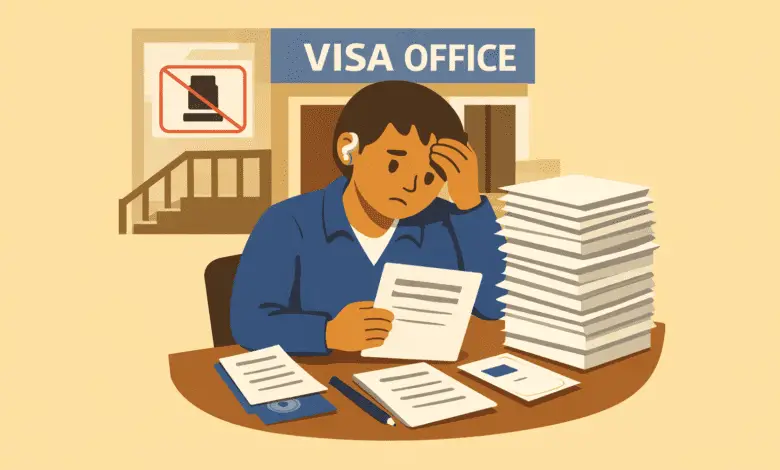
When Visa Applications Become Harder: When Disabled Applicants May Need Extra Support

Applying for a visa is rarely simple. The paperwork can be difficult to keep track of, deadlines are strict, and the rules do not always feel clear. For disabled people, these challenges often take on a different shape, as visa systems are rarely designed with access needs in mind.
This article looks at where those barriers tend to appear, the points where an application is most likely to become harder to manage, and the kinds of support that may help when things become complicated.
Where visa processes can become inaccessible

The barriers disabled people face during visa applications are not always obvious from the outside. They are often built into standard procedures that assume a certain kind of applicant – someone who can travel easily, attend appointments without difficulty, provide documents in fixed formats, and make sense of dense official language without support.
- Health assessments may require travel to specific approved clinics, sometimes at short notice, with no clear flexibility for people who cannot travel easily.
- Repeated requests for the same evidence, especially medical documentation, can mean going back to GPs or specialists several times, adding cost and delay.
- Documentation requirements that are unclear or change during the process can leave applicants unsure what has been accepted and what still needs to be provided.
- Communication in inaccessible formats can include dense PDFs, appointment letters without accessible alternatives, and online systems that do not work well with screen readers or other assistive technology.
A realistic example: A wheelchair user applying for a family visa submitted medical evidence at the start of the process, signed by her consultant, only to be told later that it needed to be sent again in a different format. Her GP surgery charged for each letter. By the third request, she had spent more than £150 on supporting documents for one application and still had no clear answer.
Another real-world example: One applicant described trying to arrange a UK visa for her mother, who had limited mobility following paralysis. The visa application centre had recently moved to an upper-floor location without lift access, making it physically impossible for her to attend a biometric appointment. Even after medical evidence was submitted and an alternative arrangement was requested, no accessible solution was offered. The delay affected her ability to travel and support a close family member who needed urgent medical care.
Situations like these show how physical access requirements, rigid processes, and poor communication can create barriers for disabled applicants long before a decision is made.
The points where applications often become more difficult
It helps to know in advance which parts of the process are most likely to cause problems. These issues are not inevitable, but they are the stages where applications often stall, become harder to follow, or create extra pressure.
When requirements are unclear or change
Immigration rules are updated regularly, and official guidance does not always match what applicants are later asked to provide in practice. That can leave people following published requirements, only to be told that more evidence is needed or that documents must be submitted in a different format. You can see how often rule changes happen in the Home Office’s statement of changes to the Immigration Rules.
For disabled applicants, this can be especially difficult when it affects medical evidence, disability-related income, or requests for supporting documents that were not mentioned clearly at the start.
After a refusal or delay
A refusal can be difficult for anyone to deal with. For disabled people, it can be even harder to work out what happened if the refusal letter does not clearly explain what was missing, what was not accepted, or whether disability-related information played a role.
Without a clear explanation, it becomes difficult to know what should change in a fresh application or challenge. Many people end up repeating the same steps because the original reasoning was never properly explained.
When documentation becomes repetitive
Being asked more than once for the same evidence is one of the most frustrating parts of the process. This might include proof of a diagnosis, confirmation of care needs, or financial evidence connected to benefits or support. For people managing pain, fatigue, or limited daily capacity, those repeated requests are not minor admin issues. They can take real time, money, and energy.
This is a systems problem, not a personal failing. It often reflects poor communication inside the process, but the pressure lands on the applicant.
When communication becomes a barrier
Official immigration correspondence is usually written in formal, technical language. For applicants with cognitive disabilities, learning disabilities, acquired brain injuries, or limited English, that can create a serious barrier to understanding what is being asked. GOV.UK has its own guidance acknowledging situations where applicants may not be able to write in the standard way, including on its page for applicants who are unable to sign their name.
Digital systems can also create barriers. Reporting on the UK’s move to eVisas has raised concerns about exclusion for people who struggle with digital-only processes, including disabled migrants, as noted in coverage by Migrants Rights Network.
When extra support might be worth considering
Support is not always necessary. Plenty of applications are more straightforward, and many disabled people manage them successfully using official guidance and free advice. But there are situations where having someone else help interpret the process can make a practical difference.
You may want to look at extra support if:
- you have already had a refusal and do not understand the reason;
- your application involves complex financial evidence, including disability-related income or benefits;
- you are unable to attend appointments easily and need help requesting adjustments or alternatives;
- the evidence requirements keep changing and you are losing track of what has been accepted;
- the administrative load is becoming too much for you or for the person helping you.
For example, applicants dealing with repeated requests for medical evidence or unclear feedback may choose to work with a migration agent in Australia to clarify what information is actually being asked for and avoid sending the same documents more than once. This may be especially relevant when an application involves health-related evidence or personal circumstances that do not fit neatly into standard categories.
The value of professional help often lies less in filling out forms and more in understanding how requirements are interpreted in practice, which evidence is likely to matter most, and how to explain circumstances that fall outside a standard template.
Other types of support to consider
Paid professional help is only one option. Depending on your situation, other forms of support may be just as useful.
- Disability advocacy organisations may be able to help you understand your rights, request adjustments, or explain barriers you are facing.
- Immigration charities and legal support services can sometimes offer free or lower-cost advice, especially in difficult or refused cases.
- Citizens Advice can help with understanding reasonable adjustments and discrimination issues.
- Peer support groups and forums can provide practical insight from people who have dealt with similar barriers. That kind of shared experience can sometimes be more useful than another general FAQ page.
None of these options replaces specialist legal advice in every case, but they can be a useful first step and, in some situations, may be enough on their own.
Things to consider before paying for support
Professional immigration support can be useful, but it costs money, and not everyone will need it. It is worth looking carefully at what you are paying for before making a decision.
- Not every application needs professional help. If your case is relatively straightforward, official guidance and free support may be enough.
- Free alternatives do exist. Legal aid, charities, disability advocacy groups, and community organisations may be able to help without the cost of private services.
- Cost matters. For some disabled people, paid support is simply not affordable, which makes access to clear information and free advice even more important.
- Ask clear questions before agreeing to anything. A reputable adviser should explain what they will do, what they charge, and what they cannot promise.
- Check credentials. In the UK, immigration advisers should be regulated. In Australia, migration agents should be registered with MARA. Unregulated paid advice should raise concerns.
- Think about the actual value being offered. The most useful support is often not basic form-filling, but help with explaining disability-related evidence, accessing alternative procedures, or dealing with practical barriers such as biometric issues.
Final thoughts
Some visa applications are straightforward. Others become much harder – not because the applicant has failed, but because the process was not designed with everyone in mind. That gap shows up in inaccessible buildings, digital systems that do not work well for all users, rigid evidence rules, and a general assumption that every applicant can move through the process in the same way.
For disabled people, knowing where those pressure points are can make a real difference. It can help you decide when to keep going on your own, when to ask for adjustments, and when it may be worth getting extra support.
If your application is moving smoothly, that is positive. If it is not, you are not the only one dealing with these barriers, and support does exist.
