Accessible Health Education: Top Tools Helping Patients and Carers Visualize the Invisible

Clear health information is essential for meaningful consent and shared decision-making.
This resource explores how visual health education tools can support clearer communication between professionals, patients, and carers, particularly where complex or invisible conditions are involved. Examples are illustrative rather than exhaustive, and no single approach will meet everyone’s access needs.
Accessible Health Education: Tools That Help Make Invisible Conditions Easier to Understand
For patients and carers navigating complex diagnoses, one of the biggest barriers to understanding is how health information is presented. Medical explanations often rely on abstract language, dense terminology, and static two-dimensional images that are primarily designed for clinical use rather than patient understanding. This can create gaps in communication, increase anxiety, and leave people feeling unsure about what is happening in their own bodies.
Digital visualisation tools are increasingly being used to present health information in clearer, more accessible ways. By showing anatomy, processes, and treatment pathways visually, these tools can support conversations that are otherwise difficult to follow through words alone.
Moving from abstract explanations to clearer visual references
Traditional patient education often assumes that verbal explanations or written leaflets are sufficient. For many people, particularly those managing long-term or complex conditions, this is not the case. Without a clear visual reference, it can be hard to understand where a problem is located, how it affects the body, or why a particular treatment has been recommended.
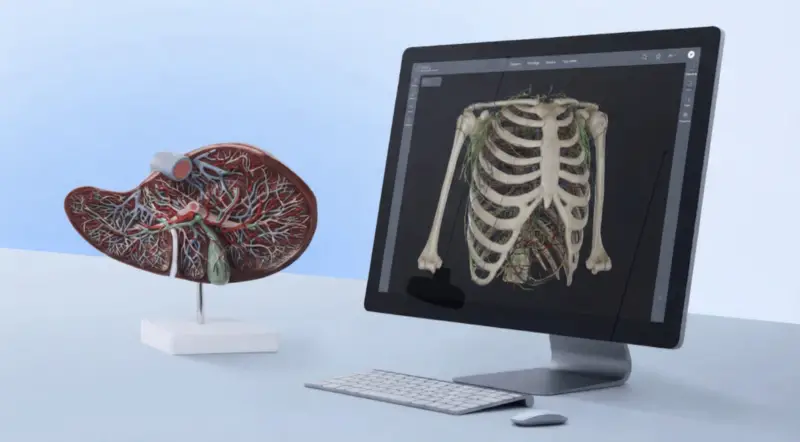
Three-dimensional anatomical visualisations can provide a shared reference point during consultations. For example, when discussing a shoulder injury, a clinician may use a rotatable 3D model to show which tendons are affected and how movement is limited. This can make discussions more concrete and reduce misunderstandings that arise from purely verbal descriptions.
Platforms such as Voka 3D Anatomy & Pathology offer libraries of anatomical and pathological models that can be used in educational or clinical contexts. Used appropriately, these kinds of tools can help align understanding between professionals, patients, and carers.
Showing processes, not just structures
Understanding anatomy alone is often not enough. Many people want to know how symptoms relate to what is happening inside the body and why specific treatments are being suggested.
Animated visualisations can help explain processes such as:
- how disrupted electrical signals affect heart rhythm
- how airway inflammation restricts breathing in asthma
- how certain treatments interact with specific cells or tissues
By linking symptoms to visible processes, these explanations can help people make sense of treatment plans and feel more prepared to discuss options or ask questions.
Clear explanations can also reduce uncertainty, particularly when someone is supporting a family member or caring for a child and needs to understand what to look out for or how treatments are expected to work.
Centralised learning and reliable information
Beyond individual appointments, many patients and carers look for reliable ways to revisit information in their own time. Structured educational platforms that combine visual material with plain-language explanations can support this need.

Knowledge hubs such as Wiki Voka combine visual models with written information on conditions, symptoms, and treatment approaches. In one place, a user can explore how a condition affects the body while also reading contextual information that supports understanding.
For some people, this can help with:
- preparing questions ahead of appointments
- revisiting explanations after consultations
- reducing reliance on unmoderated or misleading online searches
As with all health information, these resources are most useful when treated as a supplement to professional advice rather than a replacement for it.
Practical uses across the care process
Visual health education tools are being used in a range of professional contexts, including:
Supporting informed discussions
When explaining procedures or treatment options, visual models can help clarify what is being proposed, where risks may lie, and what outcomes are expected. This can support clearer conversations rather than relying solely on written consent forms or verbal summaries.
Rehabilitation and follow-up care
In physiotherapy and rehabilitation settings, animated guides can show how specific exercises are intended to work. Seeing which muscles are being targeted can help some people understand the purpose of an exercise and perform it more confidently at home.

Supporting carers
Carers often need to understand conditions in order to provide day-to-day support or communicate effectively with professionals. Visual explanations can help carers build a clearer picture of symptom patterns, triggers, or treatment goals.
Access, choice, and limitations
Visual tools are not helpful for everyone. People with visual impairments, certain cognitive access needs, or sensory sensitivities may find them inaccessible or overwhelming. For this reason, visual resources should be offered as an option rather than a default, alongside other formats such as written summaries or verbal explanations.
Cost and availability are also important considerations. Many digital platforms are subscription-based or only available within specific institutions. No single tool will suit all settings or all patients.
Using visual tools responsibly in practice
When used thoughtfully, visual health education tools can support clearer communication and shared understanding. Their value lies not in replacing professional judgement or personal discussion, but in helping information be presented in ways that are easier to follow and revisit.
Accessible health education depends on flexibility, choice, and an awareness that people process information differently. Visual tools can be part of that mix when they are used with care, transparency, and respect for individual access needs.