Anxiety With a Disability: Coping Tools That Work on Hard Days
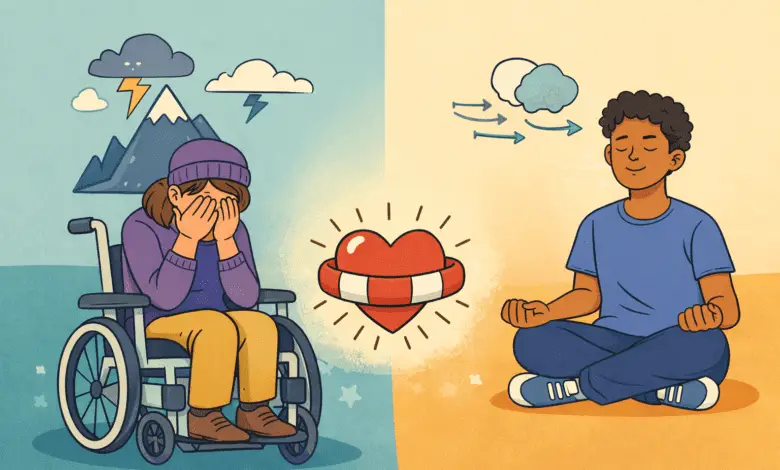
Anxiety With a Disability: Coping Tools That Work on Hard Days
Living with a disability can mean navigating life with extra layers of planning, pain management, uncertainty, and constant adaptation. Some days feel manageable. Other days, even simple tasks can feel like climbing a mountain. When anxiety shows up on top of physical or accessibility challenges, it can feel overwhelming, frustrating, and deeply exhausting.
Anxiety isn’t a sign that you’re weak or failing. It’s often your nervous system responding to stress, unpredictability, or past experiences where you didn’t feel safe, supported, or understood. And while you can’t always control what your body does, what other people say, or how the day unfolds, you can build tools that help you stay grounded, reduce panic spirals, and feel more in control when things get hard.
This guide shares practical coping strategies that work well on “hard days,” days when symptoms flare, fatigue hits, plans fall apart, or you feel emotionally stretched thin.
Why Anxiety Can Feel Bigger When You Live With a Disability
Anxiety is often fueled by uncertainty, and disability can bring a lot of it. Not just about health, but about everyday life.
You might experience anxiety because of:
- Unpredictable symptoms (pain flare-ups, fatigue crashes, mobility issues)
- Medical appointments and past healthcare experiences
- Accessibility barriers in public spaces or workplaces
- Fear of being judged, dismissed, or misunderstood
- Social pressure to “push through” when your body needs rest
- Financial and job-related stress
- Dependence on support and the guilt that can come with it
Even when nothing “bad” is happening in the moment, your mind might stay on high alert because it’s trying to protect you from what could go wrong. That kind of constant scanning for danger can keep anxiety running in the background all day.
Reddit users with disabilities echo this: unpredictable symptoms and fear of judgment keep the mind on ‘high alert,’ like one who simplified life to avoid overload.
The goal is not to eliminate anxiety completely. The goal is to reduce how intense it feels, shorten how long it lasts, and make it easier to recover.
Hard Day Anxiety Looks Different for Everyone
Some people think anxiety always looks like panic, but many disabled adults experience anxiety in quieter ways.
You might notice:
- Racing thoughts and constant “what if” scenarios
- A tight chest, shaky breath, or nausea
- Feeling overstimulated by sound, light, or movement
- A sudden urge to cancel plans or avoid people
- Trouble making decisions (even small ones)
- Feeling like you’re not safe or not in control
- Feeling emotional, irritable, or close to tears
- Sleep issues, nightmares, or restless nights
If any of this sounds familiar, you’re not alone. And there are ways to support your nervous system without forcing yourself to “snap out of it.”
Many report racing thoughts from accessibility barriers or social stares, as a teen with hand syndactyly shared: feeling ‘on display’ prompts hiding hands.
1) Start With a Simple Grounding Reset (2 Minutes)
When anxiety spikes, your body often shifts into fight-or-flight mode. You can’t reason your way out of it while your nervous system is screaming “danger.”
Instead, start with body-based grounding, which helps signal safety.
Try this quick reset:
The 5–4–3–2–1 Technique
Look around and identify:
- 5 things you can see
- 4 things you can feel
- 3 things you can hear
- 2 things you can smell
- 1 thing you can taste
This brings you out of spiraling thoughts and back into the present moment, without requiring physical movement.
If you can’t focus on your surroundings, use a variation:
- Name five words you can see in the room (labels, signs, app buttons)
- Hold a textured object (fabric, pillow, stress ball) and describe it
The point is not perfection. The point is “I’m here, I’m present, and this moment is survivable.”
2) Use Breath That Doesn’t Feel Like a Struggle
Breathing exercises can be incredibly helpful, but some people find traditional breathing techniques uncomfortable, especially if they already have breathing issues, pain, or sensory discomfort.
A gentler approach is extended exhale breathing, where your exhale is slightly longer than your inhale.
Try this:
- Inhale for 3 seconds
- Exhale for 5 seconds
- Repeat for 6 rounds
If counting is stressful, try this instead:
- Breathe in normally
- Exhale slowly like you’re fogging up a mirror
Longer exhales stimulate the vagus nerve and can help your body shift toward a calmer state.
3) Create a “Hard Day Plan” Before You Need It
When anxiety hits, decision-making becomes harder. That’s why having a simple “hard day plan” can make a huge difference.
Your plan can be as short as this:
My Hard Day Plan
- 1 thing I will cancel without guilt
- 1 thing I will do to stay comfortable
- 1 person I can message
- 1 coping tool I’ll use for 5 minutes
- 1 reminder I need to hear today
Examples:
- “I will postpone laundry and rest.”
- “I’ll use a heating pad and a comfort show.”
- “I’ll text a friend: ‘Not okay today, but I’m safe.’”
- “I’ll do grounding for 2 minutes.”
- “Today is temporary. My job is to get through it, not win it.”
Hard days are not the time to push for productivity. They’re the time to protect your energy.
4) Reduce Anxiety by Reducing Micro-Stressors
Anxiety builds up from big things — but it also builds up from small daily friction that your mind and body can’t ignore.
A few small changes can lower your stress load:
- Keep essentials in one place (meds, chargers, wallet, keys)
- Prepare a “grab bag” for appointments or outings
- Use reminders instead of relying on memory
- Simplify meals (repeat safe foods, use easy prep)
- Cut down sensory overload (dim lights, noise reduction, comfortable textures)
- Block off time after stressful events to recover
These aren’t “life hacks.” They’re nervous system support.
5) Talk Back to Anxiety Without Forcing Positivity
Many people try to fight anxious thoughts with positive thinking. But on hard days, that can feel fake and frustrating.
Instead, use balanced statements that calm your brain without denying reality.
Try phrases like:
- “This is anxiety, not danger.”
- “I’ve felt this before and it passed.”
- “My body is reacting. I can still choose my next step.”
- “I don’t have to solve everything today.”
- “I can do this slowly.”
If your anxiety is tied to disability-related fear (appointments, accessibility, symptoms), it can help to remind yourself:
“I have support. I have options. I don’t have to handle this alone.”
That is a powerful reframe, and it’s true.
6) Use “Tiny Wins” to Interrupt the Spiral
On hard days, your brain might tell you:
“I can’t do anything. I’m stuck.”
A practical anxiety strategy is to focus on tiny actions that are easy enough to do even when you feel low.
Examples:
- Drink water
- Open a window or adjust the room temperature
- Wash your face or hands
- Put on a clean shirt
- Sit in a new position
- Play one calming song
- Message someone with one sentence
- Set a timer for 5 minutes and rest without scrolling
These small actions create momentum, and momentum reduces helplessness.
7) When Anxiety Feels Like Panic: Try a “Safety Anchor”
Panic can feel intense and physical. Some people describe it as a wave that takes over their whole body.
A “safety anchor” is something you do consistently that tells your brain:
“This is my calming ritual. I know what comes next.”
Your safety anchor could be:
- Holding a warm mug
- Listening to a specific playlist
- Repeating a short phrase or prayer
- Sitting in a specific corner or safe space
- Using a grounding object (stone, bracelet, textured cloth)
The goal is not to remove all fear instantly; it’s to teach your nervous system a predictable path back to steadiness.
8) Normalize Asking for Help (It’s Not a Failure)
Anxiety often gets worse when you’re alone with it.
If you can, try simple, honest communication:
- “I’m having a rough anxiety day. Can you check in later?”
- “I might need to cancel, but I still want to stay connected.”
- “Can you help me break this down into one next step?”
You don’t need long explanations. And you don’t need to justify your needs.
Support is part of coping.
9) When You Need More Support: Therapy Can Be a Turning Point
Sometimes coping tools help in the moment, but anxiety keeps returning because something deeper needs attention — past experiences, trauma, fear of losing independence, chronic stress, or ongoing health challenges.
Therapy can help you:
- Understand your anxiety triggers
- Build emotional regulation skills
- Reduce panic and intrusive thoughts
- Improve relationships and communication
- Process medical trauma and chronic stress
- Feel more stable and confident on difficult days
If you’re looking for professional support, NexumHC offers therapy services that can help you manage anxiety and build healthier coping patterns, especially when life feels heavy and unpredictable.
Final Thoughts: You’re Not “Too Sensitive” — You’re Carrying a Lot
Anxiety with a disability isn’t just about nervousness. It’s often the result of living in a world that requires you to adapt constantly, advocate for yourself repeatedly, and manage challenges other people don’t even see.
Hard days will happen. But hard days don’t have to define you. Start with one tool. One reset. One small action. One kind sentence to yourself.
Read more: a scientist with ‘invisible’ anxiety/depression found therapy transformative amid chronic challenges.
Even if today is messy, tiring, or emotionally heavy, you’re still doing something incredibly powerful: You’re showing up for your life in the middle of difficulty. And that matters.