What was it like to race an adapted car at Rockingham?
Dan McIntyre’s day at Rockingham offers a first-person account of something disabled drivers still search for today: what it is actually like to take an adapted car onto a racing circuit. His Volvo S60 T5 was race-prepared and fitted with hand controls, showing that accessible driving can extend beyond everyday road use and into motorsport.
Archive note: This experience took place when Rockingham was operating as a motorsport venue. Rockingham Motor Speedway closed as a racing circuit in 2018, so readers should treat references to the venue and booking information in Dan’s original account as historical.
How do hand controls make driving accessible?
Hand controls can allow a driver to operate the accelerator and brake without using conventional foot pedals. Modern systems vary considerably. The Motability Scheme lists push/pull controls, electronic accelerators and high-tech controls among the adaptations available to disabled drivers. Some drivers may also use steering aids or remote controls for indicators, lights and other functions.
There is no single adaptation that suits every driver or vehicle. An assessment can help establish which controls suit a person’s movement, strength and preferred driving technique. Compatibility with the vehicle also needs to be checked by an adaptations specialist.
What can Dan’s track experience tell us about accessible motorsport?
- Adaptations can work in performance settings. Dan was not simply riding as a passenger; he was controlling a race-prepared car on the circuit.
- Instruction matters. Paul Rivett helped Dan learn braking points, racing lines and the sequence of corners.
- Practice changed his technique. Dan describes struggling with a series of left-hand bends before Paul demonstrated the steering movement and Dan tried it himself.
- Access is about removing barriers. Suitable controls, an adapted vehicle and appropriate instruction gave Dan the means to take part.
Expert insights: choosing adapted driving controls
The Motability Scheme says adaptations can be made to controls including steering wheels, accelerators and gearsticks. It recommends speaking to an adaptations installer and, where appropriate, arranging an adaptations review at a Driving Mobility centre.
For motorsport specifically, prospective drivers should speak directly to current circuit or experience providers about available vehicles, adaptations, transfer access, instruction and individual eligibility before booking.
Dan’s original article follows:
Are you an adrenaline junkie? Love racing and motorsport? Then prepare to be filled with jealousy at Dan McIntyre’s account of racing with ST Motorsport.
On a dark, cold and thoroughly miserable looking November morning I drag myself from my bed to the shower at 4am. Having freshened up and gotten dressed, I bring myself to life with a coffee and some porridge. I then fill my travel mug with coffee for the road. Coffee is good.
Loaded up, I hit the road. One good thing about travelling at this time of morning is that the roads are practically empty. Soon I’m on the M1 southbound with the music up loud, the car smelling of coffee and me feeling a lot less bleary eyed.
At 7:15am I arrive at Rockingham Raceway and, following directions from the security guard, wind my way around the roads within the complex to the paddock where I find the ST Motorsport van and trailer.
The Volvo S60 T5 is being unloaded and taken into the garage. I park up and make my way into the garage where Steve Collett welcomes me. Then it hits me: today is the day I am finally going to drive the beast of a car that I’ve had my eye on for months. Having seen it several times at shows and events such as Get Going and Motability’s One Big Days, I’ve wanted to get behind the wheel ever since. This car is race prepared and adapted with hand controls, which can be changed very quickly to suit drivers with various disabilities.
 Guided out from the garage, I enter the pit lane, checking it’s clear before moving out towards the traffic lights and the track. Approaching the lights the marshall there holds his arm up and points to his wrist. My driving instructor for the day, Paul Rivett, and I raise our arms and show our wristbands, signifying that we are registered as drivers and have attended the drivers briefing. Satisfied, the marshall waves us past and we accelerate as the pit lane ends and we join the proper track. The sun has made an appearance and most of the track is bright and dry, with just a couple of damp patches.
The pit lane joins the track right after the first turn, one of the fastest points on the track. Straight away there are cars whizzing past on our right. This is the only part of the track where overtaking is permitted on the right. At all other times the rules say to pass on the left and there is no overtaking on bends, only on straights.
Lap 1 and Paul is reminding me of the braking and turning points. I had noticed on the sighting laps (laps done before the race, so drivers can familiarise themselves with the course) how he used the whole width of the track when taking the bends and I start to do the same. Coming to the hairpin I take it perhaps a touch too fast and the car starts sliding a fair bit. I steer into it and ease off the gas. Once the car has settled down I pull the throttle again and receive a congratulations from Paul for the way I’d held and corrected the slide.
While I hear that, I am stuck thinking about how it was my fault we slid in the first place, but there’s no time to dwell on that for we are fast approaching a turn which sits at the crest of a short hill and appears to me to be a left hander but is in fact a right. I approach ready to turn left and the surprise throws me somewhat. I thankfully make it round to where we’re faced with a series of left handers, which Paul wants me to tackle in one long, smooth movement. I sadly fail miserably and the car lurches from one turn to the next.
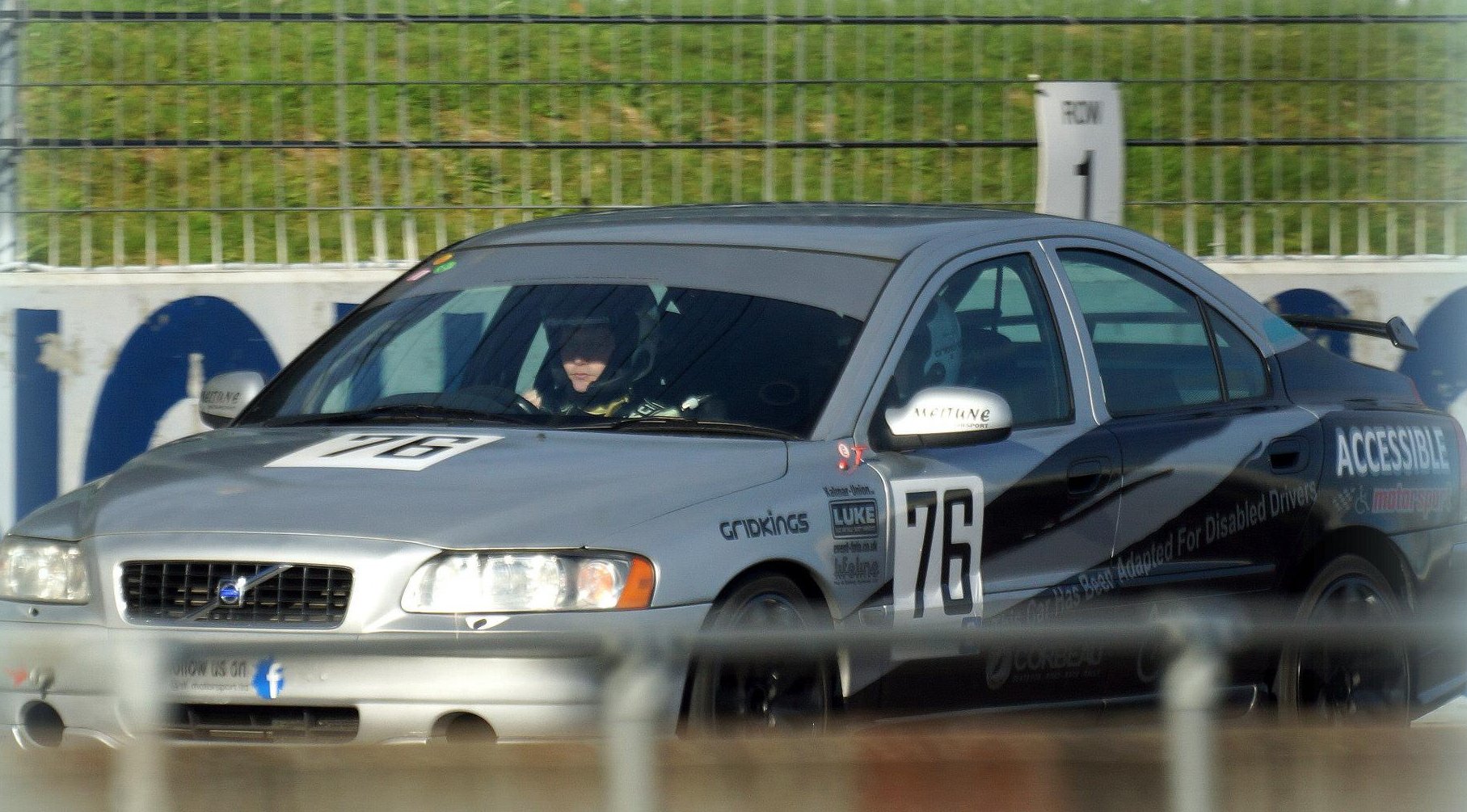 Straight after this we enter the chicane (an artificial feature that creates extra turns in a road) a little too fast, but Paul doesn’t seem to mind. This then takes me back to the longest and fastest straight on the whole track.
Paul tells me to open the throttle fully, so I pull it a bit more and aim out towards the wall on the far right of the track. I then hold position until around six feet away from the end of the straight before easing off and moving left slightly for the banked left hand curve, which is still mostly in shade and so a little slippery. At the far side of the banked curve is that hairpin again. I brake harder then I go hard on the last lap and make it round without sliding, all of which earns me great comments from Paul.
Several laps in and I’m starting to get a feel for the track. I now know how to safely take the hairpins and am remembering which way the turns go. But those left turns, that everyone else seems to be able to take fluidly, still elude me. I lurch from one to the next, missing the apex of each and getting in the way of everyone else as I repeatedly brake and then accelerate again.
Paul takes matters into his own hands, quite literally. He tells me that on the next lap he will control the steering and show me how it’s done, and that’s exactly what he does. After a quick tutorial it all seems much easier and on the next lap I manage to make all the turns flow into one. I feel like a driving God.
This feeling is short lived as we again approach the long, fast straight and, again, Paul tells me to open the throttle. Being quite a few laps in by now I am feeling much more confident and have a feel for the car so I open the throttle all the way, the first time I have done this. I squeal like a little girl as the car snarls, crouches and then launches itself down the straight which suddenly doesn’t seem as long as it had before. Driving God indeed, Paul is laughing and I can’t stop giggling at the acceleration.
A few more laps and my time is sadly up. I switch off the engine and remove my helmet. I let out a breath and realise I’m still grinning like a Cheshire cat. The only word that I can think of to do it justice is: awesome!
I’ll definitely be booking a slot on another one of these driving days.
Jealous? Then why not book a racing lesson?
By Dan McIntyre
Archive note: Dan’s experience took place at Rockingham Motor Speedway in Corby, Northamptonshire, when it was operating as a motorsport venue. The circuit stopped hosting motorsport events in 2018. Websites using the Rockingham name can still appear online, including restored archive content, so booking information in Dan’s original account should be treated as historical.
Accessible motorsport and adapted car racing FAQs
Can disabled drivers race cars with hand controls?
Yes. Some disabled drivers can use hand controls and other vehicle adaptations in motorsport settings. Dan McIntyre drove a race-prepared Volvo S60 T5 fitted with hand controls at Rockingham. Current access depends on the vehicle, circuit, provider, driver requirements and available adaptations.
How do hand controls work in an adapted car?
Hand controls can allow a driver to operate the accelerator and brake without conventional foot pedals. Systems include push/pull controls, electronic accelerators and other configurations. Steering aids and controls for functions such as indicators may also be fitted where needed.
Do all disabled drivers use the same hand controls?
No. Different drivers have different movement, strength, reach and control requirements. The most suitable setup depends on the individual and the vehicle, which is why an assessment with a driving adaptations specialist can be useful.
Can you book an accessible motorsport experience in the UK?
Accessible motorsport opportunities vary between providers. Anyone considering a track experience should ask about adapted vehicles, available controls, transfer access, instruction and eligibility before paying for a booking.
Is Rockingham Motor Speedway still open for racing?
No. Rockingham Motor Speedway stopped operating as a racing circuit in 2018. Dan McIntyre’s experience there is an archive account, so venue details and booking information from the original article should be treated as historical.

