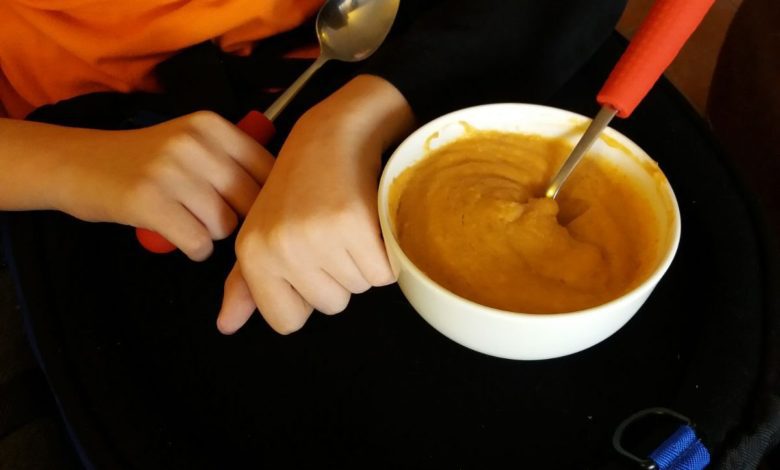
From NG Tubes to Jelly Pots: What We Learned About Dysphagia, Thickened Fluids and Daily Life

When people talk about dysphagia and thickened drinks, the information is often clinical. It explains swallowing problems, lists products, and gives medical advice. What it rarely shows is what this looks like in a family home, day after day, when you are trying to keep your child safe, hydrated and as settled as possible.
Our experience of swallowing difficulties did not begin in a neat or gradual way. It arrived with a devastating seizure.
Joe has Dravet syndrome, although at that stage we did not yet have a diagnosis. Looking back, feeding had been difficult from the beginning. We had tried breastfeeding, and my wife worked incredibly hard at it, but Joe would not latch. We even went to a neighbour for help, someone with experience of breastfeeding, but in the end we had to stop and move to bottle feeding. At the time, we did not see that as part of a bigger picture but it was probably also due to his underlying condition.
Joe had already had an unusual seizure at 3 months old – too young for ‘ordinary’ febrile seizures. Then, at around 12 months old, Joe had a catastrophic series of multiple seizures. Before that, he had been drinking from a bottle. Afterwards, while he was recovering in hospital, he simply would not swallow from a bottle again.
Watching that happen was deeply upsetting. At first, I assumed it would come back. He was still on a drip, and I thought maybe once he was stronger things would return to normal. They did not. He could still manage some food, including Weetabix and soft baby food, but drinking had changed completely.
That was when the hospital decided Joe needed an NG tube.
What NG feeding looked like in real life
An NG tube can sound manageable when it is explained in a clinical setting. In practice, it shaped our whole day.
Each feed took around half an hour. I had to get bottles ready, have a syringe and litmus paper prepared, and make sure all the equipment was within reach. The litmus check mattered because the tube had to be in the right place. If it moved into the lungs instead of the stomach, the consequences could be extremely serious.
Most feeds happened with me beside Joe’s cot, sitting him up, holding the tube carefully and watching him the whole time.
There was no room to be casual about any of it. Joe could only tolerate so much fluid at once. If he had too much, he would vomit. If we got behind with the schedule, we could not simply make it up later. The day had to run around those feeds, because the feeds could not run around anything else.
We were doing up to eight feeds a day because we wanted to avoid overnight feeding. That meant very little time between one feed and the next. Life became highly regimented. It was not just physically demanding. It was mentally exhausting too.
Outings were difficult. We had to carry equipment everywhere, and people stared. Even something as ordinary as leaving the house took planning.
What I remember most clearly is the stress. Sometimes the shock of Joe feeling the cool milk go into his stomach could trigger a seizure. Then we were dealing with rescue medication, and sometimes another hospital visit. I never knew when that might happen. That uncertainty and anxiety was relentless.
The strain on family life
At the same time, I was also supporting my wife, who is a wheelchair user. She could not do the physical side of Joe’s feeding, but she was still central to how we managed as a family.
Joe’s cot was on wheels, so we could move him into our room when needed. He also slept there, at the bottom of our bed, because that was what made life workable. During the day, we had help from “special needs nannies” – as they were called back then, and my wife had additional carers too.
The house was busy all the time, with different people arriving and leaving, each with a different role. At times it felt less like a family home and more like I was running a small 24/7 emergency response business!
My wife did a huge amount behind the scenes. She handled wages, administration and much of the organising. She could do many things, just not the physically demanding aspects of Joe’s care. I felt for her, because none of this was easy for either of us, but we worked around it in the best way we could.
Why I chose not to replace the tube myself
Joe would sometimes sneeze, rub at the tube, or catch it with his hand and pull it out. When that happened, we had to ring the district nurse and have it replaced.
I could have learned to do that myself. In one sense, it might have made life easier. In another, I knew exactly why I did not want to.
I did not want Joe to associate me with something so invasive and unpleasant. I was the person he trusted most with his care, and I wanted to protect that relationship as far as I could. I also knew tube placement was dangerous to get wrong. For us, it felt better to leave that part to the professionals.
Joe had an NG tube for about three years.
Keeping food part of Joe’s life
One thing that mattered to us throughout all this was that Joe still enjoyed food. Even during the tube feeding years, he was eating orally. He has always loved food, and I believe that mattered.
I do not judge parents who choose a PEG.
A Percutaneous Endoscopic Gastrostomy (PEG) tube is a feeding tube inserted through the skin directly into the stomach, used for people who cannot eat or drink enough by mouth to meet their nutritional needs.
It can be absolutely the right choice. I know how difficult, relentless and risky poor swallowing can be, and every family has to make the decisions that are right for them and the child. There is no easy route through it.
For us, though, it felt important to keep up with oral feeds. Joe loves to eat! We had to allow him to keep that pleasure if we could. Looking back, I think that it is the one reason he still eats orally today.
The ketogenic diet changed another part of the picture
Alongside all this, we also tried the ketogenic diet for Joe’s epilepsy. It made a real difference. His severe tonic-clonic seizures reduced, and he became brighter in himself.
At the time, that was not universally accepted in the way it is now. We were fortunate to have a consultant who supported it. Some junior doctors dismissed it and spoke as if it were nonsense. That angered me, because we could see the difference in our own son. We were not choosing quackery!
We were living with the positive results every day.
The ketogenic diet also affected what we could and could not use to help with hydration. Many standard thickened drinks were not suitable because they were starch-based and too high in carbohydrate.

The Easter weekend when everything changed
One Easter, my parents came to stay after a five-hour journey. It was Good Friday. Joe’s tube came out.
We phoned the district nurses and were told they could not come until the next day. The alternative was taking him to hospital. That news was crushing. It felt as if the whole weekend was about to collapse into another hospital stay.
After talking it through with my mother, I came up with an idea. Joe was still able to eat, and I started thinking about whether I could get enough fluid into him in another form. Because of the ketogenic diet, the usual thickened drinks were not an option. So I made sugar-free jelly.
I prepared 8 small pots, about 150ml each, and we started feeding him that instead.
I still remember the feeling when it worked. I was with my mum, and I felt such relief. First I thought, this will get him through today. Then almost immediately I thought, maybe we can keep going. Maybe we can do this without the tube.
That moment was emotional and overwhelming, and my mum’s support meant a lot.
Why jelly worked for us
The jelly needed to be cold, often straight from the fridge. If it started to warm up, it melted too quickly and became harder to manage. Sometimes it would still melt in Joe’s mouth and seep out, but enough went in to make it worthwhile.
That one emergency solution turned into years of routine.
For a long time, I was constantly making jelly, rotating flavours and trays in the fridge so there was always enough ready. We ended up doing 10-15 jelly pots at a time. It sounds almost absurd written down like that, but when something works, you keep going.
This is the part I wish more people understood about dysphagia and thickened fluids: what works in real life is not always the textbook answer. Sometimes it is a workaround you arrive at because the standard solutions do not fit your child’s needs.
Years later, we were offered a thickener made with guar gum rather than starch, which meant it was compatible with the ketogenic diet. On paper, it sounded promising. In reality, Joe hated the taste. So we stayed with the jelly until he eventually came off keto.
Again, that taught me something simple but important. A product can be clinically suitable and still be useless if the person who needs it cannot tolerate it.
What professionals did and did not understand
In some ways, we were fortunate. Joe’s syndrome was unusual, and over time I became extremely knowledgeable about him, his seizure patterns, his medication and the way his body responded. Because of that, staff on children’s wards and ambulance crews often listened to us and respected the systems we had put in place at home.
I am grateful for that.
I also know not every family gets the same response. We were organised. We knew Joe inside out. We were able to explain clearly what was happening and why. Families should not have to present themselves in a certain way to be taken seriously, but I suspect some are heard less simply because they are more overwhelmed, less confident, or less used to speaking the language professionals expect.
That is a problem, because parents and carers know the practical reality of a child’s day better than anyone.
What I would tell another parent now
The main thing I would say is this: it is a marathon, not a sprint.
You have to look after yourself too, even when that feels impossible. Take all the help you can get. You will need it, and there is no prize for doing everything alone.
When your child is in hospital or in the middle of a difficult period, you often keep going on pure necessity and adenaline. You do what needs doing and carry on. The strange part is that you do not always feel how exhausted you are at the time. That often comes later, when the immediate crisis has passed. That is when it can all hit you.
When it does, rest if you can. Recover if you can. Give yourself permission to stop and recover.
I also had to accept that I could not work in the normal sense during those years, and I felt guilty about that. In reality, there was no time. Joe’s care filled the day. That was not failure. That was simply the truth of our situation.
This was not the kind of parenting life we had expected, but it was our life. Every family’s version of that will look different. There is no single right way to do it.
Why lived experience matters in conversations about dysphagia
A lot of information about dysphagia focuses on products, consistencies and medical instructions. Those things matter, but they are only part of the story.
The other part is the daily reality. It is the timing. The watching. The carrying of equipment. The worry that something could go wrong. The trial and error. The feeling of being trapped by a routine you cannot relax for a moment. It is the small breakthrough that suddenly changes everything, like realising a fridge full of sugar-free jelly might keep your child hydrated when the standard options do not work.
That is what our experience taught us. Not that there is one perfect answer, but that practical solutions have to fit real people, real bodies and real homes.

Sometimes the thing that works is not the obvious thing. Sometimes the best guide is not the leaflet or the product description, but the close attention of a parent who knows their child and keeps going until they find a way through.
Further Reading
Clinical and research resources
- Feeding Difficulties and Gastrostomy in Dravet Syndrome — peer-reviewed research (PMC/NIH, 2024) confirming that feeding problems are common in Dravet syndrome and should be proactively discussed with families
- The IDDSI Framework — the international standard for classifying thickened fluids and texture-modified foods, used by speech and language therapists worldwide
- Thickened Fluids Briefing — Royal College of Speech and Language Therapists — UK professional guidance on thickened fluids as a dysphagia management tool, including their limitations
- Weaning Children with Aspiration off Thickened Liquids — peer-reviewed case series on individually tailored plans for children with swallowing difficulties (PMC/NIH, 2017)
Resources for families and general readers
- Dravet Syndrome UK — Family Guide Resources — the UK’s leading Dravet charity, with comprehensive guides written with input from parents and carers
- Dravet Syndrome UK — Helpful Resources — practical guides covering emergencies, carer mental health, and ambulance crew information packs
- Epilepsy Society — Ketogenic Diet — a clear UK overview of the ketogenic diet as a treatment for drug-resistant epilepsy
- NHS — Nasogastric Tube Feeding at Home — practical NHS guidance on NG tube feeding at home, covering equipment, safety checks, and daily management
