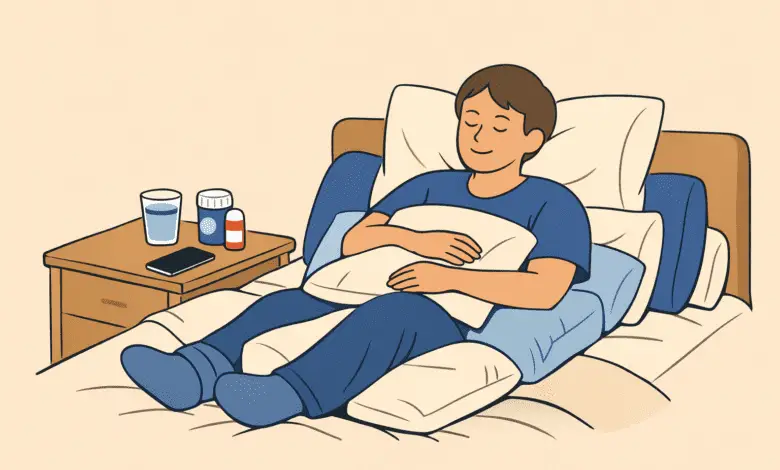
Falling asleep when you live with pain, spasms, or deep fatigue usually has very little to do with being “tired enough”. It is about setting things up so your body has fewer barriers to rest. Many disabled people find that sleep improves through small, repeatable adjustments rather than chasing an ideal routine that never survives real life.
Letting evenings bend around your body
Fixed bedtimes often clash with pain flares, medication schedules, and care needs. A flexible wind-down period tends to work better. Some people set a reminder to start preparing for rest, especially if fatigue or time blindness means evenings slip past unnoticed. That moment might signal a shift from bright lighting and fast-paced content to softer lamps, slower television, or an audiobook saved just for night-time, so the brain starts to recognise the change.
Medication timing often plays a big role in making rest possible. Some people find it helps to:
- Take slow-release pain relief so it reaches its strongest point once they are lying down
- Plan breakthrough medication for the evening if symptoms tend to peak later in the day
- Use topical supports before getting into bed, such as:
- heat rubs
- cannabidiol (CBD) balms, drinks or sprays that some people find help their body relax
- transcutaneous electrical nerve stimulation (TENS)
Evidence, access, and effects vary, and these options don’t work for everyone. They are not cures, but some people find they take enough of the edge off pain or muscle tension — or help their body settle — so rest feels more achievable.
The aim is not to remove pain completely, which is not realistic for many people, but to take the sharpest edge off so rest becomes possible.
Turning the bed into usable space
A bedroom that supports rest needs to work with your body, not just look calming. Many disabled people describe building layers of support with pillows placed wherever joints tend to drop or twist: along the back, between the knees, under the ankles, or wrapped around the body to keep everything aligned. Pregnancy pillows, wedges, mattress toppers, and pressure-relief cushions can all help reduce strain, support breathing, or allow you to stay slightly upright if lying flat worsens symptoms.
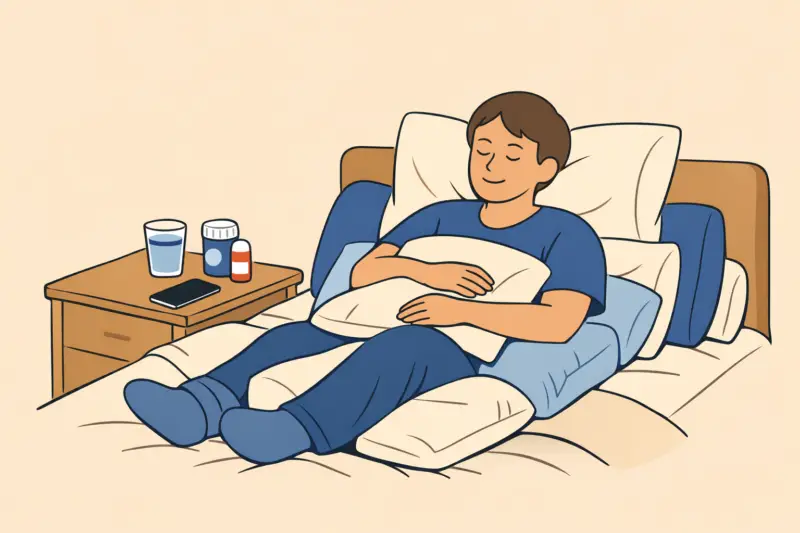
Access matters just as much as comfort. Keeping medication, water, continence supplies, a phone, or communication equipment within arm’s reach reduces the need for painful or exhausting movements during the night. Bedside trolleys, over-bed tables, and storage that can be reached without stretching are common adaptations. Smart plugs and voice-controlled lights or fans can replace awkward switches, giving you control even when movement is limited. Others depend on warmth: electric blankets set low, heat packs placed on problem joints, or a warm bath earlier in the evening to ease muscle tension before bed.
Creating a restful atmosphere
The space you sleep in has a strong influence on how well you rest. Keeping your bedroom tidy, well-ventilated and softly lit helps create an environment that feels safe and peaceful. The goal isn’t perfection, but a sense of comfort that allows your mind to let go of the day.
Small sensory details also play a role. Some disabled people rely on a consistent scent, such as a particular pillow spray, to signal that it is time to rest. Scent can also play a surprisingly powerful role in this process. Using a pillow mist to help you sleep can make your bed feel more inviting while subtly encouraging relaxation through familiar, soothing aromas. Some people also find that lighting a cosy scented candle before bed helps them slow down and enjoy the moment before turning off the lights.
Make sure to extinguish any candles completely before getting into bed. If you’re concerned about fire safety or have reduced mobility, electric wax warmers, reed diffusers or battery-operated LED candles offer the same calming scent without the risk.
Low-cost ways people adapt their sleep space
| Sleep need | Use-what-you-have options |
|---|---|
| Body support | Rolled towels or blankets, folded duvets, sofa cushions, a hoodie or jumper used to support the neck or lower back |
| Keeping essentials close | Cardboard box or plastic container by the bed, reusable shopping bag hooked to the bed frame, pillowcase hung from the bedpost, existing shelf moved closer |
| Scent cues for sleep | Essential oil on a tissue in the pillowcase, scented soap in a dish, dried lavender in a cloth bag made from an old sock, consistent bedding scent |
| Warmth and comfort | Hot water bottle, microwaveable wheat or rice bag, extra bedding layers, warm socks or a night-time hoodie |
| Soft lighting | Lamp dimmer switch, tape over bright LEDs, scarf safely draped over lampshade, hallway light with the door slightly open |
Settling a restless mind
Many disabled people experience mentally “loud nights”. Pain, trauma, attention deficit hyperactivity disorder, autism, and anxiety can all make it hard for the brain to slow down enough for sleep.
Some approaches focus on calming the mind rather than trying to empty it:
- Grounding techniques that can be done in bed, such as:
- Slow, steady breathing
- Counting objects in the room
- Repeating a short phrase with each exhale
These can create just enough quiet for sleep to take hold.
Getting thoughts out of your head can also help:
- Journalling, which does not have to involve handwriting
- Voice notes, dictation, or typing into a notes app can work just as well and may be easier on the body
Distraction is another commonly used coping tool:
- Gentle television, podcasts, ambient sound, or audiobooks
- Setting audio to turn off automatically can help avoid overstimulation
- Some people find heavier duvets or weighted blankets helpful, as steady pressure can help the nervous system settle
Personal tip: A familiar visualisation I use at night
One approach that works for some people is building a detailed mental journey that stays consistent night after night. The repetition becomes soothing rather than boring, because the mind knows where it’s going.
For instance, I use the same visualisation every evening. I imagine leaving my house and meeting an old friend on the driveway. He drives me to a large castle, and I go through the same steps each time: saying hello, smiling, getting into the car, watching the same countryside roll past, crossing familiar bridges, and looking out over fields.
We arrive at the castle with its wide grounds and grand entrance, then climb the stairway to a corridor lined with doors. Some nights we go into a room that holds a pleasant memory. Other nights we walk through the gardens, into the greenhouse, and I stop to look at the flowers and plants. Usually, I fall asleep somewhere along the way.
The key is the predictability. My mind learns the route and can follow it even when pain or anxiety are loud. The details can shift slightly — different rooms, different garden paths — but the journey itself stays the same. It gives restless thoughts somewhere to go that isn’t the day’s worries or tomorrow’s concerns.
Using screens without fighting reality
Advice to stop using screens early in the evening rarely reflects disabled lives. Phones and tablets are often essential for communication, care coordination, reminders, and social contact. Instead of removing screens altogether, many people change how they use them later at night.
On most modern phones, that can include small adjustments like these:
Use night or comfort display settings
-
- On iPhones and iPads, Night Shift warms the screen colour in the evening, and Reduce White Point can take the harsh edge off brightness.
- On Android phones, Night Light or Eye Comfort Shield does a similar job.
- Some people also switch on Dark Mode so bright backgrounds aren’t glaring in a dark room.
Lower brightness beyond the default
-
-
- Many phones allow you to dim the screen further using accessibility settings, which can be easier on tired or light-sensitive eyes.
- Auto-brightness can be helpful for some people and annoying for others — it’s fine to turn it off and keep things consistent.
-
Change what the phone is used for
-
- Late at night, some people stop scrolling and use their phone mainly for listening or watching something familiar.
- Audiobooks, podcasts, gentle television, or videos you’ve already seen can be easier to tolerate than fast-moving or unpredictable content.
Reduce interruptions
-
- Using Do Not Disturb, Focus modes, or muting notifications can stop new messages, news alerts, or work emails arriving just as your body starts to settle.
- Some people allow calls or messages from specific contacts to come through, while silencing everything else.
For many disabled people, screens aren’t the problem — constant demands and bright, noisy content are. Small changes like warmer light, lower brightness, fewer notifications, and predictable audio can make screens part of winding down rather than something you have to fight against.
Some people set a clear shift point where the phone stops being a source of news or messages and becomes just an audio player. Notifications are muted so new demands do not arrive at the exact moment rest is most fragile.
Personal tip: taking a break from my phone in the early evening
By around 6pm, I’ve usually had a long working day with near-constant phone use — replying quickly to customer and work messages, keeping up with updates from friends and relatives, and dealing with whatever comes in.
At that point, I often put my phone on charge in another room. That gives me a complete break from it for a while. I can enjoy a meal and watch television with my wife without the pull of notifications or the feeling that I need to respond to everything immediately.
It doesn’t mean I avoid screens for the rest of the evening. It just creates a clear pause between a busy, demanding part of the day and a quieter one.
Routines that hold up on difficult days
Sleep routines for disabled people need to survive flares, appointments, and nights where symptoms refuse to settle. Many people focus on a few anchor habits that happen most evenings, even if timing and order change. Dimming the lights, turning on the same background noise, using a familiar scent, or starting a trusted podcast can all act as cues, even if sleep is still some distance away.
Just as important is letting go of blame when sleep falls apart. A stretch of bad nights is not a personal failure; it is often the reality of living in a body that flares and fluctuates. Routines exist to increase the number of manageable nights over time, not to guarantee perfect sleep. Approaches that respect pain levels, energy limits, and access needs usually do far more than any rigid set of rules ever will.

