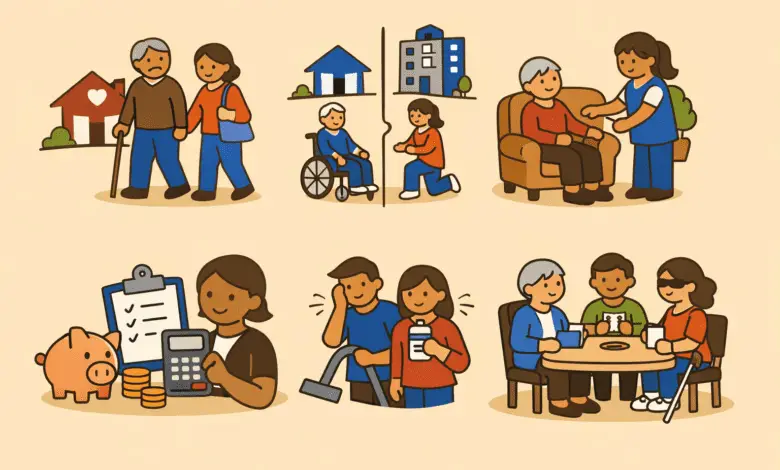
Families choosing between assisted living vs home care are often guided by assumptions rather than clear information.
Families choosing between assisted living and home care are often guided by assumptions rather than clear information. Cost myths play a major role in shaping decisions, sometimes pushing people toward options that are difficult to sustain over time. Looking closely at how care actually works — financially and practically — helps families plan with confidence, avoid unexpected pressure, and support long-term independence.
Key takeaways
| What to know | Why it matters |
|---|---|
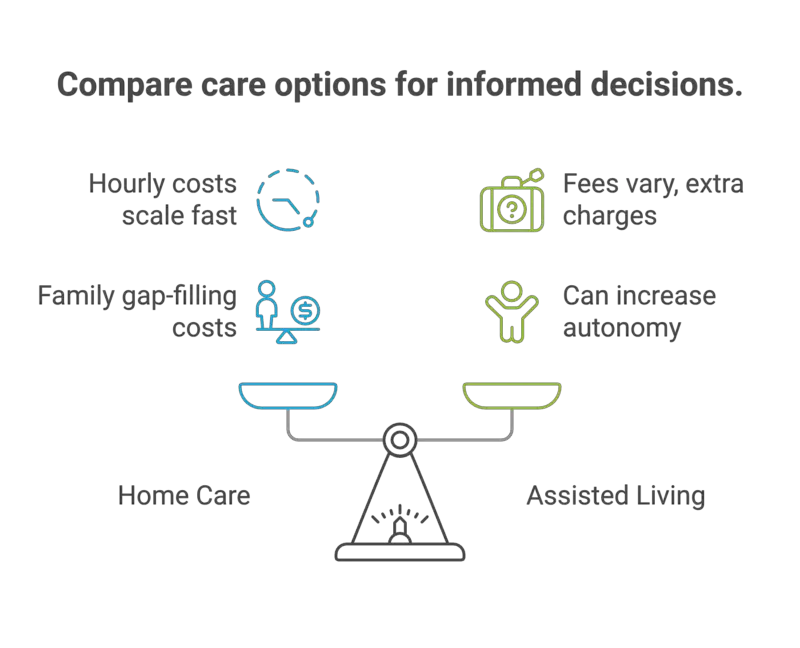
| Hourly home care costs can rise quickly | Increased support needs change the real cost |
| Assisted living fees vary by service | Extra charges are common and need checking |
| Independence is not lost in assisted living | The right environment can increase autonomy |
| Care needs change over time | Early planning avoids rushed decisions |
| Family care has personal costs | Sustainability matters for everyone involved |
Why cost myths influence care choices
Decisions about care are rarely just financial. Families are balancing independence, safety, wellbeing, and emotional responsibility at the same time. What complicates this is how often choices are shaped by repeated claims about cost that do not reflect how care works in real life.
Care arrangements are not fixed. Support can increase gradually or change suddenly, and costs tend to follow. Looking only at current needs often hides the long-term picture, particularly when unpaid family care is filling the gaps.
Myth one: Home care is always cheaper
Home care often appears more affordable at first because it is priced by the hour. Paying for a few hours a day can feel manageable, especially when compared with a monthly assisted living fee.
The picture changes as support needs grow. Extra hours, overnight care, or specialist input can quickly increase costs. Families may find themselves coordinating several carers, each with different schedules and rates, which adds practical strain as well as expense.
There are also costs that never appear on an invoice. When a family member is providing care, responsibility does not stop when paid support ends. If a carer is sick or does not arrive, someone still has to step in.
“It can appear to be cheaper, but when you are a family member carer there is also the personal cost to your life of having the responsibility of providing 24/7 care.” Duncan Edwards Family Carer and Disabilty Horizons Magazine Editor
Covering gaps at short notice affects work, sleep, health, and family routines. Over time, being constantly on call can take a financial, mental, and physical toll. These pressures are rarely included in cost comparisons, yet they play a major role in whether care is sustainable.
Myth two: Assisted living fees include everything
Many people assume assisted living works on a single, all-inclusive payment. In practice, this varies widely. Core accommodation and basic support are usually covered, but services such as medication support, personal assistance, transport, or specific dietary needs may be charged separately.
It is also important to look beyond care tasks and consider everyday life.
“Holidays and trips out can mount up, and paying for carers to accompany your relative on trips to paid events can add unexpected costs.”
Some settings include basic personal items or support with clothing and toiletries, while others treat these as extras. Reviewing contracts in detail helps families understand what they are paying for and compare options fairly, rather than relying on headline figures.
Myth three: Home care always means one-to-one attention
Home care is often described as personalised, but that depends on staffing and availability. Carers usually work to fixed schedules, and continuous one-to-one support often requires a significant increase in paid hours or live-in arrangements.
Assisted living settings typically have staff on site throughout the day and night. While this does not mean constant individual attention, it does mean support is available when needs change suddenly, without reorganising care at short notice.
Myth four: Assisted living removes independence
There is a common belief that moving into assisted living means giving up control. Many communities, however, are designed around choice. Residents often decide when to eat, how to spend their time, and which activities to join, with support available when needed rather than imposed.
In practice, assisted living can increase independence.
“When our son moved to assisted living, his quality of life and independence increased because he could do much more in terms of going out and socialising than we could manage at home.”
Shared staffing and resources often make it easier to organise outings, social events, and everyday activities. What can be difficult for one household to manage becomes more achievable when support is coordinated across a larger setting.
Myth five: Home care is always flexible
Care at home can feel flexible because it happens in familiar surroundings. Scheduling, however, is often more complex than expected. Evening, overnight, and weekend support may be limited, and last-minute changes can be difficult to cover.
Flexibility can also be affected when multiple providers are involved.
“We were balancing different agencies to provide care at home, and one went bust, leaving us high and dry at short notice.”
Replacing care takes time. New agencies need to be researched, assessed, and set up with care plans. During that period, families often step in to cover gaps, increasing pressure at an already stressful point.
Myth six: Family members can always step in
Family involvement is central to many care arrangements, but it has limits. Managing work, other caring responsibilities, and personal health alongside ongoing support can lead to exhaustion.
Relying too heavily on unpaid care can strain relationships and affect wellbeing on all sides. Sustainable care plans recognise the value of family support while ensuring responsibility is shared and predictable.
Myth seven: Assisted living is only for wealthy families
Assisted living is often seen as out of reach, yet costs vary by location, accommodation type, and level of support. When housing costs, utilities, transport, and increasing home care hours are considered together, the gap is sometimes smaller than expected.
Funding options, including long-term care insurance or changes to housing arrangements, can also affect affordability. Understanding these factors early allows for more realistic planning.
Myth eight: Care needs stay the same
Support needs rarely remain fixed. Progressive conditions, changes in mobility, or shifts in mental health can all affect how care is delivered.
Families often approach care as something they can manage “for now,” without knowing how long that period may last.
“Caring is a marathon, not a sprint.”
Constant responsibility over time can affect emotional wellbeing and family relationships. The person receiving care may sense stress or feel like a burden, even when no one intends that message. Shared responsibility within a professional setting can reduce this pressure and support stability.
Looking at the full cost picture
Comparing assisted living and home care means looking beyond basic fees. Transport, home maintenance, equipment, and healthcare all play a role. Assisted living often brings these together in one setting, while home care spreads them across multiple services.
Neither option is automatically better. The right choice depends on access needs, personal priorities, and how support is likely to change over time.
Making informed decisions
Clear information supports better decisions. Questioning common cost myths, reviewing contracts carefully, and planning for future needs can help families avoid sudden financial or emotional strain. Thoughtful planning supports dignity, independence, and long-term wellbeing — whatever form care eventually takes.
Useful resources
The following resources are provided for general information only. They are independent, public-interest organisations and do not represent endorsements of specific care providers or services.
These links offer practical guidance on home care, assisted living, funding, and support for disabled people and family carers in the UK and the United States.
UK care and support resources
- NHS social care and support guide
Official NHS guidance explaining how adult social care works in England, including needs assessments, eligibility, and available support. - Carers UK advice and support for unpaid carers
Independent information on carers’ rights, financial support, employment issues, and the long-term impact of caring. - Age UK guide to care at home and residential care
Plain-language explanations of home care, assisted living, and residential care options, including questions to ask and cost considerations. - Scope advice on independent living and support
Disability-focused guidance on independent living, access to support, and navigating social care systems. - Local council adult social care services
Local authority pages for requesting care assessments, understanding eligibility for funded support, and finding local services.
US care and support resources
- National Institute on Aging guidance on long-term care
Federal information on home care, assisted living, long-term care planning, and how care needs can change over time. - Eldercare Locator – local support services
A public service from the U.S. Administration for Community Living that connects families to local care, benefits, and support programmes. - Family Caregiver Alliance caregiving resources
Evidence-based information on the financial, emotional, and practical realities of family caregiving. - AARP caregiving and long-term care advice
Independent guidance on care options, planning ahead, and balancing care with work and personal health. - Medicaid long-term services and supports (LTSS)
Information on publicly funded long-term care support, including home- and community-based services for eligible individuals.

