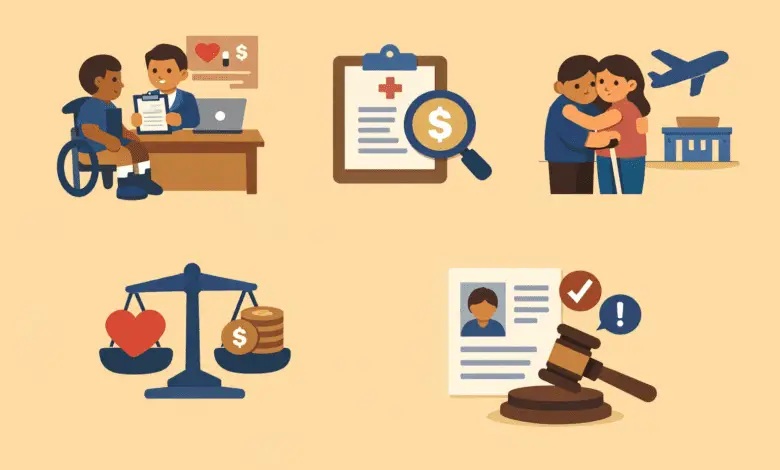
When Immigration Health Checks Become a Barrier: Disabled Couples and Australia’s Partner Visa

For many couples, applying for Australia’s Partner visa feels straightforward: prove your relationship is genuine, submit the paperwork, complete the medical. Then the health assessment changes everything. For some disabled applicants, it’s the point where love is reduced to projected cost because of how the migration system is designed.
Key points:
- The health test uses projected costs, not what you promise to use.
- The Significant Cost Threshold (SCT) is $86,000 on current Home Affairs guidance.
- Some visas allow a waiver (PIC 4007), which can let decision-makers consider personal circumstances.
What the 309/100 Partner Visa Is
The Partner Visa Subclass 309/100 is for people applying from outside Australia as the spouse or de facto partner of an Australian citizen, permanent resident, or eligible New Zealand citizen. The 309 visa is temporary. The 100 visa is permanent and usually follows after further assessment of the relationship.
Like most Australian visas, Partner visas include a health requirement. That assessment is based on Public Interest Criteria 4005 or 4007. You can read the Department of Home Affairs overview here. Disability advocacy group NEDA also explains how the rules affect disabled applicants in this factsheet.
The Health Requirement and the “Significant Cost” Rule
The health requirement looks at whether an applicant is likely to:
- Require health or community services that exceed the Significant Cost Threshold, or
- Limit access to services that are already in short supply.
The Significant Cost Threshold (SCT) is the cut-off used in Australia’s migration health requirement. Home Affairs guidance states that if a Medical Officer of the Commonwealth (MOC) assesses your estimated costs as above $86,000, you exceed the SCT and do not meet the health requirement.
For permanent and provisional visas, Home Affairs’ April 2024 review explains that costs for a reasonably predictable permanent condition can be assessed across up to 10 years, which means a condition costed at (for example) $11,700 per year could be modelled as $117,000 over that period.
Importantly, this is based on modelling — not on what a person says they will use, and not on whether they have private health insurance. It is a system calculation.
Disability advocates argue the rule disproportionately affects disabled people because it assigns projected public cost to impairment, rather than assessing a person’s real contribution, family life, or existing support network. The Australian Human Rights Commission has raised concerns about discrimination and transparency in how these costs are calculated.
It’s also important to keep the scale in view. Home Affairs reports that over 99% of visa applicants meet the health requirement. In 2022–23, there were 1,327,370 immigration medical examinations and 2,267 applicants were assessed as not meeting the requirement.
“We Felt Like a Price Tag Was Put on Our Relationship”
Anonymised account (composite from online posts): One disabled partner‑visa applicant described being told they did not meet the health requirement because the Medical Officer’s projected costs for their future supports were calculated as higher than the threshold. By then, they and their partner had already spent months compiling relationship evidence and planning a shared life in Australia.
“We’d already proved our relationship was genuine. Then suddenly it felt like our marriage had a dollar figure attached to it.”
The emotional impact can be severe. Couples talk about long periods of uncertainty, paying for extra specialist reports, and trying to make sense of cost projections they had no say in designing. When people do seek legal advice, the fees can run to thousands of dollars — simply not realistic for every family.
What people say it feels like: In anonymised accounts shared on online visa forums, some disabled partner-visa applicants describe being shocked by decade-long “projected cost” estimates and the fear of being separated from a spouse despite a genuine relationship. Others describe the stress of gathering extra specialist letters, waiting months for updates, and trying to make health decisions while the visa remains uncertain.
The stress doesn’t come from disability itself, but from a system that can separate partners on the basis of a spreadsheet of projected expenditure.
Success Stories and Appeals
Not every health concern leads to refusal. Some Partner visas fall under PIC 4007, which allows for a health waiver. In those cases, decision-makers can consider compassionate circumstances, including the impact on an Australian partner.
There are documented cases where couples prepared detailed submissions, included strong medical evidence, and were granted a waiver. Advocacy organisations have also played a role in highlighting systemic unfairness and pushing for clearer guidance.
Why advocates say this is discriminatory
The Australian Human Rights Commission argues the Significant Cost Threshold reflects an outdated “deficit” view of disability and raises concerns about whether the policy’s operation aligns with Australia’s obligations under the Convention on the Rights of Persons with Disabilities (CRPD). The Commission also calls for clearer, more objective criteria and greater transparency about how costs are defined and calculated.
If a visa is subject to PIC 4007, Home Affairs explains a delegate can consider a health waiver after a “does not meet” opinion, including personal circumstances and capacity to mitigate costs and/or compelling or compassionate circumstances. In 2022–23, Home Affairs reports that 60% of people who failed the health requirement had access to a waiver, and a majority of those waivers were exercised.
In practice, the strongest waiver cases tend to be built around very specific evidence rather than general reassurance. Migration practitioners describe successful PIC 4007 submissions that included detailed letters from treating specialists setting out diagnosis, prognosis, functional capacity, treatment plan, and expected long‑term service use; evidence that some costs can be met privately (for example, via stable employment, savings, family support or insurance); and clear statements about the impact refusal would have on Australian citizen or permanent-resident family members.
A refusal is not always the end of the process. Some applicants seek merits review where available. Outcomes depend heavily on the individual case and the evidence provided.
What Disabled Applicants Can Do
- Gather detailed medical evidence early. Ask treating specialists to describe functional capacity, likely support needs, and prognosis clearly.
- Understand whether a waiver is available. Partner visas often allow waiver consideration under PIC 4007.
- Budget realistically. Additional reports, translations, and administrative delays can increase costs.
- Seek disability advocacy support. Community legal centres and disability organisations can sometimes provide guidance beyond paid migration advice.
Disabled people are not “high risk” applicants. The barrier sits in how the policy calculates projected service use. For couples facing this process, preparation and clear evidence matter — but so does ongoing scrutiny of a system that continues to treat disability as a projected expense rather than a normal part of human diversity.
