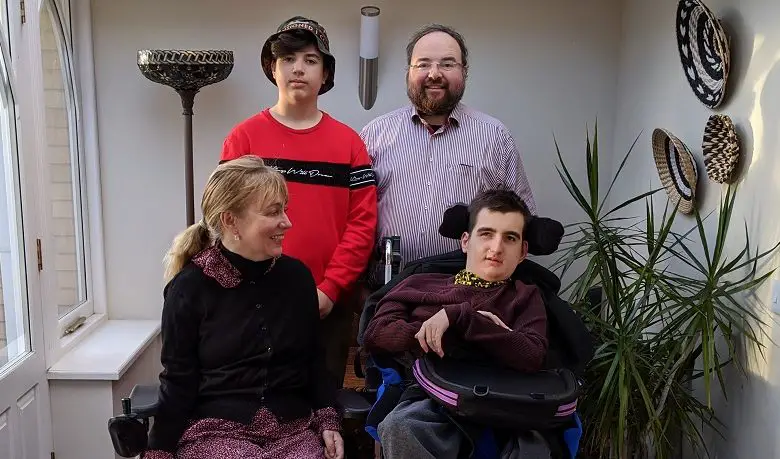
An editor reflects on invisible disability, allyship, and belonging.
By Duncan Edwards, Editor, Disability Horizons
This morning I got an email from Lloyds Bank inviting me to join their new Disabled Entrepreneurs Research Panel. I spent ten minutes wondering if I was allowed to say yes.
That probably tells you everything you need to know about where my head is. And maybe yours too.
The Email That Started It
Lloyds’ invitation was warm, well-intentioned, and genuinely inclusive. They defined disability broadly: “a long-term condition that affects your daily life… If you identify as disabled, with or without a formal diagnosis, you’re welcome to join.”
By that definition, I likely qualify. Every night I strap a CPAP mask to my face to manage sleep apnoea. Without it, I’d be exhausted, cognitively impaired, and at serious cardiovascular risk. Because of it, I qualify for VAT exemption on medical equipment as a “chronically sick person” under HMRC’s definition.
I can’t go camping. I can’t stay somewhere without electricity. There’s a machine involved in my survival every single night.
And yet my first instinct on reading that email was: that’s not really meant for me, is it?
That reaction of reflexive self-exclusion, is something I suspect a lot of people in the disability community’s orbit will recognise. And I think it’s worth talking about.
Who Am I to Be Here?
I’m the editor of Disability Horizons, one of the UK’s leading disability lifestyle magazines. I’ve worked in disability services for years. I’m a passionate advocate for accessibility, independence, and inclusion.
But I walk into rooms without anyone noticing. I don’t use a wheelchair. I have no visible impairment. I tend my apple trees (I also make cider!), do my work, and get on with life in ways that most people would see as entirely unremarkable.
So who am I to be editing a disability magazine? It’s a question I’ve carried for years, long before this morning’s email.
The disability community’s foundational principle — “nothing about us without us“ — exists for very good reason. For too long, decisions about disabled people’s lives were made by people with no lived experience and no real accountability to the people they claimed to serve.
Am I one of those people?
Lived Experience Isn’t Always Your Own
Here’s where my situation gets complicated, and perhaps where yours might too.
My wife Clare is a wheelchair user. Following a spinal injury, she co-founded Trabasack, a lap desk and bag born from genuine necessity. From the daily frustration of products that simply didn’t work for real life.
Clare often says the biggest barrier is number of products designed without disabled people in mind and the attitudes of other people. Trabasack started because she needed something that worked for her and we couldn’t find anything to buy that did.
Our son Joe has Dravet syndrome, a severe and complex form of epilepsy. These aren’t things we dwell on — they’re just part of our usual family life, the same way anyone’s circumstances shape their days. But being Joe’s dad has given me a profound education in dealing with the NHS, social care, the benefits system, and the particular, grinding exhaustion of loving someone whose needs the world consistently underestimates and isn’t built for.
Earlier in my career, I spent years as a welfare benefits and homelessness advisor, sitting across tables from some of the most marginalised people in society, helping them fight systems seemingly designed to grind them down.
None of that makes me disabled. But it does mean I’m not an outsider looking in, either.
The “Disabled Enough” Trap
I’ve come to believe that “disabled or not” is the wrong binary — and that the “am I disabled enough?” question is a trap that catches a lot of people.
Disability isn’t about medical conditions. It’s the systems around us — workplaces, financial services, public attitudes — that decide who gets treated as disabled and who gets overlooked. The Equality Act 2010 has one definition. HMRC has another. The social model of disability offers a different lens entirely.
Fewer than 1 in 10 disabled people use a wheelchair, yet that’s still the dominant image used to represent disability in media and advertising. With 16 million disabled people in the UK — around 1 in 4 of the population — the vast majority live with conditions that are invisible to the outside world. It’s hardly surprising that many people who would legally qualify as disabled never identify with the label at all. Disability identity is personal: some people claim it proudly, others never do, and both positions are entirely valid.
My nightly machine doesn’t place me in the same category as someone managing a complex, life-limiting condition. But I’m also not the non-disabled marketing executive who spotted disability as an “underserved market” and hired a PR firm to look the part.
There’s a spectrum of proximity to lived experience, and where you sit on it matters.
What Actually Counts
I don’t think the right question is “are you disabled enough to do this?”
I think the right questions are:
- Are disabled people’s voices genuinely at the centre of what you publish, sell, or advocate for?
- Are you platforming disabled writers, entrepreneurs, and thinkers — or speaking for them?
- Are you using your position to open doors, or occupying space that should belong to someone else?
- Do you listen, really listen, when the community pushes back?
- Do disabled contributors get something meaningful from the platform? Whether payment, publicity, or a genuine voice they wouldn’t otherwise have?
Disability Horizons isn’t what it was three years ago, when a team of disabled writers, entrepreneurs, and creators produced content I was proud to be a part of. The magazine has scaled back significantly, the team disbanded, and I now largely maintain the archive and publish occasional articles to keep the site alive and useful. It’s a different kind of stewardship, and I’m honest with myself that it’s not the same thing.
By those measures, I think of myself less as “The Editor” and more as a caretaker, keeping something valuable alive and accessible until it can be more than that again.
The Worry Is the Point
A colleague once told me that editors who never question their own position are usually the ones to be wary of.
I’m not complacent.
So I’m going to reply to Lloyds and register my interest. I have something useful to offer, and it’s coming from the right place. Whether that’s enough for their eligibility criteria, I’ll leave to them.
And if you’re a disabled reader who thinks I’ve got this wrong, I genuinely want to hear it. That conversation is exactly what Disability Horizons has always existed for.
Duncan Edwards is the editor of Disability Horizons and manager of Disability Horizons Shop, a marketplace supporting disabled entrepreneurs and practical independence solutions. His wife Clare co-founded Trabasack.

