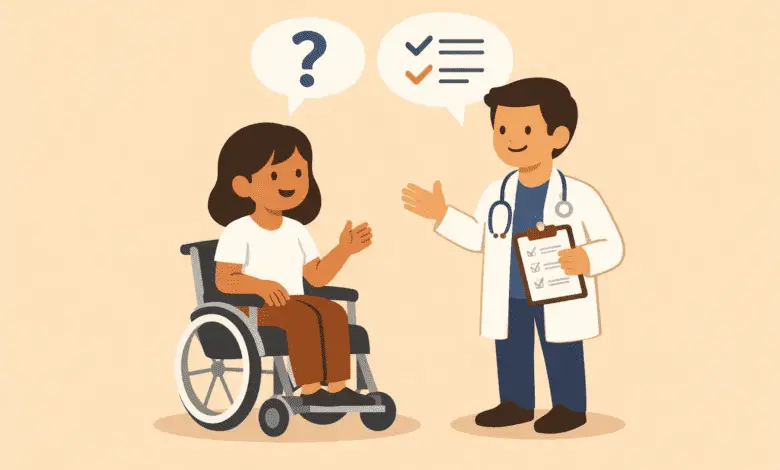
Inpatient Mental Health Treatment for Disabled People: What to Expect and What to Ask

Disclosure: Dr. Ali is Executive Clinical Director at We Level Up California and provides medical review support for the Washington State facility.
For many disabled people, the idea of inpatient mental health treatment brings up a very specific fear: not the treatment itself, but whether the service will actually work for them. Will staff understand their medication? Will routines be rigid? Will access needs be treated as a nuisance? Will disability be used to dismiss what they say?
This guide is for people trying to make a difficult decision with limited trustworthy information. It looks at what inpatient care is, where disabled people often face barriers, what rights exist in the UK and USA, and what questions are worth asking before agreeing to admission.
Inpatient mental health treatment for disabled people: key insights
| Key insight | Why it matters |
|---|---|
| Disabled people face higher mental health risks | Barriers such as pain, isolation, discrimination, and inaccessible support can increase the need for effective care |
| Access barriers affect whether people seek treatment | Fear of losing control or not being understood can delay help |
| Reasonable adjustments are a legal requirement | Both UK and US services have legal duties to adapt access and care processes |
| Experiences vary widely between centres | Policies on paper do not always match day-to-day ward reality |
| Asking the right questions improves outcomes | Clarity before admission reduces the risk of inaccessible or unsuitable care |
What is inpatient mental health treatment?
Inpatient mental health treatment is a structured form of support where someone stays in a hospital or residential treatment setting while receiving therapy, medication management, and monitoring. For some people it provides a level of safety and intensity that outpatient care cannot offer.
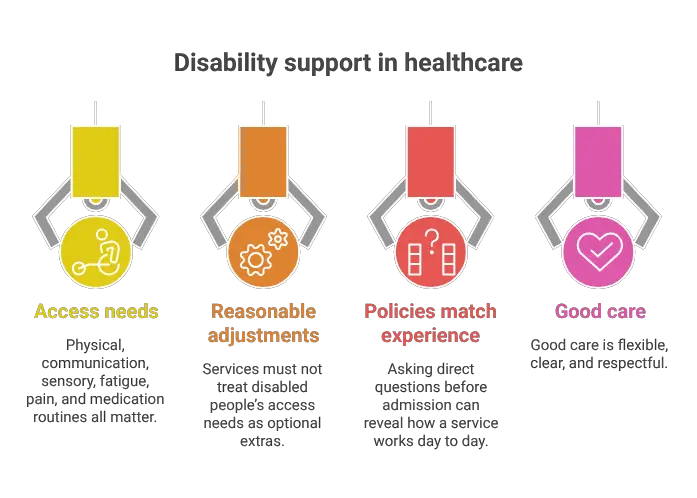
For disabled people, though, the experience depends heavily on whether the service removes barriers. That means more than physical access. It includes communication, flexibility, sensory environment, medication processes, and whether staff understand how disability and mental health interact.
Why many disabled people hesitate to seek inpatient treatment
Disabled people are more likely to experience mental health difficulties, but access to support is still uneven. One issue that repeatedly comes up is diagnostic overshadowing – where professionals assume distress is simply part of someone’s disability rather than a separate mental health issue that deserves proper treatment.
There are also practical fears: medication being changed without proper review, routines that do not allow for fatigue or pain, inaccessible bathrooms, no quiet space, or staff treating reasonable adjustments like special favours. These are real concerns shaped by people’s documented experiences.
What the law says in the UK and USA
In the UK, healthcare providers must make reasonable adjustments under the Equality Act 2010. The Royal College of Psychiatrists explains that reasonable adjustments can include changes to communication, environment, timing, and processes so disabled people can access care fairly.
In England, NHS England has also published national standards for mental health inpatient services, stating that care should be trauma informed, autism informed, culturally competent, and shaped by lived experience. Those standards apply across all NHS-funded mental health inpatient settings.
In the USA, psychiatric and inpatient mental health facilities are also covered by disability law. The ADA.gov disability rights guide explains that the Americans with Disabilities Act is one of the core laws protecting disabled people from discrimination in public life, including access to services.
A real inpatient experience: one person’s account
First-hand accounts can sometimes tell you more than official descriptions. In June 2025, a Reddit user posted an unsolicited review of their inpatient stay at We Level Up Washington on the r/mentalhealth subreddit. You can read the post here: Honest inpatient facility review: We Level Up WA. This is one person’s perspective, not a representative sample, but some of the details they highlighted are especially relevant for disabled and neurodivergent readers.
- Group sessions were described as flexible, with stepping out accepted when needed.
- Staff were described as responsive when concerns were raised.
- The reviewer mentioned therapy around medication, relapse prevention, family dynamics, and trust-building.
- The main criticism was privacy during night checks.
Reading reviews and first-hand experiences shared on forums, Reddit threads, and community groups can help you build a more honest picture of any service provider you are considering – including how they actually handle accessibility and disability-related needs day to day, rather than just what their website says.
Comparing inpatient service models
Disabled readers often need to weigh not just care quality, but affordability, waiting time, and who controls the route into treatment.
- NHS inpatient care (UK): care is NHS-funded, but access may depend on local crisis thresholds and bed availability. NHS England’s inpatient standards apply across NHS-funded services.
- Private inpatient care (UK): may offer faster access, but cost can be a major barrier and mental health cover in private insurance varies.
- Residential/private treatment (USA): often depends on insurance approval, benefit limits, network restrictions, or self-pay capacity, which can make access financially difficult.
This matters because disabled people are often expected to work through these systems as if cost, energy, time, and admin burden are not difficult issues to also cope with.
Questions disabled people should ask before admission
Physical access
- Is the environment step-free throughout?
- Are bathrooms accessible and usable independently?
- What support is available for mobility, fatigue, or pain?
Medication and health needs
- Who reviews existing medication on arrival?
- How are long-term conditions monitored?
- Can medication be adjusted during your stay?
Flexibility and sensory needs
- Are group sessions optional or adaptable?
- Are there quiet or low-stimulation spaces?
- Can routines be adjusted if needed?
Communication and support
- Can information be provided in accessible formats?
- Can carers or family be involved in planning?
- What happens if you raise a concern?
Discharge and ongoing support
- What does discharge planning involve?
- How are community services linked in?
- What support continues after leaving?
Red flags to watch for in inpatient care
- Staff dismiss access needs as secondary or inconvenient.
- Medication processes are vague or inconsistent.
- Rigid routines are imposed with no flexibility for disability-related needs.
- There is no clear process for complaints or raising concerns.
- Family, carers, or advocates are excluded without good reason.
What good inpatient care looks like
NHS England’s culture of care standards say inpatient care should help people access therapeutic support, feel safe, and experience the least restrictive care possible. The standards also say lived experience should be valued in design, delivery, governance, and oversight.
Good care usually looks less glamorous than brochures suggest. It is clear communication, flexible approaches, staff who listen, practical support with physical and mental health together, and an environment that does not make disabled people fight for every adjustment.
The Broader Picture
This article includes clinically relevant review and links to trusted sources, but it still has a limitation: it does not fully solve the lived-experience gap. One Reddit account is useful, but it is not a substitute for broader disabled led and informed services.
If you have been through inpatient mental health treatment as a disabled person, sharing what worked and what did not helps build a clearer picture for others making the same decision.
Further Reading and Useful References:
- Mind (UK): Going to hospital for mental health treatment
- ADA.gov: Guide to disability rights laws
- NHS England: Culture of care standards
- Care Quality Commission (CQC)
Frequently asked questions
What is inpatient mental health treatment?
Inpatient mental health treatment is care provided in a hospital or residential setting where someone stays on site while receiving therapy, medication support, and monitoring.
Why can inpatient mental health treatment be difficult for disabled people?
Barriers can include inaccessible environments, rigid routines, poor communication, lack of sensory support, and staff not understanding how disability and mental health interact.
Do mental health services have to make reasonable adjustments?
Yes. In the UK, healthcare providers must make reasonable adjustments under the Equality Act 2010. In the USA, disability rights laws such as the ADA protect access to services and freedom from discrimination.
What should disabled people ask before agreeing to admission?
It helps to ask about physical access, medication reviews, sensory needs, communication formats, complaint processes, family or carer involvement, and discharge planning.
What are red flags in inpatient mental health care?
Warning signs include staff dismissing access needs, vague medication processes, inflexible routines, poor complaint systems, and excluding carers or advocates without a clear reason.
What does good inpatient care look like for disabled people?
Good care includes clear communication, practical adjustments, flexible routines, staff who listen, and support that takes physical and mental health needs seriously together.
