When you care for a disabled child, partner or family member, your calendar can fill up quickly. Hospital appointments, therapy, school meetings, prescriptions, reviews and the practical work around them all take time.
That can make a carer’s own healthcare easier to postpone. A dental check-up gets moved. A repeat prescription is left until later. A shoulder that has hurt after years of lifting and assisting someone is tolerated for another month because somebody else’s appointment cannot be changed.
Inflexible appointment systems, limited replacement care, work commitments, transport, cost and the amount of administration involved in caring can all make it harder for carers to look after their own health.
Duncan Edwards, Editor, Disability Horizons and long-term family carer:
“I often use the aircraft oxygen-mask analogy: put your own mask on before helping your child. I care for my wife every day, including during the night, and previously cared for my son in the same way until he reached adulthood, so that principle has always mattered to me.”
Hospital appointments for them come first, and I have built my working life around caring. Since my marriage I have not worked conventional nine-to-five hours. Leaving home for a few days means arranging a live-in carer.
I still try to attend my own important appointments. I book them around caring where possible. Routine appointments, including the dentist, sometimes get delayed or cancelled when something more urgent happens.
But I don’t believe carers should automatically put themselves last. Looking after your own health is part of caring for somebody else.”
Why Carers May Delay Their Own Health Appointments
One appointment can take much longer than the time shown on the letter. There may be travel, parking, waiting, discussions with clinicians, collecting medication and dealing with what happens afterwards.
For some families, that sits alongside school meetings, work, supporting siblings and arranging care at home. When something has to move, a carer’s routine appointment can be the easiest thing to sacrifice.
There is a kind of repeated triage involved. A hospital appointment for the person you care for arrives with a date, time, clinic and reference number. A carer’s aching back, overdue dental check-up or intention to make a GP appointment may have none of those things. The fixed appointment stays in the calendar while the less urgent task moves down the list again.
Carers can become extremely good at this kind of prioritising. The problem comes when their own health remains in the low-urgency column for months or years.
This does not mean every carer puts themselves last. It means caring responsibilities and inflexible systems can leave very little spare capacity when something unexpected happens.
Health Problems Carers Can Find Themselves Postponing
The things that slip can appear fairly ordinary: an overdue dental appointment, a repeat prescription that needs sorting out, a back that has been painful since last winter or a shoulder affected by years of lifting and physical assistance.
Physical strain can be particularly relevant for people providing hands-on care. Moving equipment, helping with transfers or providing physical support repeatedly can take a toll, especially where suitable equipment, adaptations or outside assistance are limited.
Routine healthcare may be easier to postpone, but new, changing or worsening symptoms should not simply be placed at the bottom of the list. Some health concerns need prompt clinical advice, examination or tests.
Carers already have crowded weeks, so expecting them to find more time through better organisation misses many of the barriers they face. Healthcare and support need to recognise the practical realities of caring.
Carer’s Assessments: What Support Can You Ask For?
If caring is affecting your own health or making everyday life harder to manage, you can ask your local council for a carer’s assessment.
In England, a carer’s assessment is free and is separate from the needs assessment of the person you care for, although the two can be carried out together. It should consider how caring affects areas including your physical and mental health, work, free time and relationships.
Depending on your assessed needs, support might include someone taking over caring so you can have a break, help with transport, gardening or housework, training or access to local support services. If you qualify for help, the council should work with you on a support plan.
For current information about the process and how to request an assessment, see the NHS guide to carer’s assessments.
Duncan Edwards, Editor, Disability Horizons:
“I had a carer’s assessment around 15 years ago, before the current Care Act framework was introduced. At the time, I found it rather like a tick-box exercise.
I was awarded a contribution of about £30 towards gardening help, but I then had to submit invoices. By the time I took into account the assessment itself and the administration afterwards, I didn’t feel that the small amount of support justified the time involved.
That was my experience around 15 years ago, so I wouldn’t assume somebody having an assessment today will have the same experience. I also wouldn’t use it as a reason not to ask for one.
What it taught me is that support for carers needs to reduce pressure rather than give somebody who is already short of time another administrative job.”
That distinction matters. Current Care Act guidance says care and support planning should be person-centred and that the process of agreeing a personal budget should be timely and proportionate.
For somebody already managing appointments, forms and services for another person, the administrative cost of accessing support matters too. Support is more useful when it reduces that workload rather than creating another process to manage.
Ways Carers Can Make Healthcare Easier to Access
There is no single approach that works for every carer, and some barriers cannot be solved by individual organisation. A few practical steps can, however, reduce some of the friction.
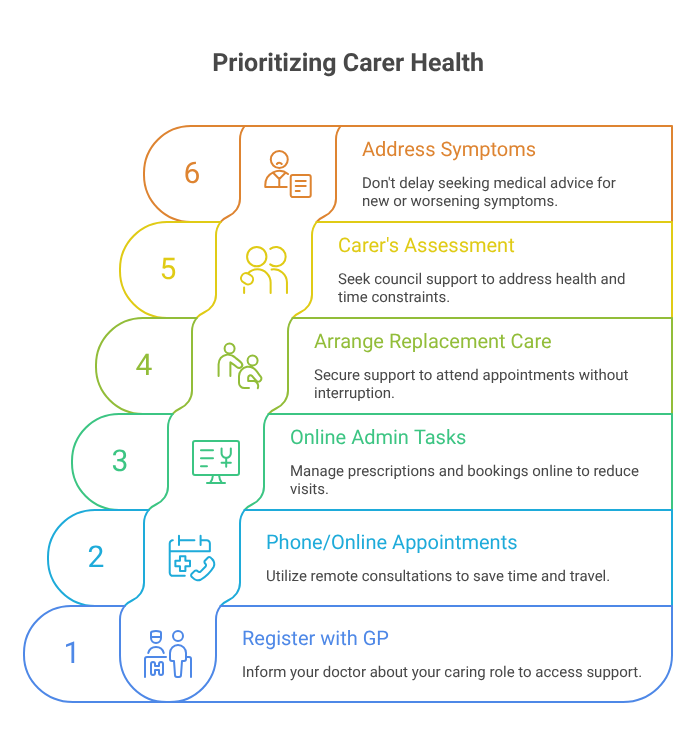
- Register with your GP practice as a carer. Letting your practice know about your caring responsibilities can help staff understand your circumstances and identify support or arrangements that may be available to carers.
Duncan Edwards, Editor, Disability Horizons:
“Registering as a carer with my GP has been genuinely useful. It means the practice knows about my caring responsibilities and can take them into account when I need healthcare myself.
One practical benefit has been vaccinations. I have been offered free flu vaccinations as a carer, and during earlier stages of the COVID-19 vaccination programme I was also included when unpaid carers were part of the eligible groups.
The rules can change from year to year, so it is worth checking current eligibility rather than assuming previous arrangements still apply.”
For the 2026/27 flu programme in England, the NHS says the free flu vaccine is available to people who are the main carer for an older or disabled person, or who receive Carer’s Allowance. See the NHS flu vaccine guidance for current eligibility and booking information.
COVID-19 vaccination eligibility is now narrower than it was earlier in the pandemic. Being an unpaid carer by itself does not currently qualify someone for the 2026 programme, although a carer may still be eligible for another reason, such as age or being immunosuppressed.
- Ask about telephone or remote appointments where appropriate. Some issues can be discussed without travelling to the surgery, while others need an in-person examination.
- Separate small administrative jobs from appointments. Repeat-prescription requests, booking appointments and some routine queries may be possible online or by telephone rather than requiring a visit.
- Ask for replacement care where possible. Family, friends or paid support may sometimes make it possible to attend an appointment without having to rush back immediately.
- Keep relevant school staff informed. If you are a parent carer, a SENCO or another member of staff who understands what is happening at home may be able to offer flexibility around meetings. A missed meeting does not necessarily mean a parent is disengaged; sometimes another caring or health responsibility has taken priority.
- Do not assume every health problem can wait. If something is new, changing, worsening or worrying you, seek appropriate medical advice rather than waiting indefinitely for a quieter week.
These steps will not remove wider problems such as shortages of replacement care, inaccessible services, appointment availability or the cost of taking time away from work. They are ways of reducing some of the administrative load rather than placing responsibility for those barriers on carers.
Separate Healthcare Admin From Health Problems That Need Examining
One way to make a long health to-do list feel more manageable is to separate administrative tasks from health concerns that need clinical assessment.
Administrative and routine tasks might include requesting a repeat prescription, booking an appointment, checking a referral or asking whether a routine issue can be discussed remotely. Many of these can now be started online or by telephone, depending on the service.
Clinical concerns may need a different approach. Persistent pain, new symptoms, changes to an existing condition or anything causing concern may require examination, tests or a face-to-face appointment.
The distinction is not for the carer to make as a medical judgement. If you are unsure whether something needs to be examined, ask an appropriate healthcare professional.
When Remote Healthcare May Be Useful
For some non-urgent health concerns that are suitable for remote assessment, written, telephone or online consultations can reduce the time needed away from caring.
NHS services may provide remote options, depending on the issue and local service. Private services are another option for people who choose to use them. For example, Anytime Doctor offers online consultations reviewed by UK-registered clinicians, which may be useful for some carers who find attending appointments during normal working hours difficult.
Private healthcare involves a cost and will not be affordable or appropriate for every household. It is worth checking what telephone, online and flexible appointment options are available through your GP and NHS services as well.
Remote healthcare also has limits. Some symptoms and conditions need an examination, tests or face-to-face assessment, and the appropriate route will depend on the individual health concern.
When looking after myself helped everyone
“I learned this myself when I eventually got diagnosed with sleep aponea. I started using a CPAP machine at night. Improving my own sleep and breathing benefited the whole family.
I was less exhausted and much more able to work and care during the day. Sometimes putting your own oxygen mask on first really does help everyone around you.”
— Duncan Edwards, Editor, Disability Horizons
Looking After Your Health Is Part of Caring
Carers should not be expected to solve inaccessible healthcare systems by becoming better at squeezing themselves into the gaps.
Flexible appointments, reliable replacement care, accessible services and recognition of caring responsibilities can make it easier for carers to look after their health without taking support away from the person they care for.
School staff, healthcare professionals, social care services, employers, friends and family can play a part too. Sometimes something as simple as recognising why a parent has missed a meeting, or offering an appointment in a different way, removes one more obstacle.
For me, the lesson has been practical. Keeping my own health stable helps me continue caring, working and supporting my family.
Sometimes that means protecting an important appointment. Sometimes it means dealing with a small healthcare task online rather than allowing it to sit on a list for months. Sometimes it means arranging for somebody else to step in.
Carers need realistic opportunities to look after their own health. Flexible healthcare, reliable support and accessible services can help carers stay well while continuing to support the people they care for.
Carers and Healthcare FAQs
Can I register as a carer with my GP?
Yes. If you provide unpaid care for a disabled, older or ill family member, friend or partner, you can tell your GP practice about your caring responsibilities. This can help the practice understand your circumstances and tell you about support or arrangements that may be available to carers.
Can carers get a free flu vaccination?
For the 2026/27 flu programme in England, the NHS says the free flu vaccine is available to people who are the main carer for an older or disabled person, or who receive Carer’s Allowance. Eligibility can change, so check current NHS guidance before booking.
What is a carer’s assessment?
A carer’s assessment looks at how caring affects your life, including your physical and mental health, work, relationships and free time. In England, you can ask your local council for an assessment, and it is separate from the needs assessment of the person you care for.
Can a carer’s assessment help me attend health appointments?
It may identify support that makes caring responsibilities easier to manage. Depending on your assessed needs, this could include help that gives you a break from caring, transport support, practical help at home, training or access to local services.
Can carers ask for telephone or online GP appointments?
You can ask whether a telephone, online or other remote appointment is suitable. Some health concerns can be dealt with remotely, but others need an examination, tests or a face-to-face appointment. Your GP practice or another healthcare professional can advise you about the appropriate type of appointment.
What should I do if caring is making it difficult to look after my own health?
Tell your GP practice about your caring responsibilities and ask your local council about a carer’s assessment if caring is affecting your health or everyday life. New, changing or worsening symptoms should not be postponed simply because you are caring for somebody else. Ask an appropriate healthcare professional for advice if you are unsure what care you need.

