
Home Care or a Nursing Facility After Locked-In Syndrome: How US Families Can Decide

Choosing between home care and a nursing or rehabilitation facility after locked-in syndrome depends on the disabled person’s wishes, clinical needs, accessible housing, funding and available care hours. This guide explains the main US care settings, likely costs, Medicare and Medicaid rules, home access issues and questions to ask before discharge.
Locked-In Syndrome Home Care: Key Takeaways for Families
| Question | Key point |
|---|---|
| Can someone with locked-in syndrome live at home? | Yes, in some circumstances. The person’s clinical needs, communication, housing access, equipment, funding and available care support all need to be considered. |
| Should the person be involved in the decision? | Yes. Communication support should be established as early as possible so the person can express preferences and take part in decisions about where and how they live. |
| Does Medicare pay for 24-hour home care? | No. Medicare home health benefits cover eligible part-time or intermittent care rather than continuous care at home. |
| Can Medicaid pay for home care? | Medicaid Home and Community-Based Services programmes can fund home support for eligible people, but services and waiting lists vary by state. |
| Is a nursing facility always permanent? | No. Some people use hospital, rehabilitation or nursing care while housing adaptations, equipment, funding and home support are arranged. |
What Does Locked-In Syndrome Mean for Daily Care?
Locked-in syndrome usually follows damage to the brainstem. A person may have very limited voluntary movement while remaining conscious and able to think, understand and communicate. Vertical eye movements and blinking are often preserved in the classical form of locked-in syndrome. StatPearls explains the clinical features of locked-in syndrome.
The level of daily support varies considerably from one person to another. Locked-in syndrome does not automatically mean that somebody uses a ventilator, feeding tube or the same care routine as another person with the condition.
Depending on the person’s individual needs, support may include:
- tracheostomy or ventilator care where respiratory support is needed
- PEG feeding, hydration and site care where tube feeding is used
- regular repositioning and pressure care
- bowel and bladder support
- passive movement, positioning and support with muscle stiffness
- personal care and transfers
- access to communication technology
Some people need continuous supervision or skilled nursing because of respiratory, airway or other clinical needs. Others may have different levels of support. The discharge team should set out exactly what care is required, who can provide it and what training is needed.
Set Up Reliable Communication Before Placement Decisions
| Communication may start with a single blink and develop from there.
In a Cleveland Clinic locked-in syndrome case, clinicians first established one-blink/two-blink yes-or-no answers. The patient progressed to spelling words letter by letter and later used long and short blinks for Morse code. Read the Cleveland Clinic case profile. |
A person with locked-in syndrome should be directly involved in decisions about where they live wherever reliable communication can be established.
This can begin with something as simple as an agreed blink or eye-movement system for yes and no. Some people later use alphabet boards, switches or eye-gaze communication technology. The classical form of locked-in syndrome often preserves vertical eye movement, which can provide an early way to communicate. Cleveland Clinic has further information about locked-in syndrome and communication.
Families and professionals should not assume that a lack of speech means a lack of understanding or preference.
Can Someone With Locked-In Syndrome Live at Home?
Home can be possible for some people with locked-in syndrome, but the right time for discharge will depend on the individual circumstances.
Several factors usually shape the decision:
- the person’s wishes and preferred living arrangement
- airway, respiratory and other clinical needs
- the accessibility of the home
- space for a wheelchair, hoist, bed and other equipment
- the number of funded nursing or care hours available
- family or unpaid support, where this is freely available
- backup arrangements if a paid or unpaid caregiver is unavailable
- local rehabilitation, therapy and community services
Housing can become a major barrier even when somebody is medically ready to leave hospital or rehabilitation.
A large power wheelchair, for example, may not fit through narrow doorways or around tight internal corners. Steps at the entrance can prevent access entirely. There may also be insufficient room for transfers, a hoist or the medical equipment a person uses.
Renters can face different barriers from homeowners because structural changes may need permission. Some households will not have the money for major alterations, and some homes cannot be made accessible enough regardless of budget.
Ask the discharge or rehabilitation team for a home access assessment as early as possible. This can help identify what needs changing and whether another housing option should also be considered.
Mark Gisborne, whose family cared for his father Stan at home for seven years after he developed locked-in syndrome. Read the Gisborne family’s story. |
Charlotte’s Experience of Returning Home
Charlotte was 32 when a brainstem stroke resulted in locked-in syndrome. She spent two years unable to live in her own home because the building was inaccessible to her.
Changes including improved entrance access, wider doorways and alterations to the internal layout eventually made it possible for her to return.
Her experience shows how the built environment can determine whether home is a realistic option, even when the person wants to live there.
Watch Charlotte Comes Home from Greater Middlesex & Morris Habitat for Humanity
US Care Settings After Locked-In Syndrome
The most suitable setting may change over time. Someone might need hospital-level respiratory support first, intensive rehabilitation later and home support after that.
| Setting | Typical role | Support | Rehabilitation |
|---|---|---|---|
| LTACH | Long-term acute medical needs, including some people needing ventilator weaning | Hospital-level care with respiratory services | Usually based on what the person can tolerate |
| IRF | Intensive rehabilitation after stroke or neurological injury | Rehabilitation doctors, nurses and therapy teams | Higher-intensity rehabilitation for people able to take part |
| SNF | Skilled nursing and lower-intensity rehabilitation | Nursing support shared across residents | Usually lower intensity than an IRF |
| Home | Community living once the required support can be provided safely | May include private-duty nursing, personal assistance and unpaid family support | Depends on insurance, Medicaid and local services |
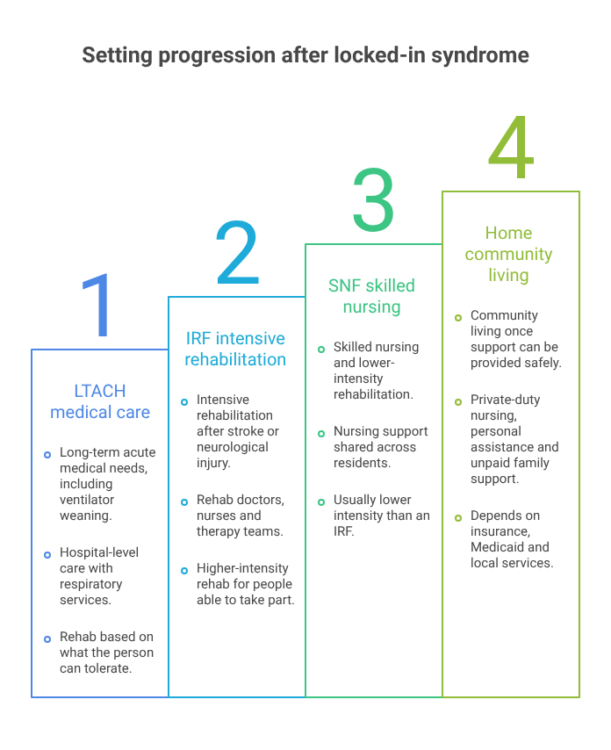
A US study of stroke rehabilitation found greater improvements in mobility and self-care among patients discharged to inpatient rehabilitation facilities than among those discharged to skilled nursing facilities. That does not mean an IRF is suitable for every person. Eligibility depends on clinical circumstances and the person’s ability to take part in an intensive rehabilitation programme. The study is available in JAMA Network Open.
Questions to Ask a Locked-In Syndrome Rehabilitation Provider
When comparing providers, information about what rehabilitation for locked-in syndrome can be a useful starting point, but ask each service exactly what it offers in practice, including AAC support, respiratory care and involvement in rehabilitation goals.
- Does the team have experience supporting people who communicate through eye movement or AAC?
- Is speech and language therapy available?
- Can therapy sessions be adjusted around fatigue and medical needs?
- Can the service support a tracheostomy or ventilator if required?
- How does the disabled person take part in setting rehabilitation goals?
- What happens if the person needs longer-term support?
How Much Does Locked-In Syndrome Home Care Cost in the US?
Home care costs depend heavily on the level of support required and where the person lives. National averages for ordinary home care can be misleading when somebody needs skilled nursing or respiratory support.
| Care or service | Indicative US cost |
|---|---|
| Home health aide | $27 to $35 per hour, based on published private-market estimates |
| Private-duty RN or LPN | Published private-market estimates can range from about $50 to $130 per hour |
| Nursing home semi-private room | Published national estimates are around $9,500 per month, although location makes a large difference |
| LTACH ventilator care | One published US study reported costs of roughly $2,200 per day |
These figures should be treated as broad reference points rather than quotes. Rates vary by state, provider, staffing needs and insurance arrangements.
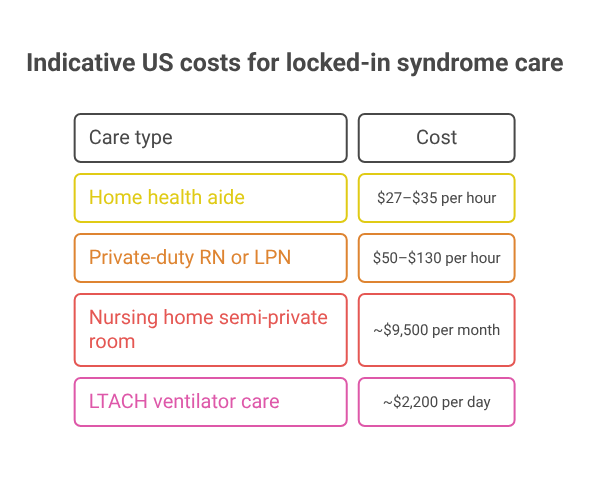
The difference becomes clear when care is required around the clock. Licensed nursing at $60 an hour for 24 hours a day would cost more than $43,000 over a 30-day month before insurance or public funding is taken into account.
This does not mean families should be expected to provide unpaid care to make home affordable. The amount of unpaid support a household can or wants to provide is an individual decision, and a home plan needs to be realistic over the long term.
Home Adaptation and Equipment Costs
Possible one-off costs may include:
- ramps or step-free entrance work
- widening doorways
- changes to bathrooms or bedrooms
- a ceiling or mobile hoist
- a suitable bed
- backup electrical power where essential equipment depends on electricity
- communication equipment such as an eye-gaze device
Costs can run from relatively small changes to major building work. Before paying privately, ask the hospital social worker, Medicaid programme, local housing service, disability organisation or relevant charitable fund what financial help may be available.
If the person rents their home, ask about permission for adaptations and whether accessible rehousing may be an option if the property cannot meet their needs.
Does Medicare Pay for Locked-In Syndrome Care?
Medicare can pay for eligible rehabilitation, skilled nursing and home health services, but it does not provide a general benefit for permanent 24-hour personal or nursing care at home.
Medicare Skilled Nursing Facility Coverage
Traditional Medicare skilled nursing facility coverage normally requires a qualifying inpatient hospital stay of at least three consecutive days. Medicare explains its skilled nursing facility rules here.
For eligible stays, Medicare can cover up to 100 days in a benefit period, subject to its medical and coverage requirements.
For 2026, days 1 to 20 have no daily coinsurance under Part A. Days 21 to 100 have a daily coinsurance of $217. CMS publishes the 2026 Medicare deductible and coinsurance figures.
Medicare Home Health Does Not Mean 24-Hour Home Care
Medicare home health benefits cover eligible part-time or intermittent skilled care. They do not generally pay for 24-hour-a-day care at home, meals delivered to the home, homemaker services that are not related to the care plan, or personal care when that is the only support required.
Medicare’s home health guide explains what is and is not covered.
Can Medicaid Pay for Home Care After Locked-In Syndrome?
Medicaid is often a more important route to long-term home support for eligible people.
Home and Community-Based Services, including 1915(c) waivers, allow states to provide community-based services to some people who would otherwise meet the criteria for institutional care. Medicaid provides information about 1915(c) waivers.
The exact services, financial rules and eligibility criteria vary by state. Some programmes are aimed at particular groups, such as people with acquired or traumatic brain injuries.
Ask About Medicaid Waiting Lists Early
Access is not always immediate. KFF has reported large HCBS waiting lists across the US, although the number of people waiting and the way lists operate vary substantially between states. KFF provides further information on state HCBS waiting lists.
Ask a hospital social worker, state Medicaid office or benefits adviser about relevant programmes as early as possible. Starting early can reduce delays, but families should not be told that every barrier can be solved within a fixed timescale.
Can Family Members Be Paid as Caregivers?
Some Medicaid self-directed programmes allow certain family members to be paid for providing approved care. Rules differ by state and programme, including which relatives can be paid and what training or employment requirements apply.
KFF explains how some Medicaid programmes support family caregivers.
Can Someone Move From a Facility to Home Later?
Choosing a rehabilitation or nursing setting at discharge does not necessarily mean that the person will stay there permanently.
Possible arrangements include:
- using inpatient rehabilitation while home adaptations and equipment are arranged
- moving home once funded care hours and trained staff are in place
- using short respite stays where suitable services are available
- trying home visits before a permanent move
- reviewing a discharge decision when circumstances change
Mark Gisborne, reflecting on seven years of family care for his father Stan after locked-in syndrome. |
A trial visit can reveal practical problems that are hard to spot on paper, such as whether a wheelchair can turn in the hallway, whether transfers can be completed safely or whether essential equipment can be positioned correctly.
When Might a Nursing Facility Be Needed After Locked-In Syndrome?
A nursing or specialist facility may be necessary at a particular stage if the person’s clinical or support requirements cannot currently be met at home.
This may include situations where:
- airway or respiratory needs require skilled support that is not available at home
- the person has complex wounds or other medical needs requiring specialist care
- the home cannot accommodate essential equipment or wheelchair access
- sufficient funded care hours cannot be arranged
- there is no reliable backup when a caregiver or nurse is unavailable
The decision should not be treated as a judgement on the disabled person or their family. Housing shortages, gaps in community care, funding rules and shortages of trained staff can all restrict the choices available.
If home is the person’s preferred option but is considered unsafe, ask the discharge team to explain the specific barrier. Ask what support might address it, what cannot currently be provided and when the decision can be reviewed.
What Should Families Do in the First 7, 30 and 90 Days?
Within 7 Days
- Ask for the written discharge or care plan and proposed equipment list.
- Make sure the person’s preferred communication method is documented.
- Request speech and language therapy or AAC assessment if needed.
- Ask for a home access assessment if home is being considered.
- Contact the state Medicaid office or benefits adviser about relevant HCBS programmes.
- Ask exactly what level of nursing or supervision the clinical team believes is required.
Within 30 Days
- Get quotes for any home access work that is genuinely possible and affordable.
- If the person rents, check what adaptations are permitted and ask about accessible housing alternatives.
- Visit relevant rehabilitation or nursing services where possible.
- Ask about staffing, respiratory support, AAC knowledge and therapy provision.
- Complete any agreed training for care tasks that relatives freely choose to provide.
- Check what grants, Medicaid funding, housing support or charitable funding may be available.
Within 90 Days
- Create a written care rota if home support is planned.
- Identify what happens if a scheduled nurse, personal assistant or family caregiver is unavailable.
- Confirm equipment approvals and funded care hours in writing.
- Review whether the current setting still reflects the disabled person’s wishes.
- Ask about respite options before a crisis develops.
Frequently Asked Questions About Locked-In Syndrome Home Care
Will Medicare Pay for 24-Hour Care at Home?
No. Medicare home health benefits cover eligible part-time or intermittent skilled care rather than continuous 24-hour home care. Medicaid or other state programmes may provide additional support for eligible people.
Can Family Members Be Paid to Care for Someone With Locked-In Syndrome?
Sometimes. Some Medicaid self-directed programmes allow family caregivers to be paid, but the rules vary by state and programme.
What If the Hospital Says Going Home Is Unsafe?
Ask what specifically makes the proposed home discharge unsafe. The barrier might involve respiratory support, accessible housing, equipment, available care hours or another clinical need. Ask what support could change the situation and whether the decision can be reviewed later.
Should Someone With Locked-In Syndrome Take Part in the Discharge Decision?
Yes, wherever communication can be established. A person who cannot speak may still fully understand what is happening and communicate through blinking, eye movements, AAC or another agreed method. Their wishes should remain central throughout discharge planning.
How Long Can Someone Live With Locked-In Syndrome?
Outcomes vary considerably. The early period can carry serious medical risks, including respiratory complications, but some people with locked-in syndrome live for many years. Long-term experience differs from person to person, so population statistics cannot predict an individual outcome.
Author Profile: Duncan Edwards runs Disability Horizons and has many years of experience working in the disability and independent living sector. He also runs a daily living aids business and has met and spoken with thousands of disabled people and families through hospitals, disability shows and customers. His perspective is also informed by family experience as the husband of a disabled woman and father of a disabled child.
