
Cri du Chat Syndrome in Babies: Early Signs, Diagnosis and Support for Families
An unusual high-pitched cry, feeding difficulties or low muscle tone can be early signs of Cri du Chat syndrome in newborn babies. However, not every child has the characteristic cry, and symptoms vary considerably. Understanding the signs, how genetic testing works and where to find support can help families get answers and appropriate care.
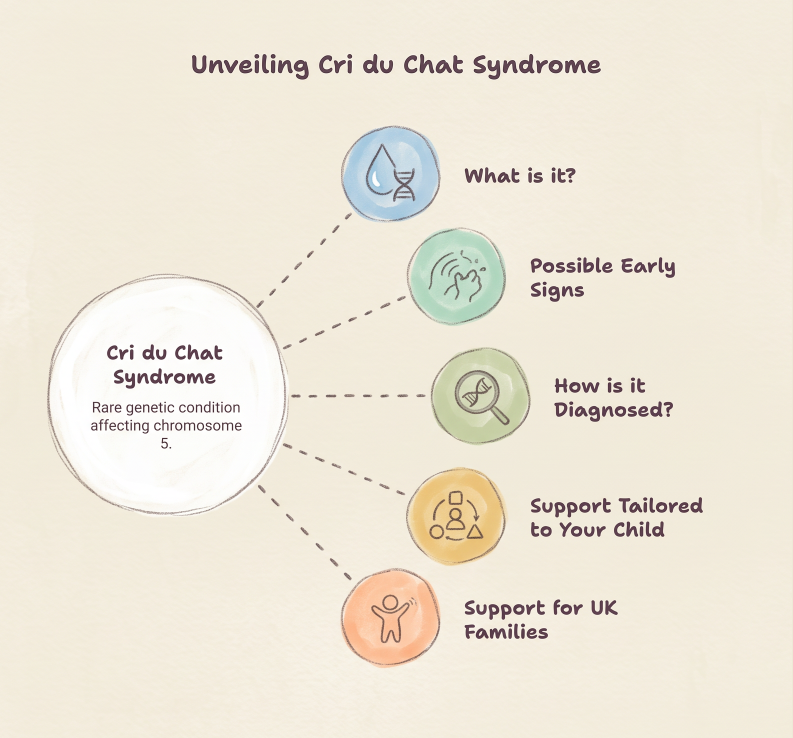
Cri du Chat Syndrome in Babies: Key Takeaways for Parents
| What parents need to know | Key information |
|---|---|
| What is Cri du Chat syndrome? | A rare genetic condition caused by missing material from the short arm of chromosome 5, also called 5p deletion syndrome. |
| What are the early signs? | A high-pitched cry, low muscle tone, feeding difficulties, slow growth and certain physical features. |
| Does every baby have the cat-like cry? | No. Some babies never have the characteristic cry, and its absence can delay diagnosis. |
| How is it diagnosed? | Genetic testing, often chromosomal microarray analysis, can identify missing chromosome material. |
| When should parents seek urgent help? | New breathing difficulties, changes in alertness, poor feeding or a concerning cry should not automatically be attributed to Cri du Chat syndrome. Some signs require emergency care. |
| What support is available? | Feeding assessments, physiotherapy, speech and language therapy, developmental support and specialist medical care, depending on the child’s needs. |
| Where can UK families get help? | Unique and Contact provide information and support for families of disabled children. |
What Is Cri du Chat Syndrome?
Cri du Chat syndrome is a rare genetic condition caused by a deletion of material from the short arm of chromosome 5. It is sometimes called 5p- syndrome or chromosome 5p deletion syndrome.
The name comes from the French expression meaning “cry of the cat”, referring to the distinctive high-pitched cry heard in some babies.
The amount of chromosome material missing can vary, as can its effects. Some children have significant communication and developmental support needs, while others develop skills and abilities that may not have been expected at diagnosis.
The condition usually occurs because of a new genetic change. In a smaller number of cases, it is associated with a chromosome rearrangement inherited from a parent.
Most importantly, a new chromosome deletion is not caused by anything parents did or failed to do during pregnancy.
A genetic diagnosis provides useful medical information, but it cannot tell parents everything about their child’s personality, relationships, interests or future.
What Are the Early Signs of Cri du Chat Syndrome in Newborns?
Several features may lead a paediatrician to investigate Cri du Chat syndrome. Some are noticeable shortly after birth, while others become clearer as a baby grows.
These signs can also occur with other conditions. Doctors consider the overall pattern rather than relying on one symptom to make a diagnosis.
A high-pitched or cat-like cry
The characteristic cry is one of the best-known features of Cri du Chat syndrome.
It may sound unusually high-pitched, weak or similar to a kitten’s mewing. Differences affecting the voice box and nervous system are thought to contribute to this sound.
However, not every baby with Cri du Chat syndrome has a cat-like cry.
Rare chromosome disorder charity Unique reports that the absence of this feature has delayed diagnosis for some children.
The cry can also become less distinctive with age.
An unusual cry on its own does not confirm a genetic condition. Babies may cry differently because of discomfort, illness or other medical reasons.
If parents notice a persistent unusual cry, particularly alongside feeding difficulties or low muscle tone, they should discuss it with their baby’s healthcare team.
A high-pitched cry can also be a warning sign of serious illness. Do not assume an unusual cry is caused by Cri du Chat syndrome, particularly if your baby is feeding poorly, difficult to wake or otherwise unwell. Follow the urgent-care advice below.
Low muscle tone and movement differences
Low muscle tone, known as hypotonia, is another recognised feature.
A baby with hypotonia may feel unusually floppy when picked up or need additional support around their head and neck.
Parents might also notice that their baby moves their arms and legs less vigorously or becomes tired during feeding.
When assessing low muscle tone, doctors also check a baby’s reflexes, strength, breathing and alertness. These observations help them understand whether the difficulties may be related to Cri du Chat syndrome or another medical condition.
For example, a baby who seems unusually floppy may need assessment for several possible causes. Low muscle tone alone does not indicate a particular genetic condition.
Sudden floppiness, particularly when a baby is difficult to wake or not responding normally, is different from an ongoing muscle-tone difference and needs emergency medical attention.
Low muscle tone can affect physical development, including learning to sit, crawl and walk. However, the pace of development varies considerably between children.
Physiotherapists and occupational therapists can support movement, positioning and access to everyday activities as a child grows.
Early support should respond to the child’s individual needs rather than focus solely on reaching developmental milestones at a particular age.
Facial features and physical differences
Some newborns with Cri du Chat syndrome have physical features that clinicians recognise as possible signs of the condition.
These may include:
- A small jaw
- A rounded face
- Widely spaced eyes
- Low-set ears
- A high-arched palate
- A smaller head circumference, known as microcephaly
These features vary between children and may become less noticeable with age.
No particular facial appearance confirms Cri du Chat syndrome. Genetic testing is needed to establish a diagnosis.
Some children also have differences affecting their heart, kidneys or skeleton. Healthcare professionals may recommend further checks based on their medical findings.
Feeding and Swallowing Difficulties in Babies With Cri du Chat Syndrome
Feeding can be one of the earliest practical concerns for families.
Some babies have difficulty latching, sucking or coordinating swallowing. Others become tired before finishing a feed or have reflux.
These difficulties may be associated with low muscle tone, differences in oral structures or difficulties coordinating the muscles used for feeding.
Why feeding difficulties need specialist attention
Feeding problems are not always simply a matter of weak sucking.
Some babies have dysphagia, the medical term for swallowing difficulties. Milk or saliva may enter the airway instead of being swallowed safely. This is called aspiration.
Signs that need medical advice include repeated coughing or choking during feeds, wet or gurgly breathing around feeding, becoming unusually sleepy or distressed during feeds, or changes in breathing or colour. These signs do not confirm aspiration, but they should be assessed.
If your baby has difficulty breathing, pauses in breathing, blue or grey lips or tongue, or is difficult to wake, call 999 rather than waiting for a feeding assessment.
Some children also experience oral aversion, where having things in or around the mouth causes distress.
A speech and language therapist with specialist training in infant feeding and swallowing can assess feeding safety. A paediatrician, dietitian and other members of the baby’s care team may also be involved.
Do not add thickener or change the concentration or consistency of feeds to manage swallowing difficulties unless your baby’s clinical team has advised you how to do so. Changes to positioning, pacing or feeding equipment should be tailored to your baby’s assessed needs.
Monitoring growth and weight gain
Feeding difficulties can affect weight gain, particularly during the newborn period.
Healthcare professionals will usually monitor weight, length and head circumference.
Some children with Cri du Chat syndrome have a different growth pattern from other children. Condition-specific growth charts have been published, although these are based on older research and should be interpreted alongside current clinical assessments.
Parents can ask whether these charts would be useful when discussing their child’s growth.
Condition-specific growth charts may help clinicians interpret growth, but poor feeding or inadequate weight gain still needs assessment. A smaller expected growth pattern should not be used to dismiss a new concern.
Keeping a short feeding record may help clinicians understand what is happening. Useful details include how long feeds take, coughing or choking, vomiting, tiredness and the number of wet nappies.
However, parents should not wait to complete a feeding diary before seeking medical help if their baby is feeding poorly or appears unwell.
When to get urgent medical help
Feeding difficulties can occur with Cri du Chat syndrome, but a baby who becomes unwell needs assessment for other causes too. Do not assume that a new feeding problem, unusual cry or change in alertness is simply part of the condition.
Call 999 if your baby:
- Has difficulty breathing, is breathing very fast, makes grunting noises or pulls in their tummy or chest when breathing.
- Has pauses in breathing.
- Has blue or grey lips, tongue or skin.
- Is difficult to wake, cannot stay awake or is unresponsive.
- Becomes floppy and is not responding normally.
On brown or black skin, colour changes may be easier to see on the palms of the hands, soles of the feet, lips or inside the mouth.
The NHS also advises calling 999 or going to A&E for a baby under three months with a temperature of 38°C or higher, a baby with a temperature below 36°C, a weak, high-pitched or continuous cry, or no urine for 12 hours.
If your newborn is not feeding normally, repeatedly coughs or chokes during feeds, has fewer wet nappies than usual or has a sunken soft spot on their head, seek urgent medical advice. Contact your baby’s clinical team or GP urgently, or call NHS 111 if you cannot get prompt advice or are unsure what to do. Do not wait for a routine appointment or for 12 hours to pass before asking for help.
If you think your baby is seriously unwell, get immediate medical help. Do not delay to record symptoms or make a video.
Read the NHS advice on when to get urgent medical help for babies and children.
How Is Cri du Chat Syndrome Diagnosed?
A paediatrician may suspect Cri du Chat syndrome after examining a baby and reviewing their feeding, growth, muscle tone and other physical features.
Because many early signs overlap with other conditions, the doctor may also assess reflexes, muscle strength, breathing, alertness and general health.
These examinations help identify any immediate medical concerns and decide which investigations are appropriate.
However, the diagnosis of Cri du Chat syndrome must be confirmed through genetic testing.
Which genetic tests identify Cri du Chat syndrome?
Chromosomal microarray analysis is commonly used to identify missing chromosome material.
This test can show which section of chromosome 5 is missing and provide information about the size of the deletion.
Other chromosome tests may also be used, depending on the findings and the family’s circumstances.
A clinical geneticist or genetic counsellor can explain the results in plain English and discuss whether testing the parents would be helpful.
The size and location of a deletion may provide some information about associated features, but genetic results cannot reliably predict every aspect of a child’s development.
What happens after a confirmed diagnosis?
A diagnosis may lead to referrals for further assessments and support.
Depending on the child’s needs, these could include feeding and swallowing assessments, hearing and vision checks, physiotherapy, occupational therapy and speech and language therapy.
Some babies may need heart or kidney investigations.
Families should be told who is coordinating these appointments and how to contact the team if new concerns arise.
What Support Can Help Children With Cri du Chat Syndrome Communicate?
Communication is an important part of life with Cri du Chat syndrome, but it is sometimes discussed only in terms of delayed speech.
That misses the different ways children and adults express themselves.
Some people use spoken words, signs, gestures, facial expressions, pictures or electronic communication devices. Many use a combination of methods.
A person may also understand considerably more than they can express through speech.
Arizona’s experience of using signs, speech and technology
In an August 2026 interview with the YouTube channel Special Books by Special Kids, teenager Arizona’s mother describes how she communicates using signs, individual spoken words and a Tobii Dynavox communication device.
Arizona’s experience shows how different communication methods can work together.
Her story is one family’s experience, rather than a guide to how every child with Cri du Chat will communicate.
Watch the Special Books by Special Kids interview with Arizona about living with Cri du Chat syndrome.
Why allowing time to respond matters
Communication may also involve sounds, movements and facial expressions that are familiar to family members.
In another Special Books by Special Kids interview, Jason, an adult with Cri du Chat syndrome, is described by his family as communicating through sounds and body cues.
His family also explains that he sometimes needs more time to respond.
The interviewer describes how, before filming began, Jason returned a kissing sound about 30 seconds after the other person had walked away.
It is a small but useful example of why an immediate lack of response should not automatically be interpreted as a lack of understanding or interest.
Watch the interview with Jason about communication and everyday life with Cri du Chat syndrome.
For families, the important question is how to make communication accessible.
This may mean introducing signing, picture-based systems or communication technology, while ensuring that other people give the child time and opportunities to express themselves.
Speech and language therapists can help families identify suitable approaches as communication develops.
What Medical Checks and Early Support Might Be Needed?
Children with Cri du Chat syndrome have different health and developmental needs.
Some need regular specialist appointments, while others require less medical input.
A care plan should be based on the individual child rather than assumptions about the diagnosis.
Hearing and vision assessments
Hearing is particularly important to consider when supporting communication.
A normal newborn hearing screening result does not rule out hearing difficulties developing later.
Unique reports that glue ear and other hearing problems can occur in children with Cri du Chat syndrome.
Regular hearing checks may be appropriate, particularly when there are concerns about communication or responses to sound.
Vision assessments can also identify difficulties that may affect learning, movement and access to activities.
Physiotherapy, occupational therapy and early years support
Physiotherapy may help with positioning, movement and physical development.
Occupational therapy can support everyday activities, equipment needs and access to play and learning.
As children grow, early years services and education providers may need to make adjustments so that they can participate fully.
For some children, this may involve communication aids, accessible learning materials, additional time or adapted activities.
The aim is to identify and remove barriers that prevent children from taking part, rather than expect every child to learn or communicate in the same way.
Questions to Ask After a Cri du Chat Syndrome Diagnosis
Receiving a genetic diagnosis often means meeting several different healthcare professionals.
Parents may find it useful to take a written list of questions to appointments, particularly when there is a lot of unfamiliar information to take in.
- Which genetic test is being used, and what will the results tell us?
- Can someone explain the chromosome findings in plain English?
- Does our baby need a specialist feeding and swallowing assessment?
- How will growth and weight gain be monitored?
- Should hearing, eyesight, heart or kidney checks be arranged?
- Would physiotherapy or occupational therapy be helpful?
- Can speech and language therapy support feeding now and communication later?
- Who is responsible for coordinating appointments and referrals?
- Where can we contact other families with experience of Cri du Chat syndrome?
What records should parents bring to medical appointments?
When several symptoms are being investigated, a few written observations can help the medical team understand what parents have noticed at home.
Useful information to bring includes:
- Hospital discharge summaries and any previous medical reports.
- Feeding notes showing how often the baby feeds, how long feeds take and any difficulties with sucking or swallowing.
- Recent weight, length and head circumference measurements, if available.
- Notes about unusual movements, muscle tone, alertness or changes in behaviour.
- Videos of unusual cries, sounds or movements, if these have been safely recorded.
- A short list of questions or concerns that parents want to discuss.
Videos can be particularly helpful when a sound or movement happens occasionally and may not occur during the appointment.
However, parents should never delay medical attention or put their baby at risk to obtain a recording.
There is no need to produce a detailed diary covering every moment of the day. A few clear observations, including when something happened and how often, can be enough to start a useful conversation.
Parents can also ask for copies of reports and written explanations of medical findings.
Disabled parents and other family members should be able to request accessible appointment locations, communication adjustments or information in formats they can use.
If appointments involve several services, asking for a named contact can make it easier to raise questions between visits.
A parent’s perspective: when you know something isn’t quite right
My son Joe has Dravet syndrome, which is a different condition from Cri du Chat syndrome. But I recognise some of the uncertainty that parents can experience when their newborn has unexplained difficulties.
One of the first things we noticed was that Joe couldn’t latch on for breastfeeding. We were very keen to breastfeed and tried hard to make it work. We had help from a very experienced midwife and a neighbour who knew a lot about breastfeeding, but despite everyone’s efforts, we couldn’t manage it.
Looking back, I came to believe that Joe’s difficulties with feeding were connected to his neurological condition, although we didn’t know that at the time.
Healthcare professionals did listen to us, and we were often reassured that things would improve. But there were also moments when very little was said. Sometimes you could see the uncertainty in people’s expressions. I had the feeling that they suspected something wasn’t right but didn’t want to worry us or take away from the happiness of having a new baby.
The hardest part was not knowing. We wanted everything to be okay, but as time went on, we noticed more differences between Joe and other children. There were things he wasn’t doing, and we couldn’t quite understand why.
Looking back, I wish someone had been a little more open with us about the possibility that something was wrong, even if they couldn’t tell us what it was. The uncertainty was difficult enough without feeling that some concerns were being left unspoken. – Duncan Edwards, Disability Horizons Editor
Where Can UK Families Find Cri du Chat Syndrome Support?
Connecting with families who have direct experience of Cri du Chat syndrome can provide information that is difficult to find in medical descriptions alone.
Parents may want to know about feeding equipment, communication methods, education, daily routines or what other families have found useful.
Unique: rare chromosome disorder support
Unique is a UK charity supporting families affected by rare chromosome and gene disorders.
Its detailed Cri du Chat information guide includes medical information, development, communication and experiences shared by families.
Following a vote on 24 April 2025, the Cri du Chat Support Group announced in May 2025 that it was winding up and transferring its services to Unique.
The announcement stated that Unique would maintain a website for the Cri du Chat community and the existing Facebook group.
Families looking for the former UK support group should be aware of this change, as some older directory listings may still refer to it as a separate organisation.
Unique contact details:
- Email: help@rarechromo.org
- Telephone: 01883 723356
Contact: support for families with disabled children
Contact provides information and practical advice for families with disabled children across the UK.
Its resources cover issues such as financial support, education, services and family life.
Contact’s freephone helpline is 0808 808 3555.
Families may also find useful advice through local parent carer forums and disability organisations.
What Does a Cri du Chat Syndrome Diagnosis Mean for a Child’s Future?
One of the hardest questions for healthcare professionals to answer is exactly how a newborn with Cri du Chat syndrome will develop.
Children can have very different levels of support need, communication preferences and health concerns.
Some will need substantial assistance throughout their lives. Others develop greater independence in particular activities as they grow.
Development also depends on access to appropriate healthcare, communication support, education and opportunities to participate.
Medical information can help families plan, but it should not become a fixed prediction about what a child will or will not do.
Accounts from people such as Arizona and Jason offer perspectives that are rarely captured in a newborn symptom checklist.
They show different ways of communicating and interacting with family and the wider world.
Practical next steps for parents
If you are concerned about possible Cri du Chat syndrome symptoms, the most useful first step is to speak to your baby’s GP, paediatrician or healthcare team.
Before the appointment, prepare a brief record of the symptoms you have noticed. Include feeding difficulties, unusual sounds or movements, changes in muscle tone and any concerns about weight gain.
Bring any available hospital records and growth measurements, together with safely recorded videos if they may help explain your concerns.
You do not need to identify the cause yourself. The medical team can assess your baby’s health, consider other possible explanations and arrange genetic testing when appropriate.
If your baby appears acutely unwell, seek urgent help rather than waiting for an appointment or collecting records.
If a diagnosis is confirmed, ask who will coordinate referrals and what support is available for your child’s individual needs.
A child is much more than the features listed in a medical report. Access to suitable healthcare, communication support and inclusive services can make a practical difference to family life from the earliest years.
Frequently Asked Questions About Cri du Chat Syndrome
Can a baby have Cri du Chat syndrome without a cat-like cry?
Yes. Not every baby with Cri du Chat syndrome has the characteristic high-pitched cry. Some children have other signs, including feeding difficulties, low muscle tone or differences in growth. Genetic testing is needed to confirm the condition.
What genetic test confirms Cri du Chat syndrome?
Chromosomal microarray analysis is commonly used to identify missing material from chromosome 5. Other genetic tests may also be appropriate. A clinical geneticist can explain which test is being used and what the results mean.
Can speech and language therapists help babies with feeding difficulties?
Yes. Speech and language therapists with specialist training in infant feeding and swallowing can assess difficulties with sucking, swallowing and feeding safety. They can also support communication as children grow.
Does Cri du Chat syndrome always cause severe learning disabilities?
No. Learning and developmental differences vary considerably. Many people with Cri du Chat syndrome have learning disabilities and need ongoing support, but the extent of those needs cannot be predicted from a newborn’s symptoms alone.
What should parents bring to a Cri du Chat assessment?
Useful items include hospital records, feeding notes, growth measurements and a short list of concerns. Videos of unusual cries or movements may also help if they have been safely recorded. Parents do not need to collect every item before requesting medical advice.
Where can UK families find support for Cri du Chat syndrome?
Unique provides specialist information about rare chromosome conditions and helps connect families. Contact offers advice for families with disabled children, including information about services, education and financial support.
Can children with Cri du Chat syndrome use communication devices?
Yes. Some children and adults use electronic communication devices, picture systems, signing, gestures or spoken words. The most suitable approach depends on the person’s communication preferences and access needs.
Medical information disclaimer
This article is provided for general information and is not a substitute for medical advice, diagnosis or treatment. It has not been clinically reviewed. Information about Cri du Chat syndrome is based on published medical resources and specialist organisations, but every child’s health and support needs are different.
If you have concerns about your baby’s health, feeding or development, speak to a qualified healthcare professional. If your baby shows signs of serious illness, seek urgent medical help. Do not delay seeking medical advice because of information in this article.

