
Can You Take Time Off Work for Stress? Disability Rights and Compensation Explained

If workplace stress is affecting your health, you may be able to take sick leave, request changes to your working conditions or seek compensation in certain circumstances. For disabled workers, understanding these rights is particularly important when inaccessible workplaces, discrimination or refused adjustments are contributing to the problem.
You might be lying awake before another shift, worrying about a manager who keeps changing your hours without warning. Perhaps you’ve repeatedly asked for accessible software, only to be told there’s no budget. Or your workload has increased despite explaining how it affects an existing health condition.
Your rights depend on where you work, your employment status and the reasons for your absence. Sick leave, disability-related adjustments and compensation are separate legal matters, although they can overlap.
Key Takeaways About Stress Leave and Disability Rights
- Can I take time off for stress? You may be entitled to sickness absence if stress affects your health or ability to work. Local rules determine the requirements.
- Will I be paid during stress leave? Payment depends on sick-pay rules, your employment status and your employer’s policies.
- Can disabled workers request adjustments? Disability laws in many countries require employers to make reasonable changes where the relevant legal duty applies.
- Can I claim compensation? Possibly, where a workplace injury, discrimination or another recognised legal claim meets the relevant tests.
- What evidence should I keep? Medical information, workplace correspondence, adjustment requests and a record of relevant events can help.
- Where can I get support? Employment advice services, trade unions, disability organisations and workplace injury authorities may provide free guidance.
Can You Take Sick Leave for Work-Related Stress?
Yes, you may be able to take sick leave when work-related stress affects your health or makes you unable to work.
However, “stress leave” is not necessarily a separate legal entitlement. In many countries, it falls under ordinary sickness absence rules.
Stress can affect people in different ways. Some experience disrupted sleep, difficulty concentrating, anxiety or physical symptoms. Others find that existing health conditions become harder to manage.
You do not necessarily need a formal psychiatric diagnosis before reporting that you are unwell. Medical certification requirements depend on local law and the length of your absence.
What should you do if you need time off for stress?
Start with four practical steps:
- Report your absence. Follow your employer’s sickness-reporting procedure where possible.
- Check your sick-pay entitlement. Look at your contract, staff handbook and relevant employment rules.
- Seek healthcare advice. A healthcare professional can assess your symptoms and provide supporting documentation where required.
- Keep a record. Note when you reported your absence, who you contacted and any response.
For example, imagine an employee whose shifts change every week. The unpredictable hours interfere with their treatment appointments and eventually contribute to severe anxiety.
They may need sickness absence immediately. Whether the employer has also breached disability law or whether compensation is available requires a separate assessment.
Casual, temporary, agency and self-employed workers may have different entitlements.
For a UK starting point, see Acas guidance on supporting mental health at work.
How Can Inaccessible Workplaces Increase Stress for Disabled Employees?
For disabled workers, workplace stress can be closely connected to barriers that employers have the power to address.
Consider an employee who uses screen-reading software. Their employer introduces a new computer system that does not work with their assistive technology.
They repeatedly ask for an accessible alternative. Instead, they are expected to complete the same tasks using a system they cannot access independently.
Missed deadlines follow. Their manager questions their performance, even though the underlying problem is the inaccessible software.
This is a hypothetical example, but it illustrates how workplace decisions can create unnecessary pressure.
How inflexible working conditions affected Katie
Katie, who lives with several long-term conditions including CFS/ME, described to disability charity Scope how limited breaks and inflexible call schedules made a full-time legal call-centre job unsustainable.
Working full-time contributed to flare-ups of her conditions, and she needed several weeks to recover after leaving the role.
In later employment, support from an adviser helped her discuss flexible hours, ergonomic equipment and tasks that could worsen her symptoms.
Her experience shows why working patterns and the organisation of everyday tasks can make such a difference. Read Katie’s account on Scope.
Other workplace barriers that can contribute to stress include:
- Unpredictable working hours that interfere with treatment, personal assistance or established routines.
- Inaccessible information, meetings or communication systems.
- Delays or refusals when reasonable adjustments are requested.
- Noisy environments or lighting that creates sensory barriers.
- Bullying, harassment or disbelief about disability-related needs.
- Pressure to disclose more medical information than is necessary.
- Attendance policies that do not properly consider disability-related absence.
These experiences can affect someone’s health, confidence and ability to remain in employment.

Why employers must address the causes of workplace stress
Offering wellbeing sessions or suggesting relaxation techniques may help some employees. However, those measures do not resolve inaccessible systems, excessive workloads or discriminatory treatment.
In Great Britain, the Health and Safety Executive states that employers have a legal duty to assess risks from work-related stress and act on their findings.
The HSE guidance on workplace stress risk assessments explains how employers should identify and address these risks.
For disabled workers, meaningful support often begins with listening to what is creating the difficulty and making practical changes.
What Reasonable Adjustments Can Help With Stress at Work?
Reasonable adjustments are changes that reduce barriers experienced by disabled employees.
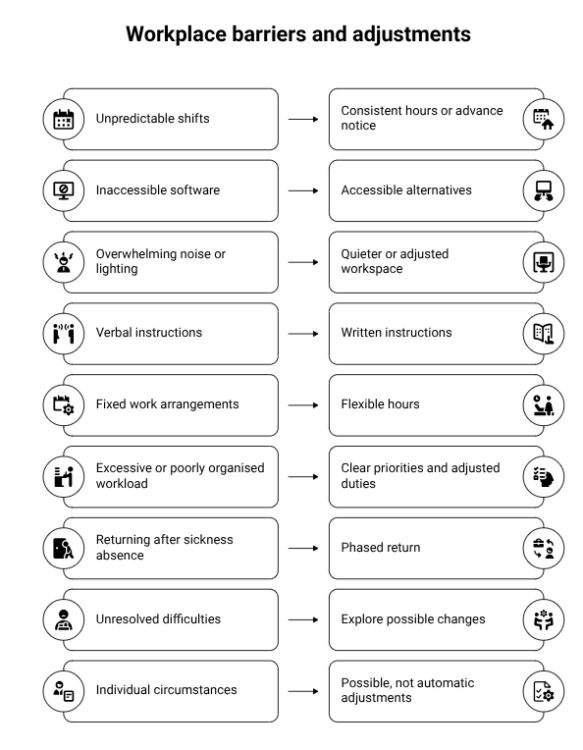
In Great Britain, the Equality Act 2010 requires employers to make reasonable adjustments where the legal duty applies. Other countries have similar protections, although the terminology and requirements differ.
The most useful adjustment depends on the individual and the workplace barrier involved.
- Unpredictable shift patterns: consistent working hours or advance notice of changes.
- Difficulty processing verbal instructions: written instructions in an accessible format.
- Overwhelming sensory environment: a quieter workspace, lighting changes or remote working.
- Regular treatment appointments: flexible hours or changes to working arrangements.
- Excessive or poorly organised workload: clear priorities, revised duties or adjusted deadlines.
- Difficulties returning after sickness absence: a phased return, agreed duties and regular reviews.
These are examples rather than automatic entitlements. What an employer must provide depends on the circumstances and relevant law.
Read the GOV.UK guidance on reasonable adjustments for disabled workers for an overview of the duty in Great Britain.
How to request reasonable adjustments
It often helps to explain the specific barrier and the change you are asking for.
For example:
“The current shift pattern makes it difficult for me to attend regular treatment appointments and manage my health. Could we discuss keeping my working hours consistent and reviewing the arrangement after four weeks?”
You can make the request in writing so there is a clear record.
An employer may need relevant medical or occupational health information to understand the request. That does not mean every detail of your medical history is automatically necessary.
What Simone’s experience shows about asking for changes
Simone, who developed repetitive strain injury affecting her arms and hands, has written for Scope about the importance of being able to discuss different ways of working.
Computer-based work had become painful for her, even after equipment adjustments, and she eventually changed career.
In a more supportive workplace, she felt comfortable raising difficulties with her manager and exploring changes to how tasks were completed.
Her experience shows that adjustments do not always have to mean reducing working hours. Sometimes changing the way a task is carried out can make a job more manageable.
Read Simone’s story on Scope.
What if you do not know which adjustments you need?
Knowing which adjustments to request is not always straightforward. You may recognise that a particular task or working arrangement is causing difficulties without knowing what would resolve them.
A UK study of 181 autistic adults’ experiences of workplace adjustments, published in PLOS ONE in 2022, found that some participants struggled to identify suitable changes, explain their needs or get agreed adjustments implemented.
The researchers highlighted the importance of employers taking a more active role rather than leaving disabled workers to identify every possible solution themselves.
The study was not representative of all autistic workers, but the experiences reported raise an important practical issue.
You do not have to arrive at an adjustment meeting with every solution already worked out.
If you are unsure what would help, explain which tasks or situations are difficult and ask your employer to explore possible adjustments with you.
For example, instead of requesting a particular piece of equipment immediately, you might explain that the current software is difficult to use and ask for an accessibility assessment or alternative ways of completing the task.
Acas also provides guidance on workplace adjustments for neurodivergent employees, including the importance of discussing and reviewing possible changes.
If your employer refuses an adjustment, ask for the reasons and whether another effective solution can be considered.
Can You Claim Compensation for Workplace Stress?
You may be able to claim compensation for work-related stress in some circumstances, but taking sick leave does not automatically mean you have a legal claim.
Compensation usually requires a recognised legal basis, supported by relevant evidence.
Workers’ compensation for psychological injuries
Some countries operate workers’ compensation schemes covering psychological injuries connected to employment.
Eligibility may depend on the nature of the injury, its relationship to work, medical evidence and exclusions within the relevant scheme.
Disability discrimination claims
A separate claim may arise if an employer breaches disability discrimination law.
Examples could include unlawful disability-related harassment, discrimination or failure to make reasonable adjustments.
The available remedies depend on local legislation and the circumstances.
Other employment or personal injury claims
In some jurisdictions, workers may have additional legal routes where an employer’s conduct has caused harm or breached employment obligations.
These claims may involve different tests, procedures and deadlines.
What if workplace stress worsens an existing condition?
Having a pre-existing mental health condition does not necessarily rule out compensation.
Some legal systems recognise the aggravation of an existing condition where the required connection to employment is established.
For example, a worker with an existing anxiety condition might experience a significant deterioration after repeated workplace harassment.
Whether this qualifies for compensation depends on the applicable law, medical evidence and circumstances. It should never be assumed that an existing diagnosis either guarantees or prevents a successful claim.
How Do Stress Leave and Compensation Rights Differ by Country?
Stress-related absence and compensation rules vary considerably between countries.
The following information provides a starting point for workers in the UK, Australia, the United States and Canada.
United Kingdom: Sick Leave, Sick Pay and Disability Rights
In the UK, employees who are unable to work because of stress-related illness can generally use ordinary sickness absence procedures.
For the first seven calendar days of sickness absence, employees can normally self-certify. A fit note is generally required for longer absences.
Eligible employees may receive Statutory Sick Pay (SSP), while some employers offer additional contractual sick pay.
From 6 April 2026, SSP became payable from the first full day of sickness absence for eligible employees, and the previous minimum earnings threshold was removed.
For the 2026/27 tax year, the weekly SSP rate is the lower of £123.25 or 80% of average weekly earnings. The amount payable for a partial week depends on the employee’s qualifying days. Individual eligibility rules still apply.
These changes are particularly relevant to disabled workers with low or irregular earnings, although SSP may still provide considerably less income than their usual wages.
Check the current Statutory Sick Pay rules and rates on GOV.UK before relying on these figures.
In Great Britain, the Equality Act 2010 may protect employees whose mental health conditions meet the legal definition of disability. This generally involves a substantial, long-term adverse effect on normal day-to-day activities.
A formal diagnosis alone does not settle whether someone meets that definition.
Northern Ireland has separate disability discrimination legislation, although UK-wide SSP rules apply.
Workers can seek guidance from Acas, Citizens Advice or, in Northern Ireland, the Labour Relations Agency and relevant advice organisations.
Australia: Personal Leave and Psychological Injury Compensation
In Australia, eligible employees may be able to take paid personal or carer’s leave when illness or injury prevents them from working.
Entitlements depend on employment arrangements and applicable workplace rules. Casual employees generally do not receive paid sick leave under the National Employment Standards.
The Fair Work Ombudsman’s guidance on paid sick and carer’s leave explains the relevant entitlements.
Workers’ compensation is a separate matter, with schemes operating under state and territory legislation.
Claiming compensation for workplace stress in Queensland
Queensland provides a useful example of the distinction between taking leave and seeking compensation.
A worker may take personal leave because stress is affecting their health without making a workers’ compensation claim.
To qualify for workers’ compensation for a psychological injury, the worker must satisfy Queensland’s applicable legal requirements. These generally include a medically diagnosed psychological injury arising out of, or in the course of, employment, with employment being a significant contributing factor. The legislation also provides specific rules for certain other work-related circumstances.
Queensland law contains an exclusion for psychological injuries caused by reasonable management action taken in a reasonable way. This can involve performance reviews, disciplinary procedures or other management decisions. Whether the exclusion applies depends on the facts, and statutory exceptions may apply to certain eligible workers.
Having an existing mental health condition does not automatically prevent a claim. An aggravation of a pre-existing condition may qualify where the legal requirements are met.
For workers who need more detail about Queensland’s rules, Smith’s Lawyers has a guide to claiming workcover stress leave in QLD, including how psychological injury claims may be affected by the circumstances of an employer’s actions.
The guide can be read alongside WorkSafe Queensland’s official information about psychological injury claims, rather than treated as a guarantee of eligibility or compensation.
Workers should check medical certification requirements, reporting and claim deadlines, and review rights. These can affect whether a claim is accepted or payments are available.
United States: FMLA Leave and Disability Protections
In the United States, eligible employees may qualify for leave under the Family and Medical Leave Act (FMLA) when they have a serious health condition, including certain mental health conditions.
FMLA provides qualifying employees with job-protected leave, but the leave is generally unpaid unless paid leave is available and used under the applicable rules.
Eligibility depends on factors including employer coverage and the employee’s work history.
The Americans with Disabilities Act (ADA) may separately require reasonable accommodation for qualifying disabilities.
State laws can provide additional paid leave, workplace protections or workers’ compensation rights.
The Department of Labor’s fact sheet on mental health conditions and FMLA leave explains the federal leave rules.
Canada: Sick Leave and Workplace Accommodation
In Canada, employment rights depend on whether a worker falls under federal, provincial or territorial jurisdiction.
Sick-leave entitlements, payment arrangements and workplace injury compensation schemes are not identical across the country.
Human rights legislation may require employers to accommodate disabled workers, subject to applicable legal limits.
Workers should check the employment standards authority, human rights body and workers’ compensation organisation covering their workplace.
Federal public-service policies should not be assumed to apply to every Canadian employee.
What Evidence Should You Keep About Workplace Stress?
Keeping a record of workplace events can help you explain what has happened, whether you are requesting adjustments, reporting sickness absence or considering a legal claim.
Useful information may include:
- Dates and descriptions of incidents contributing to stress.
- Changes in symptoms and how they affect your ability to work.
- Relevant medical certificates and healthcare records.
- Emails about workloads, shift changes or workplace concerns.
- Requests for reasonable adjustments and employer responses.
- Sickness absence notifications.
- Notes of meetings, including any actions agreed.
- Relevant workplace policies or procedures you are entitled to access.
You do not need to create an elaborate evidence file. A simple timeline can be useful, particularly when several incidents have happened over a long period.
If writing is difficult, you could use voice notes to record your own recollections, an accessible digital document or support from a trusted person or advocate.
Store sensitive information securely and avoid removing confidential workplace material you are not entitled to keep.
Recording conversations without consent can raise legal and workplace issues, so check the rules before doing so.
Different claims require different evidence. A sickness certificate alone may be enough for some absence procedures but not for a compensation or discrimination claim.
How Can You Return to Work After Stress-Related Sick Leave?
Returning to work after stress-related absence can be difficult if the conditions that contributed to the absence remain unchanged.
For example, an employee who took leave after repeated problems with inaccessible communication may face the same difficulties if nothing has been addressed.
Before returning, it may help to discuss:
- Whether the original workplace barriers have been addressed.
- Any changes needed to working hours or duties.
- Whether a phased return would be appropriate.
- Workload expectations and communication arrangements.
- How agreed adjustments will be recorded.
- When the arrangements will be reviewed.
Occupational health professionals or treating clinicians may be able to provide advice about suitable duties and working arrangements.
A return-to-work plan should reflect the employee’s circumstances. Some people need longer-term adjustments, while others may not be able to return safely to the same working environment.
Employers also need to consider whether the workplace factors that contributed to the absence have been addressed. Returning someone to the same inaccessible or harmful conditions without reviewing them can leave the original problem unresolved.
Where Can You Get Free Advice About Stress Leave and Disability Rights?
You do not necessarily need to pay for legal advice to understand your initial options.
Several organisations provide free information or support.
United Kingdom
Acas offers impartial employment advice for workers and employers in Great Britain.
Citizens Advice can provide information about employment rights, discrimination and financial concerns.
In Northern Ireland, the Labour Relations Agency and Advice NI may be useful starting points.
Australia
The Fair Work Ombudsman provides information about workplace leave and employment entitlements.
Workers considering compensation should contact the relevant state or territory workers’ compensation authority.
Community legal centres and unions may also provide assistance.
United States
The Department of Labor provides information about federal leave rights, including FMLA.
The Equal Employment Opportunity Commission provides guidance on mental health conditions and workplace rights, including discrimination and reasonable accommodation.
State labour departments and legal aid organisations may provide additional support.
Canada
Employment standards offices, human rights commissions and workers’ compensation boards provide information within their jurisdictions.
Trade unions, disability advocates and community legal services may also be able to help.
Seek timely advice if your employer threatens dismissal, disputes a workplace injury or refuses an adjustment. Legal deadlines can be short, and an internal grievance does not necessarily extend them.
Frequently Asked Questions About Stress Leave and Disability Rights
Can I take time off work for stress without a diagnosis?
You may be able to take sickness absence without a formal mental health diagnosis. Medical certification requirements depend on local rules and the length of your absence. Compensation claims may require additional medical evidence.
Can my employer dismiss me for taking stress leave?
Taking legitimate sickness absence does not automatically protect you from dismissal in every situation. Employment law, absence procedures and disability discrimination protections all matter. Seek advice promptly if your job is at risk.
Is anxiety or depression considered a disability at work?
Anxiety or depression may qualify as a disability under employment equality law. In Great Britain, the Equality Act 2010 considers whether a condition has a substantial, long-term adverse effect on normal day-to-day activities.
Can I claim compensation if I already have a mental health condition?
Possibly. Some compensation schemes recognise a significant worsening of an existing condition caused by employment. Eligibility depends on the relevant law, medical evidence and circumstances.
What happens if my employer refuses reasonable adjustments?
Ask for the reasons in writing and whether another effective adjustment is possible. Keep records of your requests and responses. You can seek advice from a trade union, employment adviser or relevant equality organisation. Legal deadlines may continue while internal procedures are ongoing.
Editorial note: This article provides general information, not individual legal advice. Employment and compensation laws differ between jurisdictions and can change. Check current official guidance and seek advice relevant to your circumstances.
