Postgraduate Disability Leadership Courses for Disabled People and Carers

Plenty of disabled people and carers find themselves taking on leadership roles without originally setting out to do so.
Adam was working as an apprentice at the Met Office when he became its workplace carers’ network lead. His experience caring for his daughter Evie made him determined that other colleagues shouldn’t feel as isolated as he had. He describes his experience in his story for Carers UK.
Ruth joined Somerset Parent Carer Forum in September 2014 and became its chair the following year. Her experience as a parent carer became part of her work with local services and families, as described in the forum’s team biographies.
These are two different routes into leadership. Both show how caring experience and involvement in support networks can lead to responsibilities that extend beyond someone’s original role.
Then a job comes up with “policy” or “strategy” in the title, and the person specification asks for a qualification you don’t have.
Postgraduate study in disability leadership or policy can help close that gap. Getting onto a course may also take less formal education than you’d expect. But it’s worth checking the entry requirements, accessibility arrangements and funding before committing.
Postgraduate Disability Leadership Courses: Key Takeaways
| What to consider | What you need to know |
| Relevant experience | Some universities consider unpaid caring, advocacy and disability-related work as part of their entry requirements. |
| Course content | Programmes may cover governance, service design, advocacy and public policy. |
| Career prospects | A qualification may support applications for policy and leadership roles, but it doesn’t guarantee employment. |
| Overseas study | Check how the qualification relates to UK employment and whether the teaching arrangements suit you. |
| Accessibility | Ask about captions, screen-reader access, flexible attendance, deadlines and breaks in study. |
| Funding | Check fees, student finance eligibility and disability-related study support before enrolling. |
How Can Disability Advocacy Lead to Leadership Roles?
Organisations are under pressure to show that disabled people shaped their decisions from the start. Councils and NHS bodies talk about co-production. Charities appoint lived experience leads and recruit disabled trustees. The people best placed to do that work have often used the services themselves.
“Nothing about us without us” is an old line. James Charlton used it as the title of his 1998 book on disability rights, and campaigners were saying it well before then. The principle is increasingly reflected in roles focused on lived experience, participation and disability policy, although opportunities vary between organisations.
Those jobs can ask for things lived experience alone may not cover, such as how a council sets its adult social care budget or how a public consultation turns into a decision. A postgraduate course can teach that material and help people connect their existing knowledge with formal policy and leadership work.
The experience Adam and Ruth brought to their roles also matters here. Their stories show how people can develop leadership responsibilities through caring and community involvement. Universities may consider similar experience when assessing applications, although admission requirements differ.
What Do Postgraduate Disability Leadership Courses Cover?
Course content varies, but disability leadership programmes may cover running services that disabled people help design, and governance: who is accountable for what, and how a board checks that a service does what it promised.
Policy modules look at how governments decide what to fund. They may also cover how advocates try to change those decisions.
Entry can be more flexible than people assume. Some courses consider relevant work experience rather than requiring every applicant to have a first degree. Others may take caring or lived experience into account alongside paid roles.
Unpaid caring, volunteering on an access panel, running a user-led group or managing your own personal assistants may count at one university and not at another. Ask how each course defines “relevant experience” before you rule yourself out.
UK universities offer postgraduate study in disability studies and social policy. A postgraduate certificate is typically 60 UK credits, and some courses offer part-time or online study.
UK Postgraduate Courses in Disability Studies and Leadership
Several UK universities offer postgraduate courses covering disability rights, policy and inclusion.
For example, the University of Leeds offers an online Postgraduate Certificate in Disability Studies, Rights and Inclusion. It also offers a longer MSc covering disability policy, activism, human rights and social justice.
Liverpool Hope University offers an MA in Disability Studies, with particular attention to disability representation, culture and policy.
For people working in education, the University of Northampton offers a Postgraduate Certificate in SEN Co-ordination and Leadership of Inclusion. This focuses on developing inclusive services and leadership within educational settings.
These courses have different aims. Some focus on disability rights and public policy, while others prepare professionals for leadership in education.
Entry requirements also vary. Leeds considers relevant experience alongside academic qualifications. Northampton has a route for applicants with substantial professional experience, subject to further assessment.
These UK options are worth comparing with international programmes, particularly if you intend to work in British disability services or public policy.
In Australia, where the NDIS (National Disability Insurance Scheme) has changed how disability support is funded and run, the University of Canberra’s online disability courses provide examples of postgraduate study focused on disability leadership, strategy, policy and advocacy.
The university has advertised Graduate Certificates in Disability Leadership and Strategy and Disability Policy and Advocacy, with entry routes that may consider relevant professional experience. Check the current course titles, entry requirements and how unpaid experience is assessed before applying.
Can Unpaid Disability Advocacy Count Towards Postgraduate Entry?
If you’ve spent years dealing with social care assessments, organising personal assistants or representing disabled people on an NHS panel, you may have developed skills relevant to disability leadership study.
The difficulty can be explaining that experience in the language universities use.
Someone who has managed their own personal assistant team might describe experience with recruitment, budgeting, employment responsibilities and coordinating support.
A parent who has challenged inaccessible education provision might describe their knowledge of statutory processes, negotiations with public bodies and representing their family’s interests.
If you’ve served on a patient panel or helped run a user-led organisation, you may have experience of meetings, consultations, service planning or working with public bodies.
These are examples of how applicants could describe responsibilities they have genuinely held. They don’t guarantee admission.
Before applying, ask the admissions team whether unpaid experience is accepted, what evidence they need and whether you can discuss your background with someone before submitting an application.
What Jobs Can a Disability Leadership Qualification Lead To?
A postgraduate qualification may be relevant to roles in disability policy, advocacy, service design and organisational leadership.
Depending on the employer, these could include disability policy officer, co-production lead, accessibility adviser, charity programme manager or service improvement roles.
The work varies considerably. A policy officer might research proposed changes to social care, prepare consultation responses or advise colleagues on legislation. A co-production lead might organise accessible meetings and make sure disabled people’s recommendations influence service decisions.
Some employers value direct experience of disability advocacy or working with disabled communities. Others ask for particular qualifications, professional knowledge or previous management experience.
Look at current job adverts for the roles you’re interested in before choosing a course. Pay attention to the essential criteria and whether a postgraduate qualification would help you meet them.
If you already have substantial advocacy or leadership experience, you may be able to apply for some roles without further study.
Can You Study an Overseas Disability Leadership Course from the UK?
The NDIS gives eligible disabled people individual funding plans, so an Australian course draws on a system that works differently from UK social care.
Co-design and governance skills can be useful across different systems, but the policy modules may be built around Australian law and funding. If you plan to work in England, you’ll need to understand how the material relates to legislation such as the Care Act 2014.
It’s also worth checking whether an overseas qualification will meet the requirements of your intended employer or professional pathway. A postgraduate certificate isn’t necessarily treated in the same way as a master’s degree, and employers may have different expectations.
Ask prospective employers or relevant professional bodies before enrolling if the qualification is important for a particular role.
Then there’s the clock. Australia’s east coast is generally 9 to 11 hours ahead of the UK, depending on the time of year, so a 7pm seminar in Canberra lands between 8am and 10am in London. Check whether live sessions are compulsory or recordings are available.
Funding can be harder. In England, Disabled Students’ Allowance (DSA) may provide study-related support for eligible postgraduate students, but eligibility depends on the course and provider. Overseas courses will not normally qualify for the same support as eligible UK courses.
The Postgraduate Master’s Loan is intended for eligible master’s courses rather than standalone postgraduate certificates. An overseas online course may also fall outside the funding rules.
Check the latest eligibility guidance on GOV.UK or speak to Student Finance England before relying on either form of support.
Some employers fund leadership study. Ask yours before you pay.
Is a Postgraduate Disability Leadership Qualification Worth the Cost?
That depends on what you want to do with it.
If you’re already involved in disability advocacy and want to move into policy work, postgraduate study may help you understand legislation, governance and public funding in greater depth.
It could also help you explain your existing experience to employers who use formal qualifications as part of their recruitment criteria.
But course fees can be substantial, particularly if you’re paying privately. There may also be costs for books, technology or time away from paid work.
Before committing, compare the total fees with the opportunities you hope the qualification will create. Look at job adverts and ask whether the course is recognised or valued by the organisations you want to work for.
It’s worth considering other routes too. Volunteering as a charity trustee, taking part in paid advisory work, joining a user-led organisation or completing shorter professional training may help you develop relevant experience.
For some people, postgraduate study will be a useful investment. Others may find that their existing experience, supported by targeted training, is enough for the next role they want.
Questions to Ask Before Choosing a Disability Leadership Course
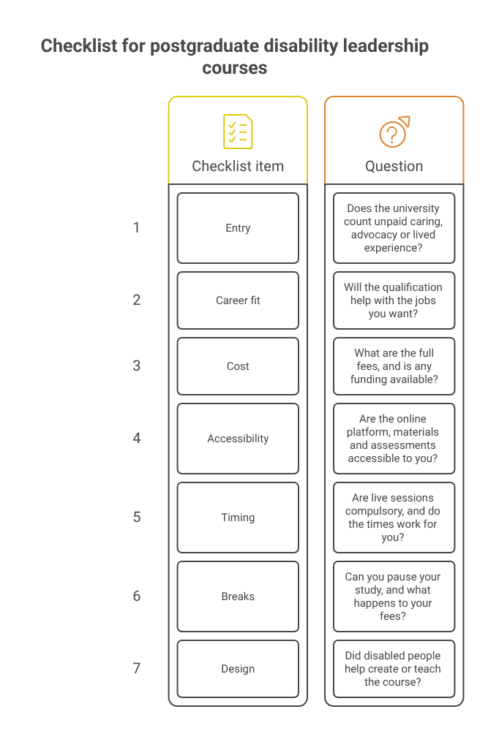
Start with entry requirements. Ask whether unpaid caring or lived experience counts, and get the answer in writing if it decides whether you apply.
Ask what adjustments exist for online study, such as extended deadlines or captioned recordings. If you use a screen reader or other assistive technology, check whether the learning platform and course materials are accessible.
Flexible attendance matters too. Find out whether seminars are recorded, whether participation must happen at set times and what happens if you need to miss a session.
Ask about interruptions to study. Some universities allow students to take an agreed break, but the rules on fees, deadlines and returning to the course can differ.
Check where the case studies come from. A course built entirely on another country’s system leaves more of the translation to you.
And ask whether disabled people helped design the course or teach on it.
Checklist before applying
- Does the university accept unpaid caring, advocacy or lived experience towards entry?
- Will the qualification be useful for the jobs or professional roles you’re interested in?
- What are the full course fees, and is any funding available?
- Are the online platform, teaching materials and assessments accessible to you?
- Are live sessions compulsory, and do the teaching times work for you?
- Can you take a break in study, and what happens to your fees if you do?
- Have disabled people been involved in developing or delivering the course?
Getting clear answers before applying can save time and help you compare courses on more than their advertised content.
Postgraduate Disability Leadership Courses: FAQs
Will a postgraduate certificate get me a policy job?
Not on its own. Hiring panels still look at what you’ve done: the groups you’ve run and the changes you’ve pushed for. A certificate can help you describe that experience in the terms organisations use.
It may strengthen an application where relevant postgraduate study is valued, but it won’t automatically meet a “degree or equivalent” requirement. That depends on the employer and the qualification level.
If you’re studying to qualify for a particular role, check the requirements with the employer first.
Can I study around caring or a fluctuating condition?
Part-time and online courses can offer more flexibility, but the arrangements vary. Some courses still require live attendance, fixed deadlines or regular group work.
Before you enrol, ask about attendance requirements, deadline extensions, study breaks and any fees you could still owe if your circumstances change.
Find out how long a break in study can last and what happens when you return. Chase a clear answer before you pay a deposit.
Do I need a degree to study disability leadership?
Some postgraduate courses accept applicants with relevant professional experience instead of a first degree. The requirements differ between universities, and not every course offers this route.
Experience of disability advocacy, caring, managing support arrangements or working with user-led organisations may be relevant. Ask the admissions team how they assess applications from people without traditional academic qualifications.
A postgraduate certificate may help turn years of advocacy, caring or service-user involvement into a recognised qualification. Before committing, check whether the course fits the work you want to do, whether its teaching is accessible to you and how you’ll cover the fees.
Your existing experience matters, with or without another qualification.
Can unpaid disability advocacy count towards postgraduate entry?
Some universities consider relevant professional or voluntary experience. This may include advocacy, caring, managing support arrangements or working with user-led organisations. Applicants should check each university’s requirements.
Do you need a degree to study disability leadership?
Not always. Some postgraduate programmes offer alternative entry routes for applicants with substantial relevant experience. Each university sets its own admission criteria.
Can you study disability leadership while working or caring?
Some courses offer part-time or online study. Check attendance requirements, recorded teaching, assessment deadlines and arrangements for taking a break.
Are overseas disability leadership qualifications useful in the UK?
They may develop relevant leadership and policy skills. However, course content can reflect another country’s legislation and services. Check whether the qualification suits your intended UK career.