6 Common Home Entrance Accessibility Problems for Disabled People
Door specialist recommends home adaptions to increase mobility.

Heavy doors, narrow garage entrances and raised thresholds can create unnecessary barriers for disabled people at home. Door specialist Karl Humphris from Eastern Garage Doors identifies six common accessibility problems and explains how changes to garage doors, front entrances, patio doors and garden gates could make everyday access easier.
Common Home Entrance Accessibility Problems and Solutions
| Accessibility problem | Possible solution |
|---|---|
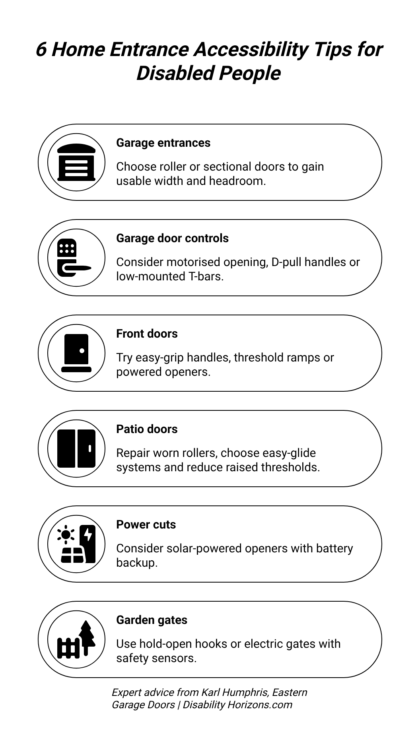
| Narrow garage entrances | Roller or sectional garage doors to increase usable opening space |
| Heavy manual garage doors | Motorised openers or easier-to-grip handles |
| Raised front door thresholds | Low-profile thresholds or suitable access ramps |
| Heavy patio doors | Roller adjustments, easy-glide systems or alternative door designs |
| Automatic doors during power cuts | Battery backup systems and suitable emergency release arrangements |
| Heavy garden gates | Hold-open catches, easier latches or powered gates |
For people who use a wheelchair, mobility scooter or adapted vehicle, getting in and out of the home is not always straightforward. A range of factors can create accessibility challenges, making everyday tasks more difficult than they need to be.
While many structural barriers found in older UK homes, such as narrow doorways, raised thresholds and changes in floor level, can be costly or impractical to alter, some access issues can be reduced through relatively simple home improvements.
According to door expert Karl Humphris, the type of entrance may be creating barriers that make everyday tasks harder than they need to be.
Karl has identified six common access issues around the home, warning that poor entryways can have a significant impact on independent living.
Footer: Expert advice from Karl Humphris, Eastern Garage Doors
He said: “Poor access can significantly impact your daily activities, making even simple tasks challenging. While various factors contribute to reduced mobility, there are practical solutions that can be recommended.”
Accessible Garage Entrances for Wheelchair-Accessible Vehicles
Many vehicles designed for disabled drivers and passengers require additional space to accommodate mobility equipment. In our 2026 guide to accessible vehicles, we highlighted larger models such as the Volkswagen Caddy Maxi as practical options for carrying wheelchairs, scooters and other bulky aids.
However, parking these vehicles can present challenges. Traditional UK single garages are typically around 7ft (2,134mm) wide, leaving very little clearance when parking larger vehicles, particularly with mirrors extended.
According to door access specialist Karl Humphris, the problem often lies not with the vehicle, but with the garage entrance itself.
“Many homeowners are surprised at how much space can be gained by changing the door rather than altering the building,” he said.
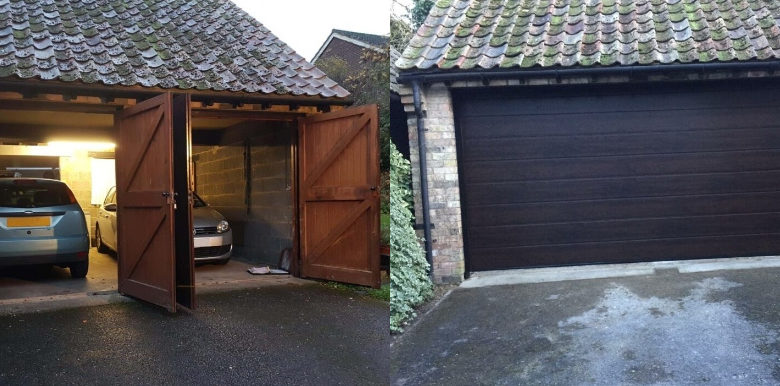
Karl recommends replacing traditional up-and-over garage doors with roller or sectional doors, which can be installed behind the opening to maximise both width and headroom.
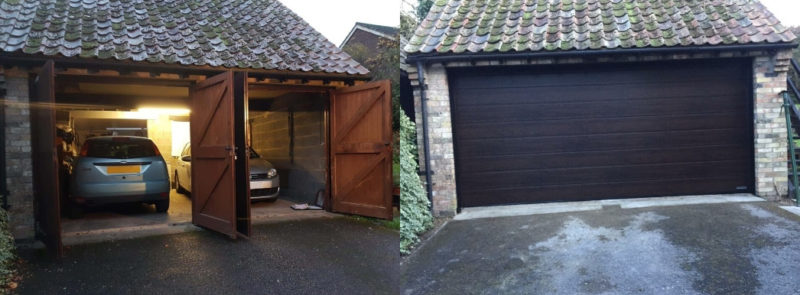
He added: “For many homes, simply replacing an old up-and-over door with a back fit roller or sectional door can recover valuable width and headroom, with no building work needed. Where more space is required, removing the central pillar on a double garage with narrow openings and adding a new lintel creates a much more accessible entrance, especially on offset driveways.”
Removing a central pillar is a structural alteration and should only be considered following professional assessment. It is also important to measure the usable opening and the space needed to enter and exit the vehicle, rather than relying on garage dimensions alone.
Making Garage Doors Easier to Open for Disabled People
Garage door accessibility is not only about the width of the entrance. Heavy manually operated doors can also create difficulties for disabled people who cannot comfortably reach the handle or apply enough force to lift the door.
Karl advises that motorising an existing garage door can be a less expensive option than installing a completely new automated or smart door solution. However, this depends on the type and condition of the existing door.
For people with reduced hand strength or dexterity, including some people with arthritis, easier-to-use options include large D-pull handles, lever extensions or low-mounted vertical T-bars.
Before choosing an automatic garage door opener, it is worth checking how the controls can be operated from a wheelchair or mobility scooter. Some systems can be controlled using a smartphone app, allowing users to open and close the door without reaching for a wall switch or separate remote. Certain existing automatic doors can also be fitted with compatible smart controllers, although this depends on the equipment installed.
Front Door Accessibility Problems and Practical Adaptations
Front doors can be a source of frustration, discomfort and even injury, particularly for people with mobility impairments, Karl says.
Common problem areas include raised thresholds that create a trip hazard and small thumb-turn locks that can be difficult to operate for those with reduced hand strength or dexterity.
“A range of adaptations can make access easier and safer,” he said. “These can be simple changes, such as installing an easy grip door handle, adding a threshold ramp, or replacing a raised sill with a low-profile alternative. For those with more complex accessibility needs, options include powered door openers, motion sensors, smart locks, or a wider door and frame with audible warning signals to indicate when the door is closing.”
Any threshold ramp should be suitable for the height of the entrance and the mobility equipment being used. Door width, manoeuvring space and the position of locks and handles are also worth considering when planning an accessible entrance.
Simple Door Accessibility Aids from Disability Horizons Shop
At Disability Horizons Shop, we also stock practical door aids that can make a difference without replacing the entire door. The T-Pull door closer, invented by disabled entrepreneur Tony Awad, has a swivelling handle that helps wheelchair users pull doors closed without having to reach back awkwardly for the original handle. For people who find lever handles difficult to operate, the Tru-Grip push-and-pull door handle extender provides a larger surface and extra leverage, making handles easier to press down or pull. Both offer relatively simple alternatives to more expensive door alterations.
Accessible Patio Doors for Wheelchair Users
Large glass sliding doors can be very heavy and difficult to open for some wheelchair users, while older doors often feature raised tracks that can catch walking frames or create a trip hazard.
Karl advised: “In some cases, simply adjusting or replacing worn rollers can make the doors much easier to open and close. For home adaptations, lift-and-slide or easy-glide systems are easier to move, whilst with both leaves open on french doors you get the full frame width as access. The downside is swing space, so they suit rooms better with lots of space.”
He also recommends considering adjustments to the threshold and surrounding floor levels.
“Simple adjustments can also make a real difference: Fitting a threshold ramp over the track is quick and inexpensive, whilst raising the patio to floor level gives step-free access to the garden.”
Where changes to patio levels are being considered, drainage and weather protection should also be assessed. A level entrance needs to remain safe and practical in wet weather.
Keeping Automatic Doors Working During Power Cuts
Power outages can create serious access problems for disabled people who rely on automatic garage doors or powered entrances. Someone may be unable to enter or leave their home, garage or storage area if the door cannot be operated manually.
Karl recommends considering solar-powered door openers where mains electricity is unavailable or unreliable.
He explains that photovoltaic cells can charge a backup battery, allowing the door motor to operate without a direct mains electricity supply. Some systems are advertised as providing extended battery operation, although the duration depends on the equipment, battery condition and frequency of use.
For disabled people who depend on powered access, it is important to check the battery backup arrangements and whether an accessible emergency release is available. A solar-powered system should not be assumed to provide uninterrupted access in every situation.
If you rely on powered doors, automatic gates or other electrical equipment for everyday access, make sure you are registered on your energy supplier’s Priority Services Register. This free service can provide extra support and information during power cuts, helping you prepare for disruptions. Find out more in our guide to joining the Priority Services Register and preparing for power cuts.
Making Garden Gates Accessible for Disabled People
Garden and side gates can also create accessibility barriers. Heavy gates, stiff latches and awkwardly positioned bolts may be difficult for some disabled people to operate, particularly when using mobility equipment.
Karl says that simple additions and electric options can help significantly.
For example, he recommends investing in an electric gate with safety sensors, which detect a person or object in the gate’s path and automatically stop or reverse it to prevent injury.
A simpler option is a manual gate stop or hold-open hook, which keeps the gate open while someone passes through.
Gate width and the condition of the surrounding path are also important. A gate that opens easily may still be inaccessible if there is insufficient room to turn a wheelchair or mobility scooter.
How Much Do Home Entrance Accessibility Adaptations Cost?
Not every accessibility problem requires a new door or major building work. Before paying for substantial alterations, it is worth checking whether smaller adjustments could solve the problem.
Replacing a difficult handle, repairing worn patio door rollers or fitting a suitable threshold ramp may be more affordable than installing a completely new entrance.
For larger changes, the cost will depend on the type of door, the existing structure, the equipment required and the installation work involved. Getting an assessment and a detailed quotation can help identify which changes are necessary.
Disabled people in England may also be eligible for a Disabled Facilities Grant for certain home adaptations, depending on their circumstances and the work required. Local councils can provide information about eligibility and the application process.
Some disability-related adaptations may also qualify for VAT relief, but eligibility depends on the specific work and the circumstances of the disabled person. It is worth checking the current HMRC guidance before agreeing to an installation.
Accessible entrances can make a significant difference to everyday life, whether that means being able to open the front door independently, park an adapted vehicle or get into the garden. The most useful changes will depend on the individual, their home and the barriers they encounter.
About Karl Humphris

Karl Humphris is a door specialist responsible for business development and technical matters at Eastern Garage Doors, part of the family-run Eastern Group UK. He joined the family business in 1987 after training in carpentry and joinery and gaining experience in building work. With nearly 40 years in the industry, Karl has extensive knowledge of garage doors, automated entrances and practical home access solutions. He now runs the business with his wife Angie and their son Austin.
Find out more about Karl and the Eastern Garage Doors team.
About Eastern Garage Doors
Eastern Garage Doors is a family-run business based in Terrington St Clement, King’s Lynn, Norfolk. Founded in 1975, the company supplies, installs and services doors across the East of England. Its experience covers all types, manual and electric. This includes home adaptations, automated entrance doors, widened entryways, low-threshold doors, wheelchair-accessible doors, patio doors, and automated garage doors carried out with both homeowners, local councils, private developers and the building trade.
Frequently Asked Questions About Accessible Home Entrances
How can I make my front door more accessible for a wheelchair user?
Possible adaptations include fitting a suitable threshold ramp, replacing a raised sill with a low-profile threshold, installing easier-to-use handles and widening the doorway where necessary. The best option depends on the available space, the door design and the wheelchair user’s access requirements.
Can an existing garage door be made automatic?
Some manual garage doors can be fitted with a motorised opener without replacing the entire door. Compatibility depends on the door’s design and condition. Certain automatic systems also support smartphone apps, allowing users to operate the door remotely.
What happens to an automatic garage door during a power cut?
Some automatic garage doors have battery backup systems or manual emergency releases. Solar-powered systems may also provide an alternative electricity supply. Disabled people who rely on powered access should check how their door can be operated safely if electricity is unavailable.
Are there affordable ways to make doors easier to open?
Yes. Depending on the door, options may include larger handles, lever extensions, door handle aids, replacing worn rollers or fitting a suitable threshold ramp. These changes can sometimes improve access without requiring a complete replacement door.
Can disabled people get financial help with home entrance adaptations?
Some disabled people in England may qualify for a Disabled Facilities Grant towards eligible home adaptations. Certain disability-related adaptations may also qualify for VAT relief. Eligibility depends on individual circumstances and the work being carried out.
Sponsored content: This article was produced in collaboration with Eastern Garage Doors as a paid contribution. Disability Horizons has reviewed and edited the content to ensure it is relevant and useful to our readers.
