
Our experience of chidcare options
Our perspective comes from years of employing nannies and organising care for our disabled son, Joe. Clare, my wife, is also a wheelchair user following a spinal injury. Clare could help with a great deal of Joe’s day-to-day care, but many physical aspects of caring for him weren’t possible for her, so we needed extra help beyond what many two-parent households require.

That isn’t the same experience as every disabled parent choosing childcare for their children, but it has taught us a great deal about recruitment, live-in care, handovers, backup arrangements and making care work around family life, including around Clare’s own access needs at home. We’ve recruited people, trained them in Joe’s individual care, managed rotas and handovers, travelled with nannies and dealt with the occasions when nobody was available to cover a shift. This guide combines that firsthand experience with current information about US childcare options.
Childcare that works well for one disabled parent may be completely impractical for another. Fixed collection times can create problems if your energy or health fluctuates. Driving to childcare may itself be a barrier. Cost, accessible communication, privacy, housing and what happens when somebody calls in sick can matter just as much as the childcare hours on offer.
We know from our own family that the arrangement that looks best on paper isn’t necessarily the one that works best at home. Some of the most important lessons only became apparent after we’d actually lived with these arrangements. We’ll share those practical lessons throughout this guide alongside the information about each childcare option.
This guide compares seven childcare options for US families in 2026. We look at schedule flexibility, cost, transport and coordination, live-in availability and support. We also consider accessibility, because a service being convenient doesn’t necessarily make it accessible to your particular family.
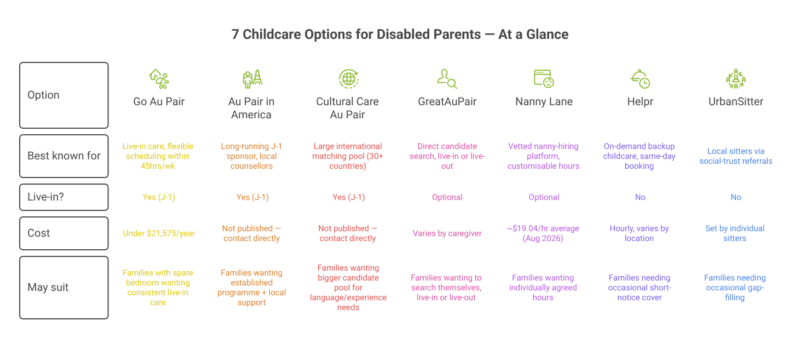
At a Glance: 7 Childcare Options
| Option | Best known for |
|---|---|
| Go Au Pair | Live-in care with flexible scheduling |
| Au Pair in America | Long-running J-1 sponsor with local counsellors |
| Cultural Care Au Pair | Large international matching pool |
| GreatAuPair | Direct candidate search, live-in or live-out |
| Nanny Lane | Vetted nanny-hiring platform |
| Helpr | On-demand backup childcare |
| UrbanSitter | Local sitters via social-trust referrals |
These options range from live-in au pair programmes to services designed for occasional or backup childcare. They solve different problems, so the highest-ranked service won’t be right for every family.
Go Au Pair scores well for families looking for live-in childcare and flexible scheduling. Au Pair in America provides another established J-1 programme. Helpr takes a different approach and may be more useful for parents who already have regular childcare but need occasional backup.
What Disabled Parents May Want to Consider When Choosing Childcare
Access requirements vary considerably between disabled parents.
A Deaf parent may prioritise text-based communication. A parent with fluctuating fatigue may want to cut unnecessary journeys and last-minute coordination. A wheelchair user, like Clare, may be able to manage many caring tasks independently but need another person for specific physical tasks. If you don’t have a suitable spare room, live-in childcare isn’t an option, regardless of how attractive its other features might be.
Before comparing providers, think about:
- Does the schedule adapt to your routine, or will you constantly have to adapt to it?
- Can you communicate with the provider in your preferred way?
- Does the arrangement reduce journeys that are difficult or inaccessible for you?
- Do you have enough space and privacy for a live-in nanny or au pair?
- What happens if your usual childcare falls through?
- If childcare takes place in your home, will the person actually fit comfortably into your family’s everyday life?
That final question is easy to underestimate.
What employing nannies taught us about choosing the right person
Having employed nannies and care workers ourselves, we’ve learned not to rely too heavily on how somebody comes across in an interview.
We would ask candidates to tell us about difficult situations they had faced in previous jobs and how they had dealt with them. The answer told us much more than simply asking whether they were good at coping with difficult situations.
We also liked asking ordinary, practical questions. For example, we might ask someone whether they cooked and what their favourite dish was to make. It wasn’t a test of their culinary skills. We wanted to get a feel for how practical and hands-on they were in everyday life.
One of the most useful parts of recruitment was having a potential nanny or care worker spend at least a day shadowing us. An interview tells you what somebody says they will do. Spending a day together lets you see how they actually interact with your child, respond to instructions and cope with the normal messiness of family life.
Even then, one successful day doesn’t show the complete picture. Most people are on their best behaviour when starting a new job. It takes time to see how a person behaves once they are comfortable.
Our practical tip: where appropriate and legally permitted, consider a paid shadowing or trial period before making a longer-term commitment. Use it to see how the person works in your real family environment, rather than creating an artificial test for them.
It’s also worth remembering that the fit works both ways. A nanny or care worker needs an honest picture of your household, routines and expectations if they are going to decide whether the job suits them.
Look beyond qualifications
Qualifications, background checks and previous experience matter, but they don’t answer every question.
Someone can have excellent childcare experience but be uncomfortable with an unpredictable household. Another person may have less directly relevant experience but be calm, practical, willing to learn and very good at communicating.
This becomes particularly important where a disabled child is involved. We’ve found that even previous experience of the same impairment or medical condition doesn’t necessarily mean someone already knows what your child needs. Two children with epilepsy, for example, may have very different seizures, responses and individual care plans. We’ll return to this later in the guide.
For the initial recruitment stage, ask questions that encourage candidates to describe what they have actually done, rather than simply confirming that they possess a skill. Instead of asking whether someone is good in an emergency, try asking them to describe a time something went wrong while they were looking after a child, and what they did about it. Instead of asking whether someone is flexible, ask what they would do if your plans changed unexpectedly.
Rather than assuming somebody understands what working in a household with a disabled parent or disabled child involves, explain the everyday reality and give them the opportunity to ask questions too. That conversation can be more revealing than ticking boxes on an application form.
How We Compared the Childcare Options
Disabled parents have different access requirements, household arrangements and budgets, so no single childcare model will work for everyone.
We used five practical areas to structure this comparison. The numbering is a starting point rather than a universal ranking.
Schedule flexibility. How much control does the family have over childcare hours, and how easily can those hours change?
Cost. Is the price predictable, and what additional costs should families expect?
Transport and coordination. Does the arrangement reduce childcare-related journeys and the amount of organisation required from the parent?
Accessibility and fit. Can the family discuss communication preferences, routines and access requirements easily? How much control do they have over choosing a person who works well within their household?
Support and continuity. If a placement or booking goes wrong, is there someone who can help? Is there another person who already knows your child? How much information would a replacement need before taking over? Is there someone within the provider or agency who can help find cover?
We have considered live-in availability separately. Having someone living at home can reduce childcare-related journeys and make some schedules much easier to manage. It also brings questions about space, food, privacy and boundaries that don’t arise in quite the same way with a live-out nanny or childcare centre. We learned quite a lot about those seemingly small details from having nannies living with us, including why sharing every meal isn’t necessarily as convenient as it sounds. That’s worth considering when we look at the live-in options first.
#1 Go Au Pair
What it offers: Go Au Pair places screened, trained au pairs with US host families through the State Department’s J-1 cultural-exchange visa. Federal rules set the childcare limit at up to 45 hours a week and 10 hours a day, and the family sets the specific hours within those limits.
Why it may work for some disabled parents
The main attraction of live-in childcare is the amount of control families can have over the agreed childcare schedule. Rather than fitting family life around daycare opening and collection times, families arrange the au pair’s working hours within the programme rules. Go Au Pair’s own au pair vs daycare breakdown lays out the trade-offs clearly.
For some disabled parents, having childcare at home may also remove journeys that are tiring or inaccessible. That can be particularly useful in households where getting everybody, and everything they need, into a car is a substantial job in itself.
There is another side to live-in childcare that is harder to understand until you’ve experienced it: your home is also somebody else’s home.
What we’ve learned from having live-in nannies
We’ve had live-in nannies ourselves, although our arrangement has been different from many families because we are fortunate to have a granny annexe outside the main part of our home.
It has its own entrance, which has proved extremely useful. Our nanny can finish work and properly go home, even though she’s only a short distance away, without us being constantly aware of another adult moving through the family home. That separation gives everybody some privacy.
Most families considering an au pair won’t have a separate annexe. The point we’d take from our experience isn’t that you need one. It’s that private space deserves much more thought than simply asking whether you have a spare bedroom.
Think about what happens after the working day finishes. Where does the person relax? Can they come home late without waking anybody? Can you sit in your pyjamas watching television without feeling that you’re still someone’s employer? Those everyday details can have a surprising effect on whether a live-in arrangement feels comfortable.
Think carefully about meals
Food was something we changed our minds about after actually living with nannies. At first, we tried sharing cooking and meals. It seemed like a nice way of including the nanny in family life.
In practice, it could become intense. Sometimes our family didn’t particularly want a cooked meal, but having another person to consider made us feel as though we ought to cook anyway. Sharing a small kitchen could create pressure too.
We eventually found a much simpler arrangement: we gave our nanny a food budget and let her buy and prepare her own food. That gave her more independence and took pressure off us.
Other families may love eating together every evening. The useful lesson is to discuss it before somebody moves in rather than assuming that “meals included” is a straightforward benefit. Ask practical questions such as who buys the food, whether there is a food allowance, where food is stored, when everyone normally cooks and whether shared meals are expected or optional.
When a child and nanny share a room
When our son was very young, we also had periods when a nanny shared his room. That’s quite a different arrangement from simply having a caregiver somewhere in the house, and it needs careful thought around working hours, sleep and privacy.
A person sleeping close to a child doesn’t automatically mean they are working throughout the night. Families need to be clear about when somebody is responsible for childcare and when they are off duty. This is one of those areas where putting expectations in writing is far safer than relying on everyone having the same understanding.
Things to consider
- Host families need suitable accommodation and a private bedroom under the J-1 programme requirements.
- Annual costs remain substantial, even if they compare favourably with some nanny arrangements.
- Another adult living in your home changes the family’s privacy.
- Discuss meals, kitchens, visitors, entrances, shared spaces and off-duty time before the placement begins.
- Au pairs provide childcare. They do not automatically provide personal assistance to a disabled parent.
- Families with particular access requirements should discuss these during matching.
- Federal limits on working hours mean some families will still need additional childcare.
Cost
Go Au Pair states that its annual programme cost stays under $21,575 per family. Check the current fee schedule and additional household costs before comparing this figure with local nanny or daycare prices.
With any live-in arrangement, think beyond the advertised fee too. Food, transport and the cost of having another adult living in the household can affect the real family budget.
Accessibility and support
Every family gets a dedicated Local Area Representative and HQ support. Federal regulations require au pairs to complete a minimum of 32 hours of child safety and child development instruction before placement: at least eight hours of child safety instruction and at least 24 hours of child development instruction (US Department of State). CPR and first-aid certification are optional credentials, so families should ask about these during matching if they are important to them.
For a family with a disabled child, go further than asking whether someone has “disability experience.” Someone having experience of a particular condition doesn’t necessarily mean they will know your child’s individual requirements. We cover this in more depth in the FAQ below.
May suit
Families with a suitable spare bedroom who want consistent live-in childcare and flexibility over agreed childcare hours.
#2 Au Pair in America
What it offers: Au Pair in America is one of twelve organisations designated by the US State Department to sponsor J-1 au pair placements. It uses a structured matching process with background checks and childcare-experience verification.
Why it may work for some disabled parents
Its established programme and local Community Counsellor structure may appeal to families who want support around the placement rather than employing someone entirely independently.
There is also an EduCare track. This provides fewer childcare hours, capped at 30 hours a week under federal rules, in exchange for more study time for the au pair.
For disabled parents, the important question isn’t simply whether a programme describes itself as flexible. Ask whether the available hours actually match the times when you need another person. Thirty hours at the right times could be far more useful to one family than 45 hours that can’t be arranged around their requirements.
Things to consider
- Pricing is less transparent than Go Au Pair’s published flat rate.
- The same private-bedroom requirement applies as with other J-1 programmes.
- EduCare provides fewer available childcare hours.
- Living together brings the same questions about privacy, meals and household boundaries discussed above.
- Programme support doesn’t remove the need for the family and au pair to communicate clearly with each other.
Cost
Au Pair in America does not publish a flat headline rate in the way Go Au Pair does. Contact the programme directly for current fees relevant to your household.
Accessibility and support
Families work with a local Community Counsellor after placement, alongside the oversight provided through the federal J-1 programme.
Ask the counsellor specific questions before choosing a programme. For example: what happens if the placement isn’t working inside your household? Who helps during a changeover? What happens to childcare while another match is being found?
May suit
Families looking for an established government-designated programme with local support.
#3 Cultural Care Au Pair
What it offers: Cultural Care Au Pair is a State Department-designated J-1 sponsor with au pairs from more than 30 countries and local support in all 48 contiguous US states (Cultural Care).
Why it may work for some disabled parents
A larger pool of candidates may improve your chances of finding somebody with particular language skills or relevant childcare experience. That could matter for bilingual households or families with specific access requirements.
But previous experience shouldn’t be your only deciding factor. A candidate saying they have worked with a disabled child before is the beginning of your questions, not the end of them. Ask what they actually did, what they found difficult, what the child’s family taught them, and how they responded when they weren’t sure what to do. Those questions tell you much more than a simple tick against “disability experience.”
Things to consider
- The same live-in bedroom requirements apply as with other J-1 programmes.
- Families should compare the complete programme fee, additional household costs and current matching availability before deciding between providers.
Cost
Contact Cultural Care Au Pair directly for its current programme fees, as no flat published rate is available for comparison.
Accessibility and support
The programme combines its screening process with a local counsellor system, plus a 24-hour on-call staff line, for post-placement support.
May suit
Families who want a larger candidate pool, perhaps because they are looking for particular language skills or relevant experience.
#4 GreatAuPair
What it offers: GreatAuPair provides an online marketplace where families can browse and contact au pairs, nannies and other caregivers directly. It also operates a State Department-designated J-1 au pair programme. Both live-in and live-out arrangements are available.
Why it may work for some disabled parents
Being able to search directly gives families more control over the people they approach. The live-out option is also significant for a family that likes the flexibility of a nanny but has neither the space nor the desire to share their home with another adult.
There is a trade-off, though. More control over the search can mean more work for the parent. Reading profiles, messaging candidates, arranging interviews and explaining your requirements all take time and energy. For someone dealing with fatigue, pain or limited energy, the administration involved in finding childcare can itself become an access barrier.
Things to consider
- The marketplace route requires more hands-on searching.
- Support varies according to which route you use. The J-1 programme includes a dedicated Local Childcare Coordinator.
- Direct matching can consume a considerable amount of time and energy.
- Families using the marketplace need to check training and credentials themselves.
- Live-in and live-out arrangements create very different household dynamics.
Cost
Costs vary according to the caregiver and type of arrangement. Check individual candidate rates and, for the J-1 route, the programme’s current fee schedule.
Accessibility and support
The J-1 route provides a dedicated coordinator. With the marketplace route, families take more responsibility for discussing access requirements directly with candidates.
May suit
Families who want to search for candidates themselves or want the choice between live-in and live-out care.
#5 Nanny Lane
What it offers: Nanny Lane is a nanny-hiring platform offering optional, family-initiated background checks alongside customisable hours (Nanny Lane). Families can post a job, browse profiles and agree the hours and duties they require. Both live-in and live-out searches are available.
Why it may work for some disabled parents
Hiring a nanny directly gives a family considerable scope to agree a routine around their own circumstances, which may suit a parent whose schedule doesn’t fit neatly into standard childcare hours.
Our experience of employing nannies has also shown us another advantage: the relationship can develop around the particular needs of one family and child. That consistency can become extremely valuable when there is a lot for a caregiver to learn.
Nannies and family holidays
One benefit we’ve experienced is being able to travel with a nanny. Holidays with our disabled child involved taking a lot of equipment. Having a nanny with us made the practical side of travelling considerably easier. Sometimes the nanny could bring their own car, giving us another vehicle for equipment as well as another adult to help during the trip.
There was also continuity: we weren’t arriving somewhere new and then trying to explain our son’s routines to an unfamiliar person.
Consider this when interviewing a nanny if travel is important to your family. Ask whether they would ever be willing to accompany you, rather than assuming that travelling is automatically part of their job. Agree the practical details beforehand: working hours, time off, accommodation, travel costs and what counts as paid working time. A family holiday for you is still work for the nanny.
Things to consider
- Families need to agree duties, hours, pay and household arrangements directly with the nanny.
- Nanny costs vary substantially by location, experience, hours and number of children.
- There is no sponsor-style local coordinator as there is with J-1 au pair programmes.
- Background checks are family-initiated rather than automatic, so confirm what has actually been checked.
- Live-in arrangements need clear boundaries around private space and off-duty time.
- If travel could form part of the job, discuss it during recruitment rather than after someone starts.
Cost
Nanny Lane’s live-in nanny page, last updated August 2026, reports a US average of $19.04 an hour across its live-in listings. Rates vary according to experience, number of children and schedule.
An au pair’s per-family fee structure may work out cheaper for some households with several children, but families should compare current local quotes and all the costs associated with each arrangement.
Accessibility and support
Families communicate their access requirements directly to candidates because the platform doesn’t provide a dedicated support representative. Use that direct conversation as an opportunity rather than treating accessibility as something to mention at the end.
May suit
Families wanting a professional nanny with individually agreed hours and a choice between live-in and live-out care.
6 things we’ve learned from employing and living with nannies
- Ask for examples, not assurances. “Tell me about a difficult situation and what you did” gives you more information than “Are you good in difficult situations?”
- See somebody working if you can. A shadowing or appropriately arranged paid trial day can show you things an interview can’t.
- Give it time. Don’t assume the person you see during the first few days is necessarily how the working relationship will feel six months later.
- Talk about ordinary domestic life. Cooking, meals, kitchens, visitors, entrances and private space can become surprisingly important with live-in childcare.
- Be honest about the job. You want the nanny to make an informed decision about your family too.
- Put boundaries into words. Living in the same building doesn’t mean somebody is permanently at work. Agree working hours, responsibilities and time off clearly.
#6 Helpr
What it offers: Helpr is an app-based platform connecting families with sitters for backup and on-demand childcare, often at short notice or on the same day. Sitters go through Helpr’s own screening process before appearing in the app.
Why it may work for some disabled parents
Backup childcare can be particularly useful when a parent’s usual arrangements change unexpectedly. That might be because a regular caregiver is ill or unavailable, or because the family’s plans have changed. For disabled parents who find repeated phone calls and organising alternative childcare tiring or inaccessible, being able to make a booking through an app may also reduce some of the work involved.
There is an important distinction, though, between having a backup option and knowing that backup will be available.
Our experience: your backup may need a backup
Over the years we used a mixture of employed nannies and carers, with an agency as another source of cover. On paper, that sounds like a fairly good backup system.
There were still occasions when somebody couldn’t work and we would call around trying to find a replacement, only to find that nobody was available. The final backup was always us. That could mean somebody failing to turn up for a night shift after we’d already been working during the day, so we would have to cover the care ourselves.
One of the things we stressed to everyone working with us was the importance of giving us as much notice as possible if they couldn’t work. The difference between finding replacement cover and having none at all could simply be how early we knew there was a problem.
Our practical tip: when you’re planning backup childcare, don’t stop after identifying one alternative. Ask yourself what you will do if your usual caregiver and your first backup are unavailable. For families where a child needs continuous support, that question can be particularly important.
Things to consider
- Hourly costs can become expensive if the service is used regularly.
- It isn’t designed to replace a full-time childcare arrangement.
- The caregiver may change between bookings.
- Availability varies by location.
- A sitter being listed as available doesn’t necessarily mean they will have experience relevant to your child’s individual requirements.
- Have another plan for occasions when no backup sitter is available.
Cost
Pricing is hourly and varies according to location and booking notice. Some families can access Helpr through employer-sponsored programmes, which may reduce their direct cost.
Accessibility and support
Caregivers go through Helpr’s screening process before matching. Families should confirm communication preferences and relevant access requirements when booking, because there isn’t a dedicated ongoing representative. For our family, there would also have been a practical limit to what a completely unfamiliar person could safely take over immediately. This is one reason good written information and handovers became so useful to us, which we explain later in this guide.
May suit
Families who already have a primary childcare arrangement and want another source of occasional or short-notice cover.
#7 UrbanSitter
What it offers: UrbanSitter is a childcare marketplace with a social-trust referral model. Families can see reviews and connections showing which sitters people within their network have previously used.
Why it may work for some disabled parents
The referral system gives families another source of information beyond a sitter’s profile. Hourly pricing and direct booking can make the service useful for evenings, weekends, school-run gaps and occasional cover.
For a family with more involved routines, think carefully about how easily one caregiver can substitute for another. A highly recommended sitter may still know nothing about your child’s communication, routines, equipment or what has happened during the previous few days. That doesn’t make them a poor caregiver. It simply means families need to be realistic about what can be handed over safely at short notice.
Things to consider
- There is no live-in option.
- There isn’t a dedicated support representative.
- It isn’t designed as the main solution for high-volume or involved scheduling.
- The same caregiver may not be available for every booking.
- A new sitter may need more information or familiarisation where a disabled child has individual care requirements.
Cost
Prices are set by individual sitters and displayed before booking.
Accessibility and support
Families discuss their requirements directly with each sitter. Community reviews may provide useful information about other families’ experiences, but they can’t tell you whether a particular sitter is right for your child.
May suit
Families looking for occasional local childcare to fill gaps around their main care arrangements.
Plan Christmas and holiday care as early as you can
Christmas, school holidays and other popular dates create a particular problem when several people want the same time off.
We learned to ask about Christmas availability as early as possible. Rather than expecting one person to sacrifice their Christmas, we tried to divide the difficult periods and take people’s circumstances into account. For example, if someone had young children, we would try to give them Christmas Day with their family and ask whether they could work on Boxing Day or Christmas Eve morning instead. An older carer without young children might prefer to cover a different shift.
Our practical tip: put Christmas and other difficult dates on the care calendar months ahead. Ask people what they would prefer to work before creating the rota.
Childcare Costs and Financial Support for Disabled Parents
Even the least expensive option in this comparison may be unaffordable for many households. Before committing to private childcare, check whether you qualify for state childcare assistance or other local programmes.
Federal and state subsidy programmes exist across the US. Your state’s child care resource and referral agency can point you towards local options. Military families may also be able to access the Exceptional Family Member Program. Eligibility and funding differ between states, so families need to check their local programmes directly.
There’s another cost worth thinking about: the cost of a childcare arrangement failing. If somebody cancels, can you miss work? Can your partner cover? Would you have to pay a higher rate for emergency cover?
Our experience was that, however many people we had around us, there were still occasions when no replacement was available. That doesn’t mean families should pay for several forms of childcare at once. It does mean reliability and backup arrangements deserve a place alongside hourly rates when comparing costs.
Questions to Ask a Childcare Provider About Accessibility
- Can we agree to communicate by text or email rather than telephone if needed?
- How much notice do you need if agreed hours have to change?
- How will you tell us if you can’t work, and who should you contact first?
- What happens if our regular childcare arrangement falls through?
- Can duties, working hours and boundaries be put in writing?
- What childcare-related journeys will I still need to make?
- Are there additional charges if hours change?
- Who do I contact if the arrangement isn’t working?
- If you work in our home, what privacy and household boundaries should we agree beforehand?
- If you’re living with us, how will food, cooking and shared spaces work?
- How will important information about our child be recorded?
- Can we agree which tasks are childcare responsibilities and which sit outside your role?
- If our child has individual care requirements, what training or familiarisation will be needed before you’re left responsible for them?
- Are you comfortable saying that you don’t know how to do something and asking us for help?
- What holiday periods can you work, and how early can we agree Christmas and other popular dates?
- If you’re unavailable unexpectedly, is there anyone else within the service or agency who may be able to cover?
How We Stopped Repeating the Same Information Every Shift
As more people became involved in our son’s care, one of the practical problems was keeping everybody up to date. You don’t want to have to remember and verbally repeat everything each time somebody starts a shift. It’s tiring for the parent and makes it easier for useful information to get missed.
We gradually developed a simple system with three parts.
A calendar
We kept a shared calendar in our son Joe’s room, showing who was working and when. That meant everyone involved in his care could see the rota rather than relying on us to hold all that information. Some families may prefer a shared digital calendar today. The principle is the same: make the rota visible to the people who need it.
A care-plan folder
We started a care-plan folder for Joe, and over the years it grew and grew. It held the more permanent information people needed to support him, giving carers somewhere to check information rather than depending entirely on what they remembered from a conversation with us.
A daily diary
The diary was particularly useful at the beginning of a shift. A carer could read back over the previous few days and quickly understand what had been happening. Had Joe been eating normally? Had he been ill? Had he experienced seizures? That gave the incoming person some context before they started, and reduced our dependence on verbal handovers.
From our experience: don’t make yourself the only source of information
For a long time, parents can become the person who knows everything. That’s understandable. You know your child.
The problem comes when every nanny or carer has to ask you who is working tomorrow, what happened yesterday and what they need to remember that day. Our calendar, care-plan folder and diary gradually moved some of that information out of our heads and into a place where the people supporting Joe could find it. We were still there when somebody needed us, but we didn’t have to personally provide every piece of information at the beginning of every shift.
For a disabled parent managing their own energy as well as family life, reducing that repeated coordination can matter a great deal.
FAQ
Which childcare options offer the most flexible scheduling?
Live-in childcare can give families considerable control over when agreed childcare hours take place. J-1 au pair programmes allow families to set schedules within federal programme limits, while independently employed nannies can agree hours directly with the family. On-demand services such as Helpr and UrbanSitter offer another kind of flexibility: childcare when occasional gaps appear.
Ask yourself what exactly you need the flexibility to solve. Is it avoiding school or daycare journeys? Covering irregular working hours? Having someone available at home? Finding cover when somebody is ill? Or being able to travel with another person who already knows your child? Those are quite different requirements, and the childcare option described as the most flexible may not solve the particular problem your family has.
How does an au pair’s cost compare with a nanny or daycare for multiple children?
An au pair’s flat per-family price doesn’t rise with the number of children. Go Au Pair states that its annual cost stays under $21,575.
Nanny costs vary considerably according to location, experience, working hours and the number of children. An au pair’s fee structure may work out cheaper for some households with several children, but compare current local quotes and the full costs of each arrangement before deciding.
With live-in care, include household costs in that calculation too. Food is a good example. We originally shared meals with our live-in nannies but eventually found it worked better to give our nanny a food budget and let her cook independently. Cost isn’t only the headline fee.
Can a disabled parent get financial assistance for childcare in the US?
Yes, although eligibility and available support vary by state. Federal and state subsidy programmes exist, and your state’s child care resource and referral agency can direct you towards local options. Military families may also have access to the Exceptional Family Member Program. Check both the eligibility rules and what the funding can actually be used for before making childcare arrangements.
What’s the difference between a J-1 au pair programme and hiring a nanny independently?
A J-1 au pair programme is a State Department-designated cultural-exchange arrangement operating under federal rules, with structured training and programme support.
Hiring a nanny independently means the family has more responsibility for matters such as recruitment, contracts, tax and dealing with problems themselves. It gives families greater control over the employment arrangement but doesn’t provide the same sponsor structure.
One practical difference is that you become responsible for building a good working system around that person: clear duties and hours, handovers, holiday planning, what happens when they are ill and, if they live with you, boundaries around private and shared space. The freedom to create your own arrangement can be extremely useful. It also means there is more for you to organise.
Are au pairs trained to support families where a parent is disabled?
Federal regulations require au pairs to complete a minimum of 32 hours of childcare training before starting, including child safety and child development instruction (US Department of State). CPR and first-aid certification aren’t universal requirements, so families should check individual candidates’ credentials where these matter. Au pair programmes don’t provide disability-specific parent training as standard, so discuss your own requirements during matching.
There is another issue if the child receiving the care is disabled, particularly if they have individual health or care requirements.
What have you learned about training someone to support a disabled child?
Don’t assume that somebody knows what to do simply because they have supported another person with the same condition.
Epilepsy is a good example. Someone might truthfully say they have experience of epilepsy, but that doesn’t mean they have seen the types of seizures our son has. They won’t automatically know what his seizures look like, what his individual care plan says or when his prescribed rescue medication should be used. Every child is different.
Over the years, we’ve had to pass on a considerable amount of practical knowledge about our son’s care, including his NG tube, his epilepsy rescue medication and using oxygen saturation monitoring equipment. Sometimes the difficulty was simply getting medical staff to provide training quickly enough, when we needed somebody who could help with his care immediately.
Our approach to teaching somebody something new was gradual. We would demonstrate what we did several times first, then supervise the person doing it themselves several times. We wanted to see that they understood, but we also wanted them to feel comfortable telling us whether they were ready to do it without us beside them. After that, we tried to stay available if they needed reassurance, so nobody felt that once we’d shown them something, they couldn’t contact us because they thought they ought to know the answer already. Somebody being willing to say “I’m not sure” was important, and it’s something we’d now look for when choosing a person as well as when training them.
This is our family’s experience of helping people understand our son’s individual care. It shouldn’t be treated as instructions for performing medical procedures or administering medication. A disabled child’s clinical care should follow their individual care plan, prescriptions and the guidance of the healthcare professionals responsible for their care. Families should check what training, delegation, consent and documentation are required for the particular tasks involved.
What should I ask someone who says they have experience with disabled children?
Don’t stop at “Have you worked with a disabled child before?” Ask what that experience actually involved.
- What did you do as part of the child’s everyday care?
- What did their parent or caregiver have to teach you?
- Was there any equipment you learned to use?
- Tell me about a time you weren’t sure what to do. What did you do next?
- How do you prefer somebody to show you a new task?
- Are you comfortable asking for help if something doesn’t seem right?
- How would you make sure you remembered an individual child’s routines?
- What information would you want before being left responsible for the child?
Pay particular attention to how somebody responds to questions they can’t answer. A person pretending to understand something they don’t understand can be far more worrying than someone saying, “I haven’t done that before, but I’m willing to learn.”
What backup childcare options exist when primary care falls through?
On-demand platforms are designed for this purpose. Helpr specialises in same-day and short-notice bookings from screened sitters, while UrbanSitter can help families find local sitters through its referral model. Both are better viewed as potential backup options rather than guaranteed replacements for a primary care arrangement.
Our own experience has made us cautious about the idea of having just one backup plan. We used employed nannies and carers and could also approach an agency for cover. There were still occasions when we called around and nobody was available. In the end, we were the final backup.
So ask yourself: what’s your backup for your backup? You might have a regular nanny or carer as Plan A, another known caregiver as Plan B, an agency or backup childcare service as Plan C, and what the family will do if nobody else is available as Plan D. Not every family will have four realistic options. The useful exercise is identifying the point at which your plans run out, before you’re dealing with a cancellation at 10pm.
Ask regular caregivers to give you as much warning as they reasonably can when they know they won’t be able to work. From our experience, those extra hours can make an enormous difference to the chances of finding somebody else.
How can I make handovers easier between different carers?
We eventually used three simple tools for our son’s care: a calendar showing who was working and when, a care-plan folder holding the more permanent information people needed to know, and a daily diary recording what had been happening recently.
Before beginning a shift, someone could read the diary and see whether Joe had been eating well, had been ill, had experienced seizures, or whether something else had changed. That meant an incoming person wasn’t starting their shift without context, and it reduced the amount of information we personally had to remember to pass from one person to another.
The same principle can work digitally if that suits your family better. Whatever system you use, think about three questions: who’s working, what do they need to know generally, and what’s happened recently? Make sure personal and health information is stored and shared appropriately, and keep important care information current.
Can autistic and disabled children qualify for subsidised preschool or childcare programmes?
Often, yes. Autistic children and children with other qualifying requirements may have access to early intervention services and special education provision. Some subsidised preschool programmes prioritise enrolment for disabled children.
These systems are separate from general childcare subsidies, so families should check both. Contact your state’s early intervention office or local school district to find out what your child may qualify for.
The Bottom Line
Flexible childcare means something different in every household. For one disabled parent, the priority may be cutting out difficult childcare journeys. Someone else may need accessible communication or childcare that can work around fluctuating energy. A family with a disabled child may place much more value on continuity, because each new caregiver needs time to learn about their child.
Our experience has changed what we look for in childcare. Qualifications and checks matter, but so do ordinary things that are harder to capture on an application form: whether someone listens, asks when they don’t know something, communicates clearly and fits comfortably into family life. We also learned to plan for what happens when the normal arrangement fails, rather than judging childcare only by how well it works on a good day.
When arranging care for a disabled child, don’t assume that experience of the same condition means someone already understands your child’s individual requirements. Our son’s seizures, NG-tube use, medication, monitoring, communication and everyday routines were individual to him. People needed to learn him.
Don’t choose a childcare model solely because it is supposed to be flexible or accessible. Work out what creates the barriers in your own family’s day, then look for the arrangement, and the people, that remove as many of those barriers as possible.
Cost matters just as much. An option being cheaper than another private childcare arrangement doesn’t make it affordable. Check state and local assistance before assuming private childcare is your only option.
Most importantly, don’t assume that the highest-ranked provider will automatically be right for your household. The right question isn’t simply “Which childcare service is best?” It’s “What does our family actually need this person or service to make possible?”
Resources
Parents comparing live-in care with a childcare centre should consider more than price. Opening hours, childcare-related travel, privacy, available space and flexibility can all affect whether an arrangement works.
For independent information about J-1 au pair programme rules, permitted hours and training requirements, see the US Department of State’s official Au Pair Program page and the federal Au Pair Program regulations.
For childcare financial support, see Childcare.gov.
Duncan Edwards, Editor

