When Disabled People’s Distress Is Mistaken for Aggression: What Frontline Staff Need to Understand

Picture a council customer service desk on a Monday morning. The queue is long, the lights hum and a phone rings unanswered. Someone nearby is talking loudly into their phone.
You’ve been waiting 50 minutes to discuss an urgent housing problem. When you finally reach the counter, you struggle to explain what has happened. Your voice rises. You pace. You find it difficult to look at the staff member.
From behind the counter, the situation may appear threatening.
“You need to calm down, or I’ll have to ask you to leave.”
A warning like this can increase someone’s distress and make the situation harder to resolve.
For many disabled people, this is a familiar concern. Staff may mistake distress for aggression, particularly when someone’s disability is not immediately apparent. A difficult encounter can quickly escalate when staff misunderstand what is happening or fail to recognise an adjustment that could help.
Why Disabled People’s Distress Can Be Mistaken for Aggression
Around one in four people in the UK is disabled, according to the Department for Work and Pensions’ Family Resources Survey. Many disabilities are not immediately apparent, so public-facing staff regularly meet disabled people without knowing it.
Behaviour that appears disruptive may have several explanations:
- Sensory overload. In a 2009 study of autistic adults, 94.4% of participants showed extreme sensory processing scores in at least one area. Bright lighting, background noise and crowded waiting rooms can become overwhelming.
- Meltdowns and shutdowns. An Autistic person experiencing a meltdown may cry, shout or make movements that staff find difficult to interpret. During a shutdown, someone may become quiet, struggle to speak or stop responding to questions. Both can occur when someone becomes overwhelmed. The Open University explains why autistic meltdowns and shutdowns occur.
- Pain and fatigue. Chronic pain, long waits and repeated questions can make it harder to communicate calmly and clearly.
- Communication differences. Someone may need longer to process spoken information, avoid eye contact or speak loudly because of hearing loss. Staff may misinterpret these behaviours as rudeness.
- Fear and previous experiences. People who have previously been dismissed, disbelieved or refused assistance may arrive feeling anxious about another difficult encounter.
Staff still need to respond appropriately to genuine threats or violence. Understanding what has caused someone’s distress can help them assess the situation and decide how to respond.
Editor’s note – Duncan Edwards: When I worked in Local Government Welfare Rights Advice, I helped many disabled people complete benefit forms. I remember several occasions when people with ataxia and other conditions affecting their speech told me that professionals had assumed they were drunk or had been drinking because their speech was slurred or their movements were unsteady. These experiences have stayed with me. They are a reminder of how easily disability-related symptoms can be misunderstood, even by professionals who regularly work with disabled people.
Why Frontline Staff May Misinterpret Disability-Related Behaviour
Frontline workers have genuine reasons to be concerned about their safety.
The Health and Safety Executive estimated 689,000 incidents of workplace violence in England and Wales during 2024/25. Health and social care associate professionals faced more than twice the average risk.
NHS England’s violence prevention information also reports findings from the NHS Staff Survey. In the 2025 survey, 14.47% of staff reported experiencing physical violence from patients, relatives or members of the public during the previous year.
These experiences can make workers particularly alert to raised voices, pacing or unexpected movements. Without suitable training, staff may struggle to recognise when these behaviours are linked to disability-related distress.
Research suggests that misunderstandings remain common.
In a 2016 National Autistic Society survey involving more than 7,500 autistic people and family members, only 16% felt the public understood how autism could affect behaviour. The findings were reported by Learning Disability Today.
A separate 2016 study of policing in England and Wales found that just 37% of 394 police officers surveyed had received autism training. Among the 31 autistic adults who participated, 69% were dissatisfied with their experiences of the police.
The University of Bath’s report on the research also highlighted the need for officers to understand autistic communication and behaviour.
These studies are relatively old, and the policing research involved small samples. However, they provide useful examples of the communication difficulties that can arise when staff lack autism awareness.
Further qualitative research into autistic adults’ experiences with police personnel describes how autistic behaviour may be misinterpreted during encounters with officers.
Similar problems can arise in everyday public services. Someone may arrive at an appointment without a document they were never told to bring, struggle with unexpected instructions or become overwhelmed when staff refuse an alternative.
Clear information before appointments, flexibility over paperwork and staff who can offer practical solutions may help prevent these situations from escalating.
Experiences of poor treatment can discourage disabled people from using public services.
Scope’s 2022 research into attitudes towards disabled people, involving more than 4,000 disabled adults, found that 72% had experienced negative attitudes or behaviour during the previous five years. Some respondents reported avoiding public transport or health and social care settings as a result.
Seven Ways Frontline Staff Can Respond to Distress
Receptionists, council workers, NHS administrators and other public-facing staff regularly deal with people who are anxious, frustrated or overwhelmed.
Recognising possible signs of disability-related distress can help staff respond before an encounter becomes more difficult.
The Local Government Association’s autism guidance explains how communication differences, sensory environments and difficulties processing information can affect interactions with public services.
The following approaches can help:
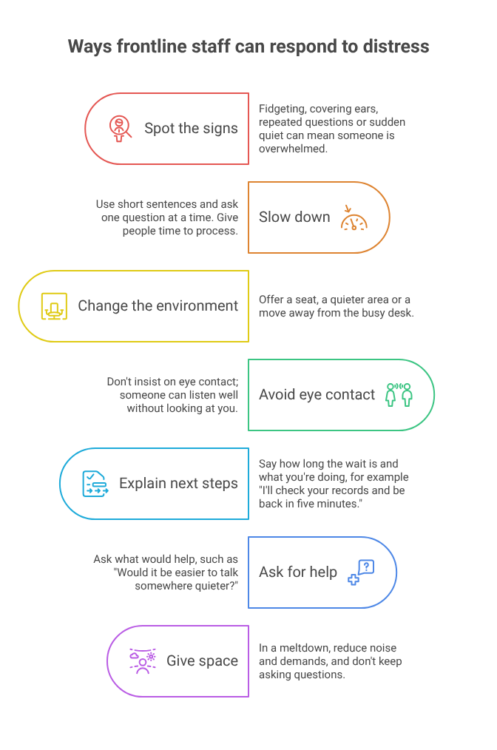
- Recognise possible signs of distress. Fidgeting, covering ears, repeating questions or becoming unusually quiet may indicate that someone is overwhelmed. Staff should consider what is happening around the person and whether an adjustment might help.
- Slow down and reduce demands. Use shorter sentences, ask one question at a time and allow enough time for someone to process the information. Repeating a question more loudly may increase their distress.
- Consider the environment. A quieter waiting area, somewhere to sit or moving away from a busy reception desk may make communication easier.
- Avoid insisting on eye contact. Some Autistic people find eye contact uncomfortable or distracting. Someone can listen and understand without looking directly at the person speaking.
- Explain what happens next. Give clear information about waiting times and procedures. Saying “I’m going to check your records and come back in five minutes” provides more reassurance than leaving someone waiting without an explanation.
- Ask what would help. A simple question such as “Would it be easier to talk somewhere quieter?” allows someone to request an adjustment without explaining their medical history at a public counter.
- Give someone space when appropriate. During a meltdown, repeated questions or attempts to reason with someone may increase their distress. Reducing sensory demands, allowing time and following an agreed support or safety plan may help.
These approaches are consistent with NHS Greater Glasgow and Clyde’s guidance on autistic meltdowns and shutdowns.
How a Reasonable Adjustment Can Help Without Delaying the Queue
Reasonable adjustments can often be made without disrupting a busy service or significantly increasing staff workloads.
The UK government’s guidance on reasonable adjustments for service providers explains that organisations may need to change procedures, provide additional assistance or address physical barriers that put disabled customers at a substantial disadvantage.
For frontline staff, this might mean offering someone a quieter place to wait, allowing extra time to answer questions, providing written instructions or finding an alternative way for someone to communicate.
An NHS receptionist could write down appointment instructions for someone who struggles to process spoken information. A council worker might allow someone to explain their circumstances in writing rather than speaking at a busy counter.
These adjustments can often be incorporated into existing procedures while other customers continue to be served. Staff need to know which options they can offer independently and when they should seek additional support.
How Organisations Can Prevent Distress From Escalating
Frontline staff need practical training, accessible working environments and clear procedures. These are particularly important when services are busy or understaffed.
Under the Equality Act 2010, service providers have a duty to make reasonable adjustments for disabled people.
This is an anticipatory duty. Organisations should consider accessibility barriers in advance and take reasonable steps to address them.
Employers also have duties under health and safety legislation to assess and manage foreseeable risks of violence towards workers.

The flowchart begins with three stages:
1. Long Wait: An initial period of waiting.
2. Struggle to Explain: Difficulty articulating needs.
3. Raised Voice and Pacing: Physical signs of distress.
These lead to Staff Perception, where staff interpret the behaviour. The flowchart then splits into two possible outcomes:
Escalation pathway:
– Threat perceived: Staff interpret the behaviour as threatening.
– Calm Down or Leave: Staff give a confrontational response.
– Distress Rises: The situation escalates.
De-escalation pathway:
– Distress noticed: Staff proactively identify the person’s needs.
– Staff Notice Distress: Staff recognise possible signs of distress.
– Offer Adjustment: Staff provide a quiet space or written information.
– Issue Resolved: The situation is successfully de-escalated.
The Health and Safety Executive’s guidance on preventing violence and aggression recommends suitable queuing arrangements, clear information about delays, appropriate staffing, communication training and procedures for responding to unsafe situations.
Several organisational changes can make a difference.
- Provide training that reflects the work staff actually do. Receptionists, council employees and other public-facing workers need practical communication and de-escalation skills. Training in managing challenging behaviour should help staff recognise disability-related distress, adapt their communication and understand when reasonable adjustments may prevent escalation. Organisations should consider involving disabled people, including Autistic experts by experience, in developing and delivering training.
- Improve waiting areas. Clear signs, predictable queuing arrangements and visible waiting-time information can reduce confusion. Where possible, organisations should provide quieter spaces or alternatives to crowded waiting rooms.
- Make adjustments easy to request. Customers should be able to ask for a quieter space, written information or extra processing time without discussing private medical details in front of other people.
- Give staff clear procedures and management support. Workers need to know when they can change an administrative process, seek help from a colleague or offer an alternative appointment arrangement. They also need clear instructions for responding to unsafe situations.
- Review incidents and recurring problems. Organisations should record threats and violence accurately while also identifying incidents involving distress or communication difficulties. Reviewing these reports may reveal preventable problems, including confusing letters, long waits or unsuitable reception environments.
The HSE provides further guidance on reporting and learning from incidents.
Trade unions have also raised concerns about workplace violence. UNISON campaigns for employers to take prevention, risk assessment, training and staff support seriously.
Employers can improve accessibility and staff safety through better service design, appropriate staffing and clear procedures.
Why Understanding Distress Matters for Disabled People and Staff
A busy reception desk will always bring challenges. Staff may face long queues, frustrated customers and difficult decisions about safety.
Recognising disability-related distress gives workers more information to help them assess what is happening.
Sometimes a quieter space, a clearer explanation or a few extra minutes can prevent an encounter from escalating.
Employers need to give staff the training, authority and support to make those adjustments.
Disabled customers should be able to ask for help without fearing that their distress will be mistaken for aggression.
Frequently Asked Questions
Can disability-related distress be mistaken for aggression?
Yes. Behaviours such as pacing, speaking loudly, avoiding eye contact or struggling to answer questions can sometimes be misinterpreted. Pain, sensory overload, anxiety and communication differences may contribute to these behaviours.
What should frontline staff do when an Autistic person becomes overwhelmed?
Staff can reduce noise and other sensory demands, use clear and simple language, allow processing time and offer a quieter space where possible. During a meltdown, giving someone space and avoiding unnecessary questions may help.
What reasonable adjustments can receptionists and customer service staff offer?
Examples include providing written instructions, allowing extra time to communicate, offering somewhere quieter to wait or accepting information in an alternative format. Appropriate adjustments depend on the person’s needs and the service being provided.
How can employers protect staff while making services accessible?
Employers can provide communication and de-escalation training, assess workplace risks, establish clear safety procedures and make reasonable adjustments easier to request. Staff should have appropriate support when dealing with threatening or violent behaviour.
