
Disabled people book treatments such as massage, reflexology and aromatherapy for many reasons. Some enjoy the relaxation, while others find that particular treatments help them feel more comfortable or relieve tension. Like everyone else, disabled people may simply enjoy taking time out for a relaxing treatment.
For therapists, providing an accessible service can mean adapting techniques, changing treatment positions, offering home visits or finding different ways to communicate with clients. These adjustments need to be considered alongside professional training, safety procedures and insurance arrangements.
Therapists offering adapted treatments or home visits should check that their holistic insurance covers the services they provide, including any relevant exclusions or conditions.
Discussing access requirements before an appointment can also help therapists prepare properly and give clients confidence that their needs have been understood.
Adapting Massage and Holistic Treatments for Disabled Clients
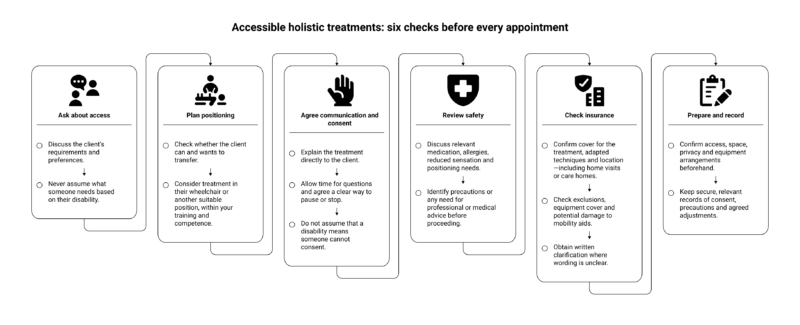
Disabled clients have different access requirements, preferences and medical circumstances. A therapist should discuss these individually rather than make assumptions based on someone’s disability.
My wife has received massages despite being unable to transfer from her wheelchair onto a treatment couch. The therapist was able to provide the massage while she remained seated in her wheelchair.
She could enjoy the treatment without needing an uncomfortable or impractical transfer.
This type of adjustment may be possible for other wheelchair users, depending on the treatment, positioning requirements and the therapist’s training.
Other considerations include:
- Reduced sensation: Some clients with nerve damage or spinal cord injuries may have difficulty detecting excessive heat or pressure. Therapists should take particular care with heated equipment and discuss suitable precautions beforehand.
- Transfers and positioning: Ask whether the client can and wants to transfer. Treatment may be possible in a wheelchair or another comfortable position. Therapists should never attempt assisted transfers without appropriate training and arrangements.
- Medication and health conditions: Some medicines, including anticoagulants, can increase bruising risk. Certain treatments may require additional precautions or medical advice.
- Communication: Some clients use communication aids, gestures, written messages or assistive technology. Agreeing on a reliable way to communicate discomfort or ask for treatment to stop is important.
A consultation should give clients the opportunity to explain what works for them. Therapists can then decide whether they can provide the requested treatment safely and within their professional competence.
What Insurance Do Holistic Therapists Need?
Holistic therapy insurance policies may combine public liability, professional indemnity and treatment-related liability cover. The exact protection depends on the insurer and the policy wording.
Therapists should check that their insurance reflects how they actually work.
For example, a practitioner who normally treats clients in a clinic may decide to offer home visits. Another may begin providing treatments in care homes or adapting techniques for clients who cannot use a standard treatment couch.
These changes can affect the circumstances in which treatment takes place.
Before accepting bookings, therapists should check:
- Whether their specific therapies and techniques are covered.
- Whether mobile treatments and care-home visits are included.
- Whether any treatments require additional qualifications or medical approval.
- Whether damage to clients’ belongings or mobility equipment is covered.
- Whether the policy contains exclusions relevant to their work.
Insurance policies may offer different levels of liability cover, including limits of £1 million, £2 million or £5 million. The appropriate amount depends on the therapist’s work, any contractual requirements and the risks covered by the policy.
Care homes and other organisations may specify minimum levels of insurance before allowing external therapists to provide treatments.
Some insurers impose conditions relating to particular therapies or medical circumstances. Practitioners should check these directly rather than assume that a general insurance certificate covers every treatment.
A signed consent form does not automatically protect a therapist from a claim or override the terms of an insurance policy.
Where policy wording is unclear, obtaining written clarification from the insurer is sensible.
Consent and Communication With Disabled Clients
Consent is an important part of any treatment, particularly when a client needs communication support or assistance from another person.
In England and Wales, the Mental Capacity Act 2005 establishes that adults must be presumed to have capacity unless it is established otherwise.
A learning disability, communication impairment or physical disability does not automatically mean someone lacks capacity to make decisions.
Capacity relates to a particular decision at a particular time.
Therapists should speak directly to clients, explain the proposed treatment and give them an opportunity to ask questions or decline.
Practical adjustments might include:
- Providing information in large print or easy-read formats.
- Allowing additional time for questions.
- Using written communication or communication aids.
- Explaining what will happen before each stage of treatment.
- Agreeing on a signal that means the client wants to pause or stop.
Some disabled clients attend appointments with a family member, personal assistant or carer. Their involvement should reflect the client’s wishes wherever the client has capacity to decide.
If someone lacks capacity for a particular treatment decision, therapists need to follow the applicable legal framework. This may involve checking whether an authorised health and welfare attorney has relevant decision-making powers or following the appropriate best-interests process.
Where the legal position is uncertain, professional advice should be sought before proceeding.
Therapists should keep appropriate records of consultations, consent and agreed treatment adjustments. This may include relevant medication, allergies, precautions and communication preferences.
Health information should be collected only where necessary, stored securely and handled in accordance with data protection requirements.
Clear records can help therapists provide consistent care, particularly when a client returns for further appointments or sees a different practitioner.
Insurance and Accessibility for Mobile Massage Therapists
Home visits can make holistic treatments accessible to people who have difficulty travelling or cannot use a therapist’s usual premises.
Working in someone’s home requires some preparation.
A therapist may need to work around a wheelchair, profiling bed, hoist or other equipment. Space may be limited, and the client may have particular preferences about positioning or privacy.
Asking about these arrangements beforehand can help avoid difficulties during the appointment.
Therapists should also check how their insurance applies to mobile work.
Some public liability policies cover treatments at different locations, although restrictions and exclusions vary.
Damage to a client’s property can be another consideration. For example, a therapist might accidentally damage a wheelchair component while moving equipment around a treatment area.
Insurance policies may treat property in a practitioner’s care differently from other third-party property.
Therapists who travel with portable treatment couches, massage equipment or other specialist items should also check whether their own equipment is insured. Cover for portable equipment may be an optional extra rather than part of a standard liability policy.
Care homes and day centres may request evidence of insurance and specify minimum cover requirements before allowing external therapists to work on their premises.
These arrangements should be confirmed before treatment begins.
Reasonable Adjustments for Disabled Clients
Under the Equality Act 2010, service providers in Great Britain have responsibilities relating to reasonable adjustments for disabled people.
The duty is anticipatory, so businesses should consider potential barriers when planning their services.
For holistic therapists, accessibility may involve:
- Providing clear information about entrances, steps and treatment rooms.
- Offering accessible booking and communication methods.
- Considering alternative treatment positions.
- Allowing additional appointment time where reasonable.
- Making information available in accessible formats.
- Considering home visits where practical.
A therapist working from an upstairs room without a lift, for example, should make this clear before a client books.
Someone who cannot transfer onto a treatment couch should be able to discuss possible alternatives before attending.
The adjustments that are reasonable will depend on the circumstances, including the service being provided and the resources available.
Where an adjustment is legally required, the cost should not be passed on to the disabled client as an additional charge for that adjustment.
The Equality and Human Rights Commission provides further guidance about service providers’ duties under the Equality Act.
Therapists should also maintain appropriate safeguarding procedures and respect clients’ privacy, dignity and personal choices.
Therapists should not assume that their liability insurance covers claims involving discrimination or safeguarding failures. Some policies contain specific exclusions, so it is important to check the wording and understand which responsibilities remain with the practitioner.
Avoiding Unsupported Health Claims
Holistic therapies are often marketed around relaxation, comfort and wellbeing.
Therapists should take care when making claims about treating medical conditions.
For example, claiming that reflexology can improve mobility in someone with multiple sclerosis would require appropriate scientific evidence. Such claims may also raise questions about professional competence, advertising rules and insurance cover.
Clients may describe personal benefits from treatments, but individual experiences do not establish that a therapy can treat a particular condition.
The Advertising Standards Authority provides guidance on advertising health-related treatments and the evidence needed to support claims.
Therapists should avoid suggesting that complementary treatments can replace prescribed medication or appropriate medical care.
Questions to Ask Before Booking an Accessible Massage
If you’re considering booking a massage or another holistic treatment, asking a few questions beforehand can help you decide whether the service meets your needs.
You should be able to ask about accessibility without having to disclose unnecessary personal medical information.
Useful questions include:
- Can I remain in my wheelchair? If transferring onto a treatment couch is difficult or impossible, ask whether the treatment can be provided in another position.
- Is the treatment room accessible? Check entrances, door widths, accessible toilets and any other facilities you need.
- Can you accommodate my communication preferences? This might include written information, communication aids or extra time.
- Do you offer home visits? Ask whether mobile appointments are available and whether there is a separate home-visit charge.
- Are you qualified and insured for this treatment? Therapists should be able to explain their qualifications and insurance arrangements.
- Will I need medical advice before treatment? If so, ask why it is required and whether the requirement comes from professional guidance or insurance conditions.
- What are your cancellation arrangements? Some disabled people experience fluctuating health conditions, so knowing the cancellation policy beforehand can be helpful.
It is also reasonable to explain what has worked well during previous treatments.
A therapist may be unfamiliar with a particular adjustment but willing to discuss whether it can be provided safely.
Making Holistic Treatments More Accessible
Accessible holistic treatments depend on good communication, appropriate training and practical preparation.
Therapists need to understand their professional responsibilities, check their insurance arrangements and discuss individual access requirements with clients.
Disabled clients should have clear information about the services available and the opportunity to make informed choices about their treatment.
My wife’s experience shows how a straightforward adjustment can make a difference. She couldn’t transfer onto a treatment couch, but the therapist was able to provide her massage while she remained in her wheelchair.
For therapists who haven’t previously worked with wheelchair users or clients with particular access requirements, discussing possible adjustments before an appointment is a useful starting point.
Editor’s note – Duncan Edwards: My wife Clare is a wheelchair user following a spinal injury. She has received massages while remaining in her wheelchair because transferring onto a treatment couch was impractical. This experience helped inform the accessibility advice in this article.
This article provides general information about accessibility, professional insurance and legal responsibilities in Great Britain. Insurance terms and professional requirements vary. Therapists should consult their insurer, professional body or an appropriately qualified adviser where necessary. Complementary therapies should not be presented as replacements for medical treatment.
Frequently Asked Questions About Accessible Holistic Therapies
Yes, some massage treatments can be provided while someone remains seated in their wheelchair. The therapist should discuss positioning, comfort and the treatment required beforehand. My wife has received massages this way because she cannot transfer onto a treatment couch.
Do holistic therapists need insurance for treating disabled clients?
Therapists should have insurance appropriate to their treatments and working arrangements. They should check whether adapted techniques, mobile appointments and relevant equipment risks are covered. Some policies contain exclusions or require additional qualifications.
Can a massage therapist offer home visits to disabled clients?
Yes, some therapists offer treatments at clients’ homes. They should check that their insurance covers mobile work. They also need to consider available space, positioning, equipment and access requirements before attending.
What reasonable adjustments should holistic therapists make?
Adjustments may include accessible booking methods, alternative treatment positions, extra appointment time and accessible information. Under the Equality Act 2010, service providers in Great Britain must make reasonable adjustments where required.
Can a therapist refuse treatment because someone has a disability?
Therapists should assess whether they can provide a treatment safely and within their professional competence. They must also consider their responsibilities under equality law. A therapist should discuss reasonable adjustments rather than assume a treatment is unsuitable because someone is disabled.

