Accessible Waiting Rooms: A Seating Guide for Disabled People and Healthcare Providers

What Makes a Waiting Room Truly Accessible? A Guide to Inclusive Seating:
Accessible waiting rooms need more than step-free entrances and accessible toilets. Suitable chairs, wheelchair spaces, clear routes and alternative waiting arrangements all affect whether disabled visitors can attend appointments comfortably. This guide explains what accessible waiting room seating should include, the barriers disabled people encounter and how healthcare providers can improve their waiting areas.
Accessible Waiting Room Seating: Key Takeaways
| Accessibility feature | Why it matters |
| Different chair heights | Gives visitors a choice of seating that suits their mobility and comfort needs. |
| Chairs with and without armrests | Supports people who need help standing and those who transfer sideways. |
| Bariatric seating | Provides wider, higher weight-capacity seating without requiring visitors to make special requests. |
| Wheelchair spaces | Allows wheelchair users to wait alongside companions without blocking walkways. |
| Accessible layouts | Keeps routes clear and everyday facilities within reach. |
| Alternative waiting arrangements | Helps people who cannot comfortably remain seated for extended periods. |
| Reasonable adjustments | Gives disabled visitors ways to request suitable arrangements when existing facilities create barriers. |
Most of us spend more time in waiting rooms than we would like: at the GP surgery, hospital outpatient clinic, dentist or council office. For many disabled people, the waiting room is where accessibility problems begin, sometimes before an appointment has even started.
A ramp at the entrance and an accessible toilet are important, but unsuitable seating can make a visit painful or exhausting. Low chairs without armrests, crowded layouts and a lack of wheelchair space can create barriers that organisations could often prevent.
Accessible waiting rooms need a choice of seating, enough space to move around and alternatives for people who cannot comfortably remain seated.
Why Accessible Waiting Room Seating Matters
Waiting can be physically demanding for people with chronic pain, fatigue conditions, arthritis, mobility impairments or balance difficulties.
If the only seats are low, armless or tightly packed together, sitting down and standing up again can be difficult or unsafe.
But accessibility also depends on whether disabled people can sit with the people accompanying them, reach facilities and move around without obstructing anyone else.
I’ve experienced these problems when attending NHS hospital appointments with my son Joe and my partner Clare, who are both wheelchair users.
Joe uses a large manual wheelchair that I push. In some waiting rooms, there simply isn’t enough space for us to sit together comfortably. He can end up positioned awkwardly in an aisle, with me sitting behind him or to one side.
This is particularly difficult because Joe has Dravet syndrome and doesn’t always understand what is happening during hospital visits. I need to stay close enough to hold his hand, reassure him and help him feel comfortable.
Being seated several feet away, even if I can still see him, isn’t always suitable.
Clare has experienced similar problems. In cramped NHS waiting areas, she may be able to position her wheelchair at the end of a row, but that can leave her partly in a walkway or corridor.
Sometimes there is technically enough room for her wheelchair, but using that space blocks access for other people.
These situations show why providing a designated wheelchair space isn’t enough if its location makes it difficult to use.
What Makes a Waiting Room Chair Accessible?
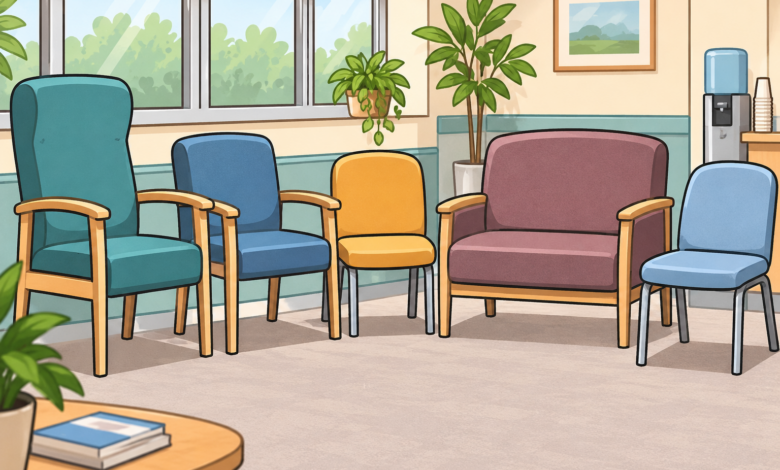
No single chair suits everyone. An accessible waiting room should offer different seating options rather than expecting every visitor to use identical furniture.
A Range of Seat Heights
A mixture of seat heights helps people with different mobility needs.
Higher seats can make standing easier for people with painful joints or reduced leg strength. Lower seats may be more comfortable for shorter visitors whose feet would otherwise hang above the floor.
The important consideration is choice. A chair that works well for one person may be uncomfortable or difficult for someone else.
Chairs With Armrests
Sturdy armrests provide support when sitting down or standing up. They can be particularly useful for people with arthritis, muscle weakness or balance difficulties.
The importance of this feature was highlighted in a 2019 Healthwatch Wolverhampton inspection of Duncan Street Primary Care Centre.
Inspectors found wooden waiting-room benches without arms to help patients stand. They recommended adding arms or providing chairs with armrests.
The practice’s response also highlighted practical difficulties involving seating capacity and funding.
Armrests are not suitable for everyone, however. Some wheelchair users need armless seating to transfer sideways, while others may need more space around the chair.
Offering both types is more useful than installing the same design throughout the room.
Bariatric Chairs and Higher Weight-Capacity Seating
Bariatric chairs are specially designed seating options that generally have wider seats, reinforced frames and higher weight capacities than standard chairs.
They are often used by larger-bodied people who need more room or stronger seating, although people with other mobility or positioning needs may also benefit.
A bariatric chair isn’t simply an ordinary chair made wider. Depending on the design, it may have reinforced legs, a stronger frame, a larger seat and armrests designed to support the chair’s intended users.
The manufacturer’s stated maximum weight capacity is particularly important, as a chair that looks substantial may not necessarily be suitable for everyone.
Bariatric seating should be part of the normal choice available in a waiting room, rather than something that a visitor has to request publicly.
Nobody should have to explain their body size or weight to reception staff simply to find somewhere safe and comfortable to sit.
Organisations should also remember that bariatric chairs take up more floor space. Their positioning must not reduce wheelchair access or block routes through the waiting area.
Supportive Backrests
A supportive backrest can reduce discomfort during long waits, particularly for people with back pain, fatigue or conditions that make maintaining one position difficult.
Seat depth, firmness and backrest angle all affect comfort.
Some people need firm support to help them stand, while others find softer seating more comfortable. Testing chairs with people who have different access needs is more reliable than judging them by appearance.
Contrasting Colours
Chairs that contrast clearly with the surrounding floor and walls can be easier for people with visual impairments to identify.
Contrast is especially helpful around seat edges and armrests, making it easier to judge where to sit and where to place a hand for support.
Wheelchair Space and Accessible Waiting Room Layouts
Even well-designed chairs are difficult to use if there is not enough space for wheelchairs, mobility scooters, walking aids or assistance dogs.
One problem I’ve encountered with both Joe and Clare is that waiting rooms often seem to have been designed around rows of ordinary chairs, with wheelchair users expected to fit into whatever gaps remain.
That can mean sitting at the end of a row, in front of other people or partly in a corridor.
With Joe, I need enough space to sit immediately beside his wheelchair, preferably close enough to hold his hand. Simply leaving a gap large enough for his chair doesn’t solve the problem if there is nowhere suitable for me to sit.
With Clare, the issue can be slightly different. She may be able to fit her wheelchair into a gap, but then other people struggle to get past.
There are also practical difficulties with reaching things.
Magazines, drinking water and other facilities may be positioned on tables or counters that Clare cannot reach easily from her wheelchair. I often have to retrieve things for her.
This means waiting-room accessibility should include the placement of everyday facilities, not simply the amount of floor space available.
Patient feedback collected by Healthwatch England in its 2024 review of NHS buildings included complaints about cramped, uncomfortable waiting rooms where seats were positioned too close together.
A further example comes from a 2013 Healthwatch visit to Liverpool’s Brownlow Practice. Visitors found that the positioning of chairs and a reception queue barrier reduced the space available for wheelchair and mobility scooter users.
The report recommended changes to the layout.
These examples illustrate why accessible waiting rooms need clear circulation routes, usable wheelchair spaces and room for companions to remain together.
A wheelchair space that obstructs a corridor or separates someone from the person supporting them is not a satisfactory arrangement.
How to Choose Accessible Waiting Room Furniture
Organisations planning a new waiting area or replacing existing furniture should involve disabled people in the decisions.
A chair may appear suitable in a catalogue but prove difficult to use in practice. People with different mobility needs can identify problems with seat height, stability, armrest position or transfer space before an organisation commits to purchasing furniture.
This approach is supported by Healthwatch Lancashire’s 2025 report on Kirkham Health Centre.
Its recommendations included providing a greater variety of waiting-area chairs to meet different patient needs and carrying out an accessibility audit involving people with lived experience wherever possible.
When choosing waiting room chairs, organisations should consider different seat heights, supportive armrests, bariatric chairs with appropriate weight capacities and furniture that allows people to transfer safely.
Specialist healthcare furniture suppliers can provide options for different settings, but organisations should assess individual products against the needs of their visitors rather than assuming that any particular chair will suit everyone.
A practical seating assessment should consider:
- Whether visitors can sit down and stand up safely.
- Whether the seat height and depth suit different users.
- Whether armrests are stable and positioned appropriately.
- Whether bariatric chairs are available, with suitable dimensions and stated weight capacities.
- Whether wheelchair users have enough room to transfer or remain in their wheelchairs.
- Whether companions can sit directly beside wheelchair users.
- Whether people can reach water dispensers, tables and other facilities.
- Whether furniture remains accessible when the waiting room is crowded.
Accessibility should also be considered alongside building requirements. In England, Approved Document M, Volume 2 provides guidance on access to and use of buildings other than dwellings, including circulation routes and facilities.
Alternative Waiting Arrangements for Disabled People
Providing better chairs will improve many waiting rooms, but some disabled people cannot comfortably remain seated for extended periods.
People with certain chronic pain conditions, spinal conditions or severe fatigue may need to change position frequently, stand, recline or lie down.
An organisation should consider whether it can offer an alternative waiting arrangement when ordinary seating is unsuitable.
Depending on the setting and available facilities, options might include allowing someone to wait in a quieter room, offering a suitable place to recline or contacting them when their appointment is ready.
These arrangements should be discussed with the person concerned rather than assuming what they need.
For some visitors, a different chair is enough. For others, the most useful adjustment is avoiding a prolonged wait in the main seating area altogether.
What Can Disabled People Do When Waiting Rooms Are Inaccessible?
Although healthcare providers should make their waiting areas accessible, improvements do not always happen quickly. There are a few things disabled visitors and their families can do to make appointments more comfortable in the meantime.
- Bring a small cushion if it helps. Some hospital chairs are hard or offer little support. A familiar pressure-relieving or supportive cushion may make waiting more comfortable, provided it is suitable for your seating needs and does not make the chair unstable.
- Take your own drink. Water dispensers may be difficult to reach from a wheelchair, particularly if they are positioned behind furniture or at an unsuitable height. Bringing a drink in an accessible bottle can be useful, especially during longer waits, where drinking is permitted and there are no medical restrictions.
- Explain if you need to stay beside someone. If you’re accompanying someone who needs reassurance or assistance, ask reception whether seating can be rearranged so you can remain close to them.
- Ask about alternative waiting arrangements. If sitting for long periods causes pain or fatigue, reception may be able to arrange somewhere more suitable to wait or contact you when your appointment is ready.
- Tell staff if a wheelchair space blocks a walkway. You shouldn’t have to choose between being able to wait comfortably and obstructing access for other people. Ask whether furniture can be repositioned safely.
These are ways of dealing with existing barriers, not substitutes for accessible facilities. Disabled people should not have to bring extra equipment or supplies simply because a waiting room has not been designed around their needs.
How Disabled Visitors Can Request Reasonable Adjustments
If a waiting room does not meet your needs, you can ask the organisation about reasonable adjustments.
Possible requests include:
- Suitable seating: Ask whether a higher chair, a chair with armrests, a bariatric chair or another seating option is available.
- Wheelchair space: Request enough room to wait in your wheelchair alongside a companion, without blocking access routes.
- Space for support: Explain if a family member, carer or personal assistant needs to remain close enough to provide reassurance or practical help.
- Alternative waiting arrangements: Ask whether you can wait somewhere quieter or in a position that is more comfortable.
- Appointment notifications: Check whether reception can telephone or text you when it is time for your appointment.
- Feedback: Explain any accessibility barriers to the organisation’s patient experience team, practice manager or complaints service.
Under the Equality Act 2010, service providers in Great Britain have a duty to make reasonable adjustments for disabled people.
This duty is anticipatory for service providers, meaning organisations should consider barriers disabled people may face without waiting for every individual to complain.
Visitors can still request adjustments that meet their particular needs, but responsibility for accessibility should not rest entirely on disabled people having to identify and explain problems repeatedly.
If a suitable arrangement is not immediately available, staff should discuss what alternatives might be possible.
How to Report Accessibility Problems in NHS Waiting Rooms
If you regularly encounter problems with seating or wheelchair access at a hospital or GP surgery, reporting them can help identify changes that would benefit other patients.
It is worth directing feedback to someone who can act on it, rather than relying on a passing comment to a member of clinical staff.
Who Should You Contact About Inaccessible NHS Waiting Rooms?
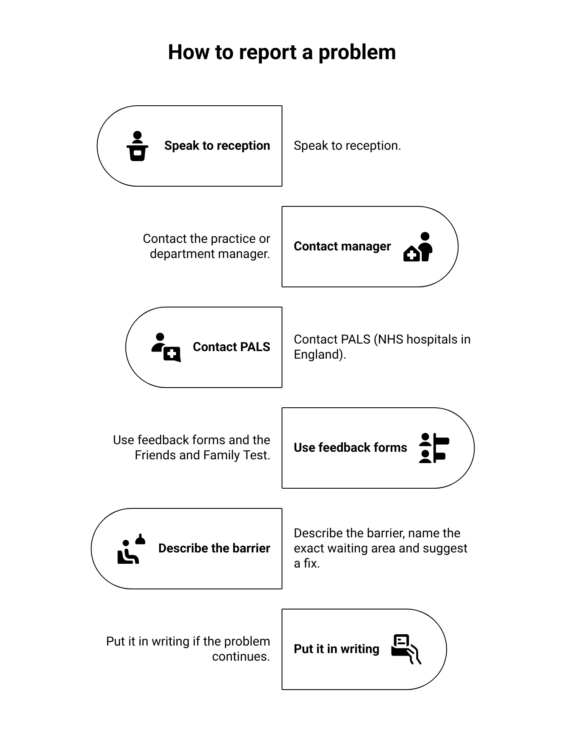
- Speak to reception first. Reception staff may be able to arrange an immediate adjustment, such as moving a chair, finding suitable wheelchair space or offering somewhere else to wait.
- Contact the appropriate manager. For ongoing problems, ask for your concerns to be passed to the practice manager, outpatient department manager or facilities team. They may have more responsibility for furniture and waiting-room layouts than clinical staff.
- Contact PALS at NHS hospitals in England. The Patient Advice and Liaison Service (PALS) can help patients and families raise concerns about hospital services, including accessibility problems. Contact details are usually available through the hospital’s website or reception.
- Use patient feedback forms and surveys. Patient experience surveys and the NHS Friends and Family Test provide opportunities to report seating problems, inaccessible facilities and inadequate wheelchair space.
- Explain what needs changing. Rather than simply reporting that a waiting room was uncomfortable, describe the barrier and suggest a practical improvement. This might mean adding chairs with armrests, providing bariatric seating or leaving space for companions beside wheelchair users.
- Identify the exact waiting area. Large hospitals may have dozens of waiting rooms. Give the clinic, department or reception area where the problem occurred, and explain which part of the layout caused difficulties.
For example, explaining that a particular outpatient clinic has fixed seating that prevents wheelchair users from sitting beside their companions gives staff something specific to investigate.
You could also mention a narrow aisle, an obstructed wheelchair space or a water dispenser that cannot be reached from a wheelchair.
If the same problem continues, consider putting your concerns in writing and asking for a response from the relevant manager or patient experience team.
You do not have to make a formal complaint simply to raise an accessibility concern, although the NHS complaints process is available if the problem is not resolved.
The aim is to make waiting rooms more accessible for everyone, rather than leaving each disabled visitor to deal with the same barriers individually.
How Healthcare Providers Can Improve Waiting Room Accessibility
An accessible waiting room offers more than somewhere to sit.
Different seat heights, supportive armrests, bariatric seating, clear visual contrast and sufficient wheelchair space can all make a difference. So can having an alternative for visitors who cannot comfortably remain seated.
My experiences attending hospital appointments with Joe and Clare have shown me how easily waiting-room layouts can create problems that might not be obvious to someone choosing the furniture.
A wheelchair space needs to be somewhere a person can actually use, without obstructing others or being separated from the people accompanying them.
Involving disabled people and their families in planning and testing waiting areas helps organisations identify these barriers before they become everyday problems.
A waiting room should allow people to prepare for their appointment without unnecessary discomfort, avoidable access barriers or having to repeatedly ask for basic consideration.
Frequently Asked Questions About Accessible Waiting Rooms
What makes a waiting room accessible?
An accessible waiting room provides a choice of seating, different chair heights, chairs with and without armrests, bariatric seating, wheelchair spaces and clear routes. Disabled visitors should be able to sit beside companions, reach everyday facilities and request alternative waiting arrangements where needed.
What is the best seat height for accessible waiting room chairs?
There is no single seat height that suits everyone. Higher chairs can make standing easier for people with painful joints or reduced leg strength, while lower chairs may suit shorter visitors. Waiting rooms should provide a choice of seat heights.
Should accessible waiting room chairs have armrests?
Waiting rooms should provide chairs both with and without armrests. Sturdy armrests can help people sit down and stand up, while armless chairs may make sideways transfers easier for some wheelchair users.
What is a bariatric waiting room chair?
A bariatric waiting room chair generally has a wider seat, reinforced construction and a higher weight capacity than a standard chair. Healthcare providers should check the manufacturer’s stated weight capacity and make suitable seating available without requiring visitors to explain their weight publicly.
How should waiting rooms accommodate wheelchair users?
Waiting rooms should provide wheelchair spaces that do not obstruct walkways, with seating for companions directly beside them. Wheelchair users should also have enough room to move around and reach facilities such as drinking water and tables.
Can I request a reasonable adjustment if I cannot sit in a hospital waiting room?
Yes. You can ask about suitable seating, somewhere quieter to wait, a place to recline or a telephone or text notification when your appointment is ready. The appropriate adjustment will depend on your needs and the circumstances.
Do NHS waiting rooms have to be accessible?
Under the Equality Act 2010, service providers in Great Britain have a duty to make reasonable adjustments for disabled people. This includes considering accessibility barriers in advance rather than relying on individual patients to report every problem.
How do I complain about an inaccessible NHS waiting room?
Raise the problem with reception staff or the relevant department or practice manager. At NHS hospitals in England, the Patient Advice and Liaison Service (PALS) can help you raise concerns. Identify the specific waiting area, explain the barrier and describe what needs changing.
