Avery’s House: Neurodiversity-Affirming Teen Mental Health Care in Arizona and Idaho
What Is Avery’s House Teen Mental Health Program?
| Feature | Details |
|---|---|
| Location | Multiple sites: Scottsdale, Apache Junction & Fountain Hills, AZ; Boise, ID |
| Type | Residential and outpatient teen mental health treatment centre |
| Accessibility | Neurodiversity-affirming clinical framing for ADHD/autism; home-like, small-group residential settings; no physical/sensory access features (ramps, hearing loops) publicly documented |
| Customer Reviews | Google reviews describe staff as attentive and facilities as clean and home-like; no disability-specific access feedback found |
| Contact | averyshouse.com; (855) 506-1906 |
About Avery’s House
Avery’s House operates as a family of teen residential treatment homes rather than a single clinic, with locations in Scottsdale, Apache Junction, and a planned Fountain Hills programme called The Nest, alongside a separate facility in Boise, Idaho. The organisation treats a broad range of conditions in adolescents aged 12 to 17, including ADHD, anxiety, depression, and substance use, working primarily through insurance-based referrals rather than walk-in public access.
What Accessibility Features Does Avery’s House Offer for Neurodivergent Teens?
The most concrete accessibility-relevant commitment is The Nest, a dedicated neurodivergent treatment programme launching Fall 2026 in Fountain Hills, AZ, described as offering “neurodiversity-affirming care” specifically for ADHD, autism, and related presentations. Beyond this clinical framing, the company’s public materials emphasise home-like, small-group residential settings and one-on-one therapeutic support, but there is no publicly available evidence of physical accessibility features such as step-free access, hearing loops, or sensory-adapted spaces. Given this is a specialised mental health facility rather than a public venue, a meaningful improvement would be publishing explicit information on physical access accommodations for teens with co-occurring physical or sensory disabilities.
Why Neurodiversity-Affirming Mental Health Care Matters for Disabled Teenagers
Using the Social Model of Disability, the value of a programme like The Nest lies in adapting the environment and clinical approach to neurodivergent young people rather than expecting them to conform to neurotypical treatment norms, which reduces a common barrier in mental healthcare access for autistic and ADHD teens. Framing ADHD and autism as differences requiring accommodation, not deficits requiring correction, aligns with how neurodiversity advocates argue treatment settings should operate. This shift matters particularly for family accessibility, since Avery’s House builds in structured family therapy and parent support groups, reducing communication barriers between clinicians and families navigating a first diagnosis.
How Avery’s House Helps Families Recognise ADHD Instead of Mistaking It for “Laziness”
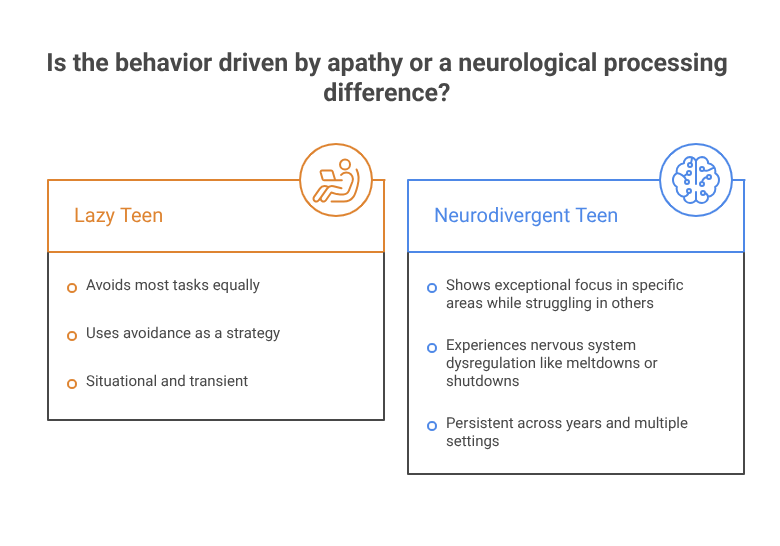
One way Avery’s House puts its neurodiversity-affirming approach into practice is by helping families distinguish genuine neurological differences from what looks, on the surface, like a lack of motivation. Most parents hit this wall at some point: your teenager seems unmotivated, forgetful, or checked out. But is that laziness, or something neurological? A teen who looks disengaged isn’t automatically being difficult; plenty of the time, that behavior masks a brain that processes differently.
The overlap between neurodivergence and what looks like “laziness” can catch even careful parents off guard. The question is ADHD neurodivergent in teens helps explain how ADHD fits within the broader neurodivergent framework and why it is so often mistaken for a behavior problem. A teen with ADHD might forget homework several nights in a row, not because they do not care, but because working memory challenges make it genuinely difficult to keep tasks in mind. A teen with dyslexia may avoid reading assignments, not out of stubbornness, but because each line of text requires significant effort.
Signs Clinicians Look for When Assessing ADHD and Neurodivergence
- Inconsistency across tasks: exceptional focus in one area, complete difficulty in another — a strong signal of processing differences rather than laziness.
- Effort without result: visible effort that doesn’t produce the expected outcome, suggesting a processing difference.
- Emotional dysregulation around demands: disproportionate frustration or shutdown when facing tasks that tap weak areas — a nervous system response, not defiance.
- Long-standing history: patterns that show up early, persist across years, and appear at home, school, and socially.
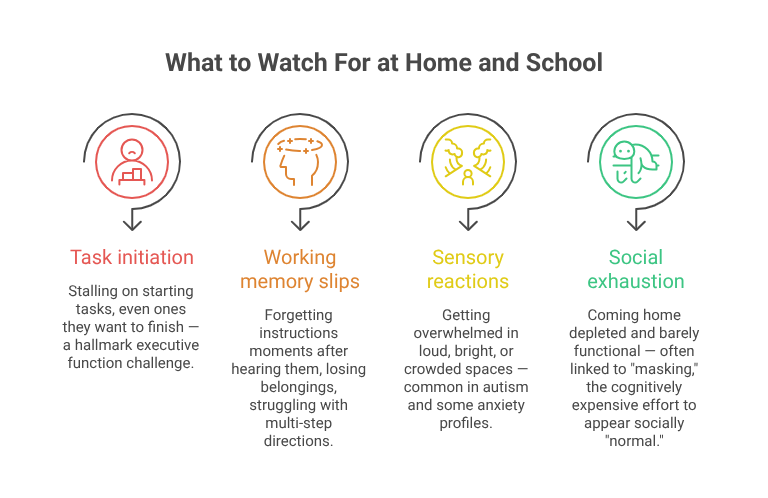
Clinicians at facilities like Avery’s House also work with families on cross-contextual observation before any formal diagnosis, watching task initiation, working memory slips, sensory reactions, and social exhaustion (masking) at home and at school. Where cost or access is a barrier, professional evaluation pathways such as school-based assessments under IDEA (Individuals with Disabilities Education Act) offer a legitimate starting point.
Should Families Consider Avery’s House for Neurodivergent Teen Mental Health Care?
Avery’s House stands out chiefly for treating neurodivergent conditions as differences to be supported rather than problems to be fixed, most visibly through its upcoming Nest programme and its practical approach to distinguishing motivation issues from genuine neurological difference. Its accreditation and BBB rating suggest a credible standard of clinical care, though the absence of published physical-accessibility information leaves a gap for families whose teens have co-occurring mobility, sensory, or communication access needs.
FAQs about Avery’s House Teen Residential Services
What is Avery’s House?
Avery’s House is a residential and outpatient mental health provider for teenagers aged 12 to 17 with locations in Arizona and Idaho. It supports young people experiencing ADHD, autism-related challenges, anxiety, depression and other behavioural or mental health conditions.
Does Avery’s House provide neurodiversity-affirming care?
Yes. Avery’s House has introduced neurodiversity-affirming treatment through its upcoming Nest programme, which is designed for autistic teenagers and young people with ADHD and related neurodivergent experiences.
Is Avery’s House accessible for disabled teenagers?
Its published information focuses on neurodiversity-affirming clinical care and small residential settings. However, it does not currently provide detailed information about physical accessibility, sensory adaptations or communication access on its public website.
Where are Avery’s House treatment centres located?
Avery’s House operates in Scottsdale, Apache Junction and Fountain Hills in Arizona, as well as Boise, Idaho.
Does Avery’s House involve families in treatment?
Yes. Family therapy, parent education and ongoing communication form part of its treatment approach, helping families understand and support neurodivergent teenagers.