
Top 10 tips to finding the right personal assistant
How to Find the Right Personal Assistant

10 Tips that Disabled People Actually Use
Finding the right personal assistant (PA) can genuinely change how your day-to-day life works – from getting out of the house to holding onto your job, your social life, or simply the routines that matter to you. But most guides repeat the same surface-level advice. These 10 tips go deeper, covering what disabled people actually learn through experience – often the hard way.
| What matters | Why it makes a difference |
|---|---|
| Understanding your lifestyle | Support works better when it fits your real life, not just basic tasks |
| Clear, specific job ads | Attracts people who actually suit you |
| More than one PA | Reduces risk if someone is off sick or leaves suddenly |
| Boundaries from the start | Prevents awkward or difficult situations later |
| Honest communication | Helps avoid early breakdowns in the working relationship |
1. Map Your Life, Not Just Your Care Needs
Before writing a job ad, think beyond the practical tasks – washing, dressing, cooking. Those matter, but they’re only part of the picture. What social activities, work commitments, hobbies, and cultural interests do you want to maintain? What does a good week actually look like for you?
A PA who understands your personality, values, and personal history will always be more effective than someone who only follows a checklist. Your job description should reflect your whole life – not just your disability. If you’re not sure where to start, think about the things that would fall apart without good support, and build from there.
2. Write a Job Ad That Sounds Like You
Generic job ads bring in generic applications. If you want someone who fits your life, your ad needs to reflect it. Most listings focus on duties – yours should also signal your lifestyle, communication style, values, and what kind of working relationship you’re looking for.
Be specific about your interests, where you live, work, or study, and the type of person you’d actually get along with. Age, pace of life, shared interests – these all matter in a role this personal. Specificity helps people decide early on whether they’re a genuine fit, which saves everyone time.
3. Recruit More Than One PA From the Start
This is one of the most underemphasised pieces of advice out there. Relying on a single PA creates pressure on both sides – and if they’re ill, on holiday, or leave suddenly, your support disappears overnight.
Having at least two PAs from the outset – even if one works fewer hours – gives you flexibility, stability, and breathing room. It makes scheduling easier and significantly reduces stress in the long run. Think of it less as a luxury and more as a basic safeguard.
4. Think Carefully Before Hiring a Friend
It feels like the easiest option. Sometimes it works well. Often, it changes the relationship in ways nobody anticipated. The moment money, rotas, and employment law enter a friendship, the dynamic shifts – and not always in a direction either person expected.
If you do go down this route, treat it as a formal business relationship from day one: a proper contract, a clear job description, agreed boundaries, and regular supervision. Goodwill alone isn’t enough to hold a working relationship together when things get difficult.

From our experience it’s better that PAs transition to good friends rather than the other way around! You never want to be in a position where you lose a good friend and a PA at the same time because of work issues. – Duncan, Editor
5. Use Peer Networks, Not Just Agencies
Agencies are one route, but they’re not the only one – and often not the best first stop. Many disabled people share advice, experiences, and even PA recommendations through peer networks. These spaces tend to be more honest about what actually works, and what doesn’t.
Sites like PA Pool and Being the Boss offer browsable PA databases alongside forums where real disabled employers share candid experiences. That kind of insight is hard to find in any agency brochure. Local organisations and Centre for Independent Living (CIL) groups are also worth contacting – they often know the landscape in your area better than anyone.
6. Ask the Right Questions at Interview – Including the Uncomfortable Ones
An interview tells you far more about how someone thinks and reacts in practice than any checklist ever will. Prepare a structured question list that covers practical experience – lifting and handling, use of equipment, relevant conditions – but also attitude and values.
Questions around privacy, confidentiality, and communication often reveal far more than experience alone. Asking directly, “What does confidentiality mean to you?” is a simple but underused question that can tell you a lot. Don’t avoid the difficult topics to keep things comfortable – that’s what the interview is for.
Beyond asking about hoisting experience etc, look out for candidates who’ve taken the initiative to upskill – such as completing a pre-nursing degree online – as this signals genuine commitment to care.
7. Be Upfront About the Difficult Parts
Many disabled people downplay the more complex aspects of their support needs during recruitment – out of embarrassment, or fear of putting someone off. But avoiding these conversations early on is one of the most common reasons PAs leave within the first few weeks.
Being clear about your needs – including the more personal, unpredictable, or challenging ones – is the only reliable way to find someone who is genuinely comfortable in the role. That honesty is better for both of you. A PA who knows what they’re taking on is far more likely to stay.
8. Treat It as an Ongoing Working Relationship
Hiring a PA isn’t a one-off decision – it’s the start of a working relationship that needs ongoing attention. Research consistently shows that poorly defined roles and unclear expectations are the biggest cause of breakdown between disabled employers and their PAs.
Regular check-ins, clear communication, and space to raise issues early all make a meaningful difference. When things are left unsaid, small problems have a way of growing. Building in time to review how things are going – even informally – keeps the relationship healthy on both sides. According to Disability Rights UK, clear communication and role boundaries are central to making direct employment work well over time.
9. Know Your Legal Responsibilities as an Employer
If you’re using a Direct Payment or Personal Budget to employ a PA directly, you’re not just organising support – you’re taking on legal responsibilities as an employer. That includes contracts, holiday pay, National Insurance contributions, and potentially pension contributions too.
None of this has to be overwhelming, but it does need to be understood. Your local Centre for Independent Living (CIL) can often provide free HR support and help you stay on the right side of employment law. Failing to get this right creates financial and legal headaches that are entirely avoidable with the right guidance in place.
10. Trust Your Judgement – But Give It a Fair Trial Period
Instinct matters enormously in a role this personal. If something doesn’t feel right in an interview, it’s worth paying attention to that. But early awkwardness is also normal – it genuinely takes time to build a working rhythm with someone new.
Building a formal trial period into your contract – typically four to twelve weeks – gives both of you a clear, low-stakes way to see how things work in practice. If it’s not the right fit, it’s easier to step away without it becoming complicated. As noted in discussions on Scope’s hiring forum, a trial period protects both the employer and the PA, and sets a healthier tone from the start.
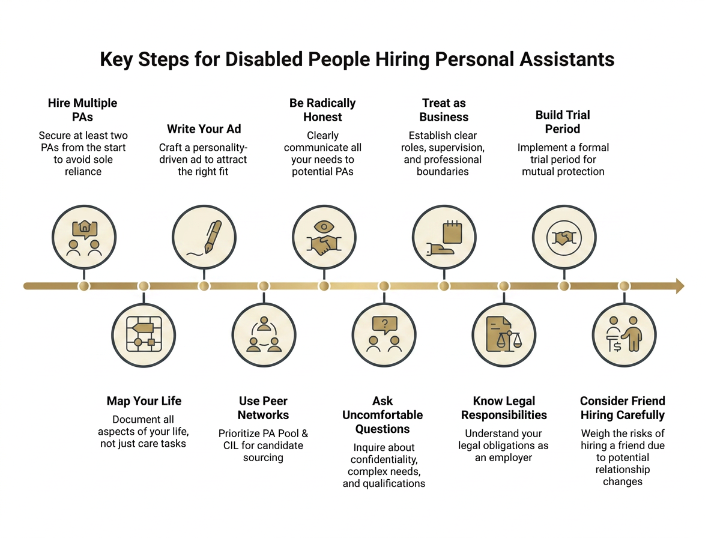
Finding the Right PA Is About Fit, Not Perfection
There isn’t a single ideal PA. What works well for one disabled person might not work for another – and that’s the point. The goal is to find someone who fits your life, respects your choices, and works with you to remove the barriers that get in the way of how you want to live.
It takes time, and occasionally it takes a few attempts. But getting the right support in place makes an enormous difference – not just to the practical side of daily life, but to your independence, confidence, and wellbeing. The effort is worth it.
Frequently asked questions about hiring a personal assistant
How many personal assistants should I have?
Most disabled people benefit from having at least two PAs. This reduces risk if someone is off sick, on holiday, or leaves unexpectedly, and makes it easier to maintain consistent support.
What should I include in a personal assistant job description?
Your job description should reflect your full lifestyle, not just care tasks. Include your routines, interests, communication style, and expectations so applicants understand how the role works in practice.
Can I hire a friend as a personal assistant?
You can, but it changes the relationship. Clear boundaries, a written contract, and agreed expectations are essential to avoid problems later on.
What questions should I ask in a PA interview?
Ask about practical skills, but also how they approach privacy, communication, and boundaries. Real-life scenarios often reveal more than qualifications.
What are my responsibilities as a PA employer?
If you employ a PA directly, you are responsible for contracts, pay, holiday entitlement, and other legal requirements. Local support organisations can help you manage this.
Originally posted on 12/01/2017 @ 12:35 am
