Managing Several Long-Term Medications: A Practical Guide to Repeat Prescriptions, Timings and Reviews

Taking one medicine is straightforward. Taking four, each on its own repeat cycle, some with food, some without, one that has to be spaced away from another, is a different proposition entirely.
Separate prescription cycles, different collection dates and medicines prescribed by different services can create a considerable amount of admin. Often, nobody in the system has responsibility for looking at the whole list at once. This guide looks at ways to reduce that workload and make better use of the services that can help.
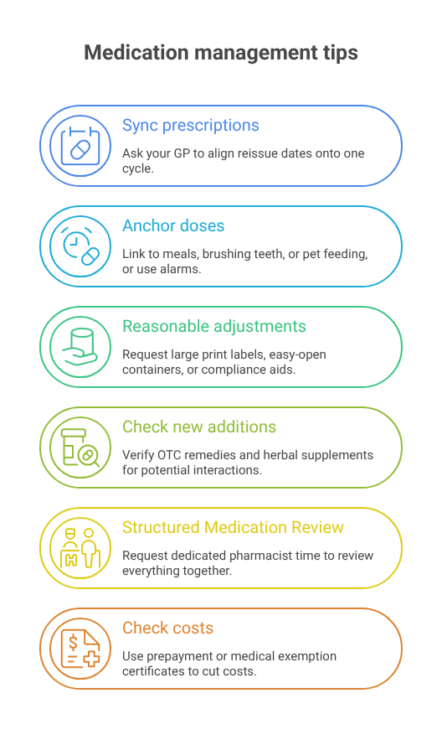
Key medication management tips
- Get your repeat prescriptions onto one cycle. Ask your GP practice to align the reissue dates so you are not ordering something different every fortnight.
- Anchor doses to things you already do, if that suits how you think. Meals, brushing your teeth, feeding a pet. Others find alarms work better. There is no single right method.
- Reasonable adjustments are your right, so ask for them. Large print labels, easy-open containers and, where assessed as necessary, a compliance aid can all fall under the Equality Act 2010.
- Ask before adding anything new. Prescriptions from a different specialist, over-the-counter remedies and herbal supplements can all interact with what you already take.
- Ask for a Structured Medication Review. Dedicated time with a pharmacist to look at your medicines together and check how well they are working for you.
- Check you are not overpaying. A prepayment certificate or a medical exemption certificate can save a substantial amount if you collect several items a month.
How to synchronise repeat prescriptions
If you are managing several conditions, it is common to end up with repeats falling due at different intervals. One every ten days, another every four weeks, a third every two months. Each one is a separate order, a separate collection and a separate opportunity to run out of something at an inconvenient moment.
For a lot of people the harder part is not remembering to take the tablets. It is remembering which prescription needs ordering this week.
Getting several prescriptions out of sync
“I take several blood-pressure tablets, and they were introduced at different times rather than all at once. That meant they ended up on different prescription cycles and would run out at different points in the month.
I found that surprisingly difficult to keep on top of. You might have plenty of one tablet left but be getting close to the end of another, so simply knowing that you’ve ‘done the prescription’ isn’t necessarily enough.
For me, this is one of those bits of medication admin that sounds minor until you’re doing it month after month. If you take several regular medicines, it’s worth asking whether the prescription dates can be brought together. Having fewer dates to remember removes one more opportunity to suddenly realise that something is about to run out.”
— Duncan Edwards, Editor
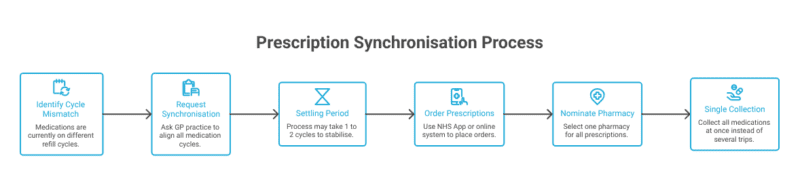
Most GP practices can synchronise your repeat items onto a shared reissue date so everything arrives together. This is worth asking for directly, because it is rarely offered without prompting.
Among patients regularly prescribed five or more medicines, only 53.3% received any kind of medication review in 2022 — and just 17.2% received a full Structured Medication Review, the more thorough, pharmacist-led check the NHS specifically recommends for this group.
Bear in mind it can take a cycle or two to settle, as some quantities may need adjusting to bring everything into line.
Ordering through the NHS App or your practice’s online system helps as well, since your whole repeat list sits in one place and you can see at a glance what is due.
You can also nominate a single pharmacy to receive all your electronic prescriptions, which means one collection or one delivery rather than several. That nomination can be a local pharmacy or an online one, whichever fits how you actually live. You can change it at any time.
I thought I had emergency tablets. I didn’t.
“I was caught out once with my ramipril because I thought I had some spare tablets in the travel pouch where I keep medicines for short trips away.
I hadn’t emptied the pouch, and in my mind that meant there were still spare tablets in it. When I actually checked, there weren’t. I was worried because this was regular blood-pressure medication and I didn’t want to simply stop taking it while I waited for another prescription.
I contacted the pharmacy, explained what had happened and was able to get an emergency supply.
It taught me something very simple that I still find useful: don’t leave tablets in different places and unpack and consolidate any you take on holiday.”
— Duncan Edwards, Editor
Reasonable adjustments for managing medication
This is the part most people are never told about. Under the Equality Act 2010, health services including pharmacies have a duty to make reasonable adjustments so that disabled people are not placed at a substantial disadvantage. What counts as reasonable depends on your circumstances, but in practice it can include:
- Large print labels if standard dispensing labels are difficult to read.
- Non-child-resistant closures or easy-open containers if you have limited grip or dexterity.
- Braille or alternative format information.
- Support with getting your medicines where travelling to a pharmacy is the barrier, which may include delivery.
- A multi-compartment compliance aid, sometimes called a dosette box, where an assessment identifies a specific need.
Two points worth being precise about, because they are often described more loosely than they should be.
First, these are not automatic entitlements you can simply select from a list. The duty is to make adjustments that are reasonable in your particular case. The conversation should start with the barrier you are experiencing, so the pharmacist can consider which adjustments would address it.
Second, compliance aids come with a caveat that is frequently glossed over.
Royal Pharmaceutical Society guidance is clear that original packs of medicines, supported by appropriate pharmaceutical care, should be the preferred option in the absence of a specific assessed need.
The Care Quality Commission takes the same position, noting that a compliance aid should be considered only where a health professional has carried out an assessment in line with the Equality Act and identified a specific need. Part of the reasoning is practical: not every medicine is stable once removed from its original packaging, and repackaging introduces its own risk of error.
Where a pharmacist assesses a specific need, a compliance aid may be provided as a reasonable adjustment. Where no such need is identified, it is a private service and the pharmacy may charge. If you think a compliance aid would genuinely help, ask the pharmacist to assess what support would work for you and what alternatives are available.
When carers administer the medication
“We’ve also used pharmacy-prepared blister packs for my son. He has care support, and the care agency required his medicines to be prepared so that carers could administer the correct medication at the correct time.
The agency also required MAR charts — Medication Administration Records — to record the medication being given.
Until you’ve had care workers supporting someone with medication, you might never have come across a MAR chart. Suddenly it becomes an important part of the system.
Our experience made me realise that medication management can involve far more than getting a prescription and remembering a dose. When family members, pharmacists and paid carers are all involved, there needs to be a clear record of what should be given and what has actually been given.
If you’re arranging care for someone, I’d ask the care provider about their medication procedures early rather than finding out after the support has started.”
— Duncan Edwards, Editor
Managing medication timings and reminders
Remembering when to take what is usually harder than remembering to take anything at all, particularly when doses are spread across the day or depend on food.
A pill organiser can take hours to prepare
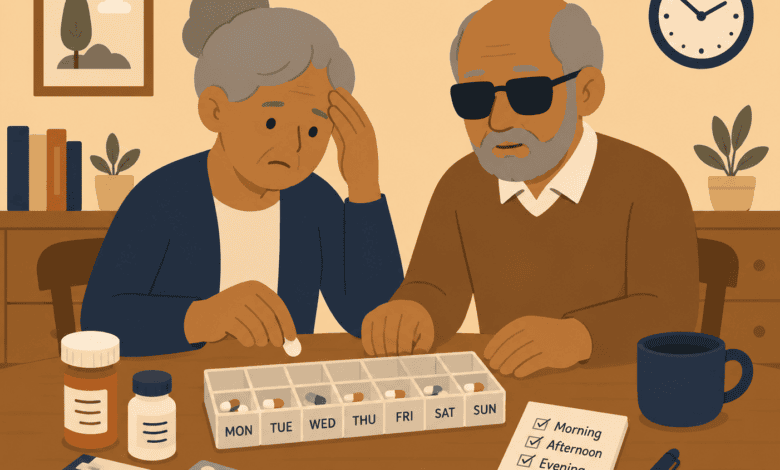
“I’ve found pill organisers really useful when someone takes a lot of medicines, but there’s another side to them that isn’t always talked about: somebody has to sit down and fill all those compartments.
I have a relative who is completely blind, and his wife prepares a month’s medication for him. With the number of tablets he takes, it can take her around two hours.
That’s a considerable amount of medication admin being done by a family member before the organiser ever becomes useful to the person taking the tablets.
I think that’s worth remembering when we talk about pill organisers as a simple solution. They certainly can make medication easier to manage, but if someone takes a large number of tablets, filling the organiser accurately can become quite a substantial regular job in its own right.”
— Duncan Edwards, Editor
What happens when the prescription changes?
“One month, my relative’s wife had already spent a long time putting a whole month of her husband’s medicines into his pill organisers when his consultant changed one of the medicines.
Suddenly she had to go back through all those compartments and remove the tablet that was no longer supposed to be there.
What worried me was that several of the tablets looked very similar. Once medicines have been taken out of their original packaging, identifying one small tablet among several others isn’t necessarily straightforward.
I thought there was too much potential for a mistake, so I suggested she explain the situation to the consultant and ask whether the medicines could be prescribed again so that she could start from scratch.
It made me much more aware that medication changes can create practical safety problems that aren’t obvious when a new prescription is issued.”
— Duncan Edwards, Editor
Some people find it easier to attach each dose to something that already happens reliably. Morning medicines straight after brushing your teeth. Evening ones when the kettle goes on.
This builds the dose into something you already do every day.
Others find that routines are exactly what fluctuating conditions disrupt, and that alarms or a medication reminder app are more dependable precisely because they do not assume the day will follow a shape. Where doses need genuine spacing rather than grouping, a timed prompt tends to be necessary either way.
Try whichever approach seems most likely to work with your day. If it stops working, change it.
It is also worth keeping a current written list of what you take, at what dose and when, somewhere accessible. Beyond your own reference, it matters if you ever need urgent care and someone unfamiliar with your history needs the full picture quickly. Your phone’s medical ID or emergency information screen works well for this, because it can be read without unlocking the device.
Checking medication interactions and new medicines
The more medicines you take, the greater the chance that something new interacts with something existing. This matters most if you see more than one specialist, because there is no guarantee each has full visibility of what the others have prescribed.
Why I’m careful about changes to my son’s epilepsy medication
“My son has severe epilepsy, so I’ve become particularly careful about continuity of his anti-seizure medication.
We’ve had situations where a pharmacy has supplied, or wanted to supply, a generic medicine from a different manufacturer. We were advised that for my son it was important to be careful about changing between products, because even subtle differences could potentially matter in his circumstances.
That changed the way I look at substitutions. If the box or manufacturer is different, I don’t automatically assume it is an insignificant change simply because the name of the medicine and dose are the same.
There is official guidance about maintaining continuity with some anti-seizure medicines, although the advice differs according to the particular medicine and the individual. In our son’s case, I want to know if his usual product is being changed and check that the change is appropriate for him rather than finding out after we’ve taken the medication home.”
— Duncan Edwards, Editor
The category people most often overlook is the things that do not feel like medicines. Herbal remedies and supplements can have significant effects. St John’s Wort is the standard example, because it reduces the effectiveness of hormonal contraception, anticoagulants, some antidepressants and immunosuppressants, and it is sold freely on the high street.
A pharmacist can usually check an interaction in a couple of minutes, often while you are already collecting something. With your consent they can also access your Summary Care Record, which lists your medicines and allergies, so the check is against your actual record rather than your recollection of it.
If you have recently been prescribed a medicine for certain long-term conditions, you may be eligible for the NHS New Medicine Service. It is a free service through community pharmacies offering structured follow-up over the first few weeks, which is exactly when side effects and practical problems tend to surface. Eligible conditions include asthma and COPD, type 2 diabetes, high blood pressure and depression, along with people newly started on antiplatelet or anticoagulant therapy. The full eligible drug list is published by the NHS Business Services Authority, and your pharmacist can tell you in a minute whether you qualify.
How to ask for a medication review
If you take several regular medicines, it is worth asking for a review that looks at the whole list together.
The NHS Structured Medication Review exists for this. It is a dedicated appointment, usually with a clinical pharmacist attached to your GP practice or primary care network, to go through everything you take, check the combination is still right for you and pick up anything that has drifted. It was introduced across primary care in England in October 2020 specifically to address complex polypharmacy.
Practices are asked to prioritise certain groups. NHS England’s guidance names people living with frailty, people in care homes, people taking ten or more medicines, people on medicines commonly associated with errors, and anyone taking medicines associated with dependence or withdrawal, including opioids, gabapentinoids, benzodiazepines, Z-drugs and antidepressants. If you recognise yourself in that list and have not been invited, you can ask.
A review is more useful if you arrive with specifics. It can help to make a note of:
- Any medicine you would like to stop taking, and why.
- Anything you have stopped taking or do not take regularly.
- Side effects you have been putting up with but would rather not live with.
- Any doses or timings that do not fit easily into your day.
Don’t feel that you are confessing to doing something wrong. Being open about what you take, what you have stopped taking and what is difficult to manage helps the pharmacist understand what is actually working for you.
“People often assume a review is about being told to take things properly. It is much closer to the opposite. Quite often the outcome is stopping something that is no longer doing anything useful, or changing a dose so it fits around someone’s day rather than the other way round,” says Ana Carolina Goncalves, Superintendent Pharmacist at Pharmica online pharmacy.
Prescription costs, exemptions and prepayment certificates
Prescription charges are a genuine cost when you collect several items a month, and a lot of people pay more than they need to.
In England the charge is £9.90 per item, frozen for 2026/27 for the second year running. A prescription prepayment certificate covers unlimited items for a flat fee: £32.05 for three months or £114.50 for twelve, both also frozen. It pays for itself at more than three items in three months, or more than eleven in twelve, which most people managing multiple conditions will pass comfortably. There is also a separate HRT-specific certificate at £19.80 a year.
Separately, a medical exemption certificate gives free prescriptions to people with certain conditions. The qualifying list is quite specific and includes:
- A continuing physical disability that means you cannot go out without another person’s help.
- Epilepsy requiring continuous anticonvulsive therapy.
- Diabetes mellitus, except where it is treated by diet alone.
- Hypoadrenalism, such as Addison’s disease.
- Hypoparathyroidism.
- Hypopituitarism, including diabetes insipidus.
- Myasthenia gravis.
- Myxoedema requiring thyroid hormone replacement.
- A permanent fistula requiring continuous dressing or an appliance.
- Cancer, including treatment for cancer or the effects of cancer or its treatment.
The certificate covers all of your prescription items, not only those relating to the qualifying condition. You apply through your GP practice.
Prescriptions are free in Scotland, Wales and Northern Ireland, so this section applies to England only.
When to get help with medication problems
Sometimes there are other options when you run out
“I have a family member who has constipation and uses micro-enemas. There have been occasions when we’ve needed more than the quantity available on the monthly prescription and have been in danger of running out before another prescription was due.
We found that the particular product we use could also be bought from a pharmacy without a prescription. It wasn’t something sitting on the pharmacy shelves where you would necessarily see it, so we only found out because we asked.
Some pharmacists have been able to sell us a small quantity, which gave us another option when the prescribed supply wasn’t enough.
I wouldn’t assume that this applies to every medicine or product. What I took from the experience was simply to ask. A pharmacist may know about an option that isn’t obvious from looking around the shop, and they can tell you what is appropriate in your particular circumstances.”
— Duncan Edwards, Editor
Most medication management is routine. Some things are worth raising with a pharmacist or your GP promptly rather than holding until your next scheduled appointment:
- A new symptom appearing shortly after starting or changing a medicine.
- Doses becoming harder to keep on top of, or being missed more often than they used to be.
- Two prescribers changing something without sight of each other’s notes.
- Feeling noticeably different, physically or mentally, without an obvious reason.
It is worth raising these things early with your pharmacist or GP, even if you are unsure whether they are significant. If you are not sure how quickly you need to act, NHS 111 can advise, and your pharmacy may also be able to help the same day.
Running out isn’t always something you can leave until tomorrow
“My experiences with my own blood-pressure medication and my son’s epilepsy medication have made me much more cautious about running out.
Some medicines shouldn’t simply be stopped suddenly, and anti-seizure medication is an obvious concern for us because my son has severe epilepsy. My experience with running out of ramipril also taught me not to assume that missing regular medication is something I should make my own judgement about.
At the same time, I don’t think it’s helpful to frighten people by suggesting every missed tablet is an emergency. Different medicines carry different risks.
My approach now is to ask someone who knows. If an important regular medicine is running low or has already run out, I contact the pharmacist, GP or NHS 111 and explain exactly what has happened. I’d much rather sort the problem while there is still time than be looking for a solution when the next dose is already due.”
— Duncan Edwards, Editor
A smaller number of things should not wait at all. Seek urgent medical help by calling 999 or going to A&E if you experience signs of a serious allergic reaction such as swelling of the face, lips or throat, difficulty breathing or a widespread rash, if you develop a severe or blistering skin reaction, if you have taken significantly more of a medicine than prescribed, or if you feel acutely unwell in a way that frightens you. Suspected overdose is always an emergency, whether or not it was deliberate.
Reviewing your medication routine when things change
Whatever arrangement you settle on will need revisiting. Conditions change, prescriptions change, and a system that worked well a year ago can quietly stop fitting.
What all this medication admin actually looks like
“One thing I’ve learned from managing my own medicines and helping family members is that the tablets themselves are only part of the job.
There are repeat prescriptions to order, different quantities to keep an eye on, pharmacies to deal with, travel supplies to check, pill organisers to fill and prescription changes to respond to. If carers are involved, there can also be blister packs, MAR charts and care-agency procedures.
Individually, each task can sound quite small. Put them together and they can consume a surprising amount of time.
That’s why I think the best medication system is the one that removes as many opportunities for things to go wrong as possible. If prescriptions can be lined up, line them up. If a pharmacy can take some of the organisational work off you, ask about it. And if the system you’re using has become too complicated, tell the pharmacist or prescriber what is actually difficult about it.”
— Duncan Edwards, Editor
The most useful medication system is usually the one that gives you less to keep track of. That might mean getting repeat prescriptions onto the same cycle, using routines or reminders that work for you, sticking with a pharmacy that knows your medication history, and asking for a review when something changes, even if you have not been invited for one.
None of this makes managing a long-term condition simple. But cutting down the number of dates, decisions and separate tasks can reduce the time and mental effort that medication admin takes out of your day.
Frequently asked questions about managing multiple medications
Can repeat prescriptions be synchronised?
Yes. If your regular medicines run out on different dates, ask your GP practice whether the repeat prescription quantities and reissue dates can be adjusted so they fall on the same cycle. It may take a cycle or two to bring everything into line.
What is a Structured Medication Review?
A Structured Medication Review is a dedicated NHS appointment that looks at your medicines together rather than treating each prescription separately. It is usually carried out by a clinical pharmacist connected to your GP practice or primary care network. You can discuss side effects, medicines you no longer take, difficult timings and whether each medicine is still right for you.
Can disabled people ask pharmacies for reasonable adjustments?
Yes. Under the Equality Act 2010, pharmacies and other health services have a duty to make reasonable adjustments where disabled people would otherwise be placed at a substantial disadvantage. Depending on the barrier and individual circumstances, adjustments could include large-print information, easier-to-open packaging or other medication support.
Can I get a dosette box as a reasonable adjustment?
A multi-compartment compliance aid, often called a dosette box, may be provided where an assessment identifies a specific need. It is not automatically suitable for everyone, and some medicines should remain in their original packaging. Ask your pharmacist to assess the barrier you are experiencing and what support would be appropriate.
How can I remember different medication timings?
Some people link doses to regular activities such as meals or brushing their teeth. Others find phone alarms or medication reminder apps more reliable, particularly when their daily routine changes. The best system is one that fits your own routine and the instructions for each medicine.
Who can check whether my medicines interact?
A pharmacist can check prescribed medicines, over-the-counter products, herbal remedies and supplements for possible interactions. This is particularly useful when medicines have been prescribed by different specialists or services.
What should I do if I run out of regular medication?
Contact a pharmacist, your GP practice or NHS 111 for advice rather than deciding for yourself whether it is safe to miss doses. The risks of stopping suddenly differ between medicines, and a pharmacist may be able to advise about an emergency supply.
Can a Prescription Prepayment Certificate save money?
For people who pay NHS prescription charges in England and need several prescription items, a Prescription Prepayment Certificate can reduce the overall cost. It covers unlimited NHS prescription items during the certificate period. Prescriptions are free in Scotland, Wales and Northern Ireland.
