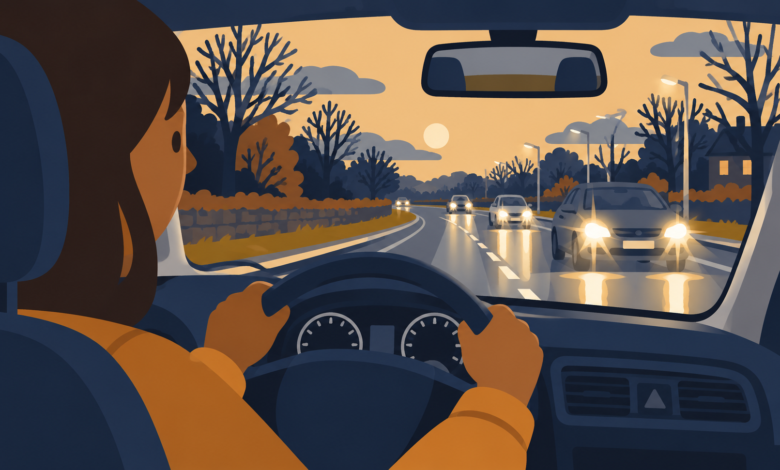
As winter approaches and the evenings get darker and colder, I’m reminded how much more difficult even a familiar car journey can become. For us, getting ready to travel means getting the wheelchair ramp out, securing the wheelchair with clamps and fastening all the safety belts. It takes time, and while we’re doing it, we’re exposed to the cold and dark, with the chilly air finding its way into the vehicle too.
It’s something we deal with every winter, but it got me thinking about the different challenges other disabled people face as the nights draw in. For some, it might be the physical effort of getting in and out of a vehicle. For others, it could be fatigue, poor visibility or the glare from oncoming headlights.
That last point made me think more about eyesight and winter driving. When you’re already dealing with the extra difficulties that colder, darker evenings bring, being able to see clearly and comfortably on the road becomes even more important.
When the clocks go back in October, journeys that were made in daylight a few weeks earlier can suddenly mean driving home in the dark. Add rain, bright headlights and reflections from wet roads, and even familiar routes can become harder to manage.
For many disabled people, driving is an important way of getting to work, attending medical appointments and seeing friends or family. Public transport isn’t always accessible, reliable or available when it’s needed, particularly during the evenings.
Winter driving can be particularly difficult if you experience light sensitivity, dry eyes, fatigue or problems with your glasses. These difficulties aren’t always caused by an outdated prescription.
Good eyesight matters throughout the year, but winter is a useful time to check whether your glasses, eye health, medication and driving setup are still working well for you.
There are also ways to make these checks easier if getting to an optician is difficult, including NHS-funded home sight tests for eligible people.
What Are the UK Legal Eyesight Requirements for Driving?
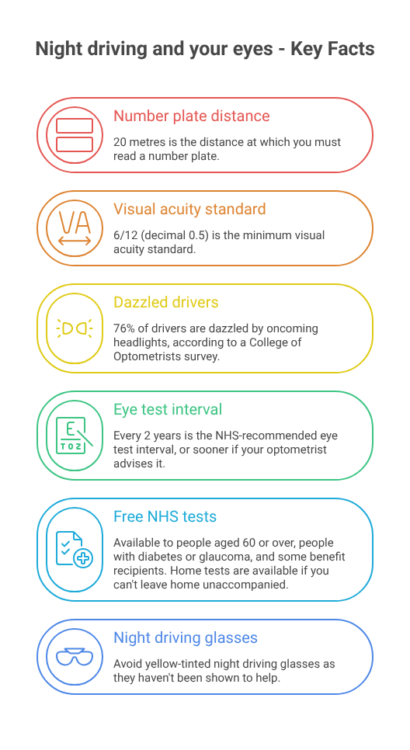
According to GOV.UK, drivers of cars and motorcycles must be able to read a number plate from 20 metres away. Glasses or contact lenses can be worn to meet this requirement.
Drivers must also meet the minimum visual acuity standard of decimal 0.5 (6/12) on the Snellen scale and have an adequate field of vision.
These requirements apply to disabled and non-disabled drivers alike. Having a disability or an eye condition doesn’t automatically mean someone cannot drive.
If you need glasses or contact lenses to meet the legal standard, you must wear them whenever you drive.
Some eyesight conditions must be reported to the DVLA. The reporting rules depend on the condition, whether one or both eyes are affected and whether your ability to drive is affected.
Check the GOV.UK driving eyesight rules and the DVLA’s medical conditions guidance if you’re unsure.
When Should Drivers Book an Eye Test?
The NHS recommends having your eyes tested every two years, or more often if your optometrist advises it. There is no fixed legal interval for drivers, but you must meet the eyesight standard every time you drive.
The NHS recommends having your eyes tested every two years, or more often if your optometrist advises it. There is no fixed legal interval for drivers, but you must meet the eyesight standard every time you drive.
The NHS recommends having your eyes tested every two years, or more often if your optometrist advises it. There is no fixed legal interval for drivers, but you must meet the eyesight standard every time you drive.
The NHS recommends having your eyes tested every two years, or more often if your optometrist advises it. There is no fixed legal interval for drivers, but you must meet the eyesight standard every time you drive.
Changes in eyesight can happen gradually. You might notice that road signs are becoming harder to read, headlights seem brighter than before or you need to concentrate more when driving after dark.
Some eye conditions and medications can affect vision, so tell your optometrist about relevant changes in your health or treatment.
When booking an appointment, mention that you drive regularly, particularly at night. Ask whether your vision meets the legal driving standard and whether your current prescription remains suitable.
Can Disabled People Get a Free NHS Eye Test?
Being disabled doesn’t automatically qualify you for a free NHS sight test. Eligibility depends on your age, your health and your circumstances. According to the NHS, groups who can get a free test include:
- people aged 60 or over
- people registered as partially sighted or blind
- people diagnosed with diabetes or glaucoma
- people who receive certain benefits, or who qualify under the NHS Low Income Scheme
The full list is longer, so check the NHS guidance on free eye tests before booking.
If you’re eligible for a free NHS test but can’t leave home unaccompanied because of a physical or mental illness or disability, you may be able to have the test at home. Vision Matters explains how this works. This can help people with significant mobility barriers or fatigue.
Not every optician offers home visits, so ask local providers whether they offer domiciliary eye care and whether you meet the criteria.
Some people qualify for free NHS sight tests, including those aged 60 or over, people with certain medical conditions and people who meet other NHS eligibility criteria.
Why Do Headlights Cause More Glare When Driving at Night?
Headlight glare is a common problem, especially during winter.
In a survey commissioned by the College of Optometrists, 76% of drivers reported problems with being dazzled by oncoming headlights.
Wet roads can make the problem worse because they reflect light towards drivers. Dirty windscreens, scratched lenses and an outdated glasses prescription may also make night driving more uncomfortable.
However, difficulty with headlights isn’t always simply a problem with prescription glasses or ageing eyesight.
Light Sensitivity and Sensory Overload
Some people experience strong discomfort from bright or contrasting lights, including oncoming headlights.
Sensory sensitivity can be particularly relevant for some autistic people, although experiences vary considerably.
In a discussion on Reddit’s autism community, a contributor described finding oncoming headlights so bright that squinting made it difficult to see anything else. They also recognised that sunglasses, which helped with daytime sensitivity, could make hazards harder to see after dark.
This individual account highlights a practical difficulty: something that reduces discomfort during the day may be unsuitable for night driving.
If headlights regularly make it difficult to see the road, explain the problem to your optometrist. Be specific about what happens, such as squinting, difficulty seeing beyond the lights or needing time to recover your vision.
Do not rely on dark or tinted lenses at night without appropriate professional advice.
Dry Eyes and Long-Term Conditions
Dry eyes can also make headlight glare worse.
The College of Optometrists identifies dry eye as one of the conditions that can increase problems with glare.
Dry eye symptoms may occur on their own or alongside conditions such as Sjögren’s syndrome, rheumatoid arthritis and lupus.
If you already use lubricating drops or other eye treatments, tell your optometrist if night driving has become more difficult.
Don’t assume that worsening glare means you simply need stronger glasses. Changes in eye health may need investigating.
New or worsening halos, blurred vision or glare can also be associated with other eye conditions, including cataracts.
Arrange an eye examination if you notice these symptoms. Sudden changes in vision may require urgent medical attention.
What Glasses Help With Glare When Driving at Night?
If you wear prescription glasses, the first step is making sure your prescription is up to date.
An anti-reflective coating may help reduce distracting reflections on spectacle lenses.
The College of Optometrists advises against yellow-filter lenses marketed for night driving because they have not been shown to improve night-driving vision and can make darker parts of the road harder to see.
If you’re considering new glasses, it’s worth checking the different lens options and comparing prices before buying. Online opticians such as Glasses2You offer practical guidance on glasses for night driving, including what to consider when choosing suitable lenses for evening drives.
Some people with light sensitivity report that tinted lenses feel more comfortable. However, feeling less discomfort does not necessarily mean being able to see pedestrians, cyclists or other hazards more clearly.
Ask your optometrist about suitable lenses rather than relying on marketing claims.
Choosing Comfortable Frames for Sensory and Physical Needs
The prescription isn’t the only consideration when choosing glasses.
Frame shape, weight and fit can affect comfort, particularly if you experience sensory sensitivity, pain around your ears or difficulty adjusting your glasses.
In discussions within Reddit’s autism community, contributors have described problems with pressure around the nose and ears, slipping frames and distracting frame edges in their peripheral vision.
These experiences vary. Larger frames aren’t automatically better, and a frame that feels comfortable to one person may be distracting to someone else.
When choosing glasses, explain any sensory or physical difficulties to the dispensing optician.
Ask whether the arms, nose pads or overall fit can be adjusted. It may also help to check how noticeable the frame edges are when looking around.
Online retailers such as Glasses2You offer prescription glasses and information about lens options. Comparing prices and frame choices can be useful, particularly if you need a second pair. However, if frame fit or sensory comfort is a concern, consider how you will obtain adjustments and check the retailer’s returns arrangements before ordering.
You don’t necessarily need expensive specialist glasses. A current prescription, suitable lenses and frames that fit comfortably may be more useful than products promoted as quick solutions to night-time glare.
Can Eye Drops and Medication Affect Night Driving?
Eye treatments and other medicines can sometimes affect vision or alertness.
This is worth considering if you have a long-term condition and take regular medication, particularly if you’ve recently started a new treatment or changed a dose.
Eye Drops and Ointments
Some lubricating eye drops can temporarily blur vision after use.
Thicker eye ointments may cause more noticeable blurring and are sometimes recommended for use at bedtime.
If you use eye drops or ointment, think about how they fit around your journey.
A treatment described as suitable for night-time use isn’t necessarily appropriate immediately before driving home after dark.
Wait until your vision is fully clear before driving, and follow the instructions for your particular treatment.
Don’t assume that waiting a fixed number of minutes will be enough for every product.
If you’re uncertain, ask your pharmacist or eye-care team. Don’t change prescribed treatment times without advice.
Other Medicines That May Affect Driving
Some medicines used for long-term conditions can cause blurred vision, dizziness or drowsiness.
For example, gabapentin can cause blurred vision, while some travel-sickness medicines can affect vision or alertness.
Certain glaucoma treatments may also temporarily affect sight. Pilocarpine eye drops, used for some glaucoma treatment, can make it harder to see in poor light and can cause temporary blurring. The patient leaflet advises against driving in poor light if you are affected.
These effects vary by medicine and person. They don’t mean that everyone taking these treatments is unable to drive.
If you notice changes after starting or adjusting medication, ask your pharmacist or prescribing clinician for advice.
Remember to mention non-prescription medicines too.
Don’t stop prescribed treatment or change the timing of doses simply to accommodate a journey.
How Can Disabled Drivers Make Winter Journeys Easier?
Your car’s setup can make a real difference to visibility, comfort and how easily you manage winter journeys, particularly if you use adapted controls or have specific mobility needs.
- Keep your windscreen and glasses clean. A dirty windscreen can scatter light from headlights and streetlights, making glare more noticeable. Clean both the inside and outside regularly, and check that your wipers are working properly. If limited mobility or reduced hand function makes cleaning difficult, a suitable long-handled tool or help from someone else may make the job easier.
- Keep essential items within easy reach. Store your driving glasses and any spare pair securely where you can reach them when parked, without awkward stretching or interfering with driving controls. This can be particularly important if you have limited upper-body movement, reduced grip or difficulty transferring in and out of the vehicle.
- Check your seating and mirror position. Make sure you have a clear view of the road, mirrors and dashboard without uncomfortable stretching. If you use adapted controls, supportive seating or other vehicle adaptations, check that everything remains correctly positioned. Make adjustments while safely parked, and only change essential adaptations in line with professional guidance.
- Allow more time for winter journeys. Rain, darkness and glare can make driving more tiring, particularly if you also manage pain or fatigue. Where possible, consider a shorter journey, a planned break or travelling earlier.
Work schedules, appointment times and limited accessible transport can leave people with little choice about when they travel. The aim is to identify changes that are realistic for your circumstances.
Good visibility isn’t only about eyesight. The way your car is set up can also affect how comfortable and manageable winter driving feels.
What If You No Longer Feel Comfortable Driving After Dark?
Finding night driving more difficult doesn’t automatically mean you have to stop driving altogether.
An eye test may identify a prescription change or another treatable problem. Cleaning your windscreen or adjusting your driving setup may also help.
However, if you cannot see clearly enough to drive safely, do not continue until the problem has been addressed.
For disabled people who depend on their cars, this can be particularly disruptive.
Accessible taxis may be expensive or unavailable, buses may not serve the places you need to visit, and community transport often requires advance booking.
If you’re concerned about losing access to important journeys, investigate local community transport, accessible taxi services or hospital transport arrangements where eligible.
These services vary considerably between areas, and not everyone will have a suitable alternative.
If you have a health condition that may affect driving, your optometrist, GP or relevant specialist can help you understand whether further assessment or DVLA notification is needed.
Winter Driving Eyesight Checklist for Disabled Drivers
Before setting off on a winter journey, use this checklist to make sure your vision and driving setup are ready.
- Check your prescription. Book an eye test if your vision has changed or your last test is overdue.
- Clean your glasses and windscreen. Remove smears that could make glare more distracting.
- Check for changing light sensitivity. Speak to your optometrist if headlights regularly make it difficult to see the road.
- Review eye-treatment timing. Allow any blurring from drops or ointments to clear fully before driving.
- Check medication side effects. Ask a pharmacist about blurred vision, dizziness or drowsiness, particularly after starting or changing treatment.
- Check frame comfort. Make sure your glasses aren’t slipping, causing pressure or distracting you when looking around.
- Check your seating and mirrors. Make sure you have a clear view without uncomfortable stretching.
- Keep essential items accessible. Store spare glasses securely where you can reach them when parked.
- Plan your journey. Allow extra time if darkness, fatigue or poor weather makes driving more demanding.
- Take new symptoms seriously. Arrange an eye examination if you notice worsening glare, halos or blurred vision.
You don’t need to buy expensive accessories to address every winter driving difficulty. For many drivers, the most useful starting points are an up-to-date prescription, appropriate eye care and a driving setup that works for them.
Sources and Further Reading
- GOV.UK – Driving eyesight rules
- GOV.UK – Medical conditions and driving
- NHS – Free NHS eye tests and optical vouchers
- College of Optometrists – Wear glasses for night driving
- NHS – Carmellose sodium eye drops and driving
- NHS – Gabapentin side effects
- Reddit r/autism – Headlight sensitivity discussion
- Reddit r/autism – Sensory experiences with glasses
Frequently Asked Questions About Winter Driving Eyesight
What are the legal eyesight requirements for driving in the UK?
Car drivers must be able to read a number plate made after 1 September 2001 from 20 metres away. They must also meet minimum visual acuity and field-of-vision standards. Glasses or contact lenses can be worn to meet these requirements.
Do yellow-tinted glasses help with night driving?
The College of Optometrists advises against yellow-filter lenses marketed for night driving. They have not been shown to improve night-driving vision and may make darker areas harder to see. An up-to-date prescription and suitable anti-reflective coatings may be more useful.
Can disabled people get a free NHS eye test at home?
Some disabled people qualify for NHS-funded home sight tests. Eligibility depends on meeting NHS sight test criteria and being unable to leave home unaccompanied because of illness or disability. Not every optician provides home visits.
Can medication affect eyesight when driving at night?
Some medicines and eye treatments can cause blurred vision, dizziness or drowsiness. Eye ointments and certain drops may temporarily affect sight. Check the instructions and wait until your vision is clear before driving.

