Australian Protection Visa: What Disabled Applicants Need to Know About Eligibility, Evidence and Access

Getting an Australian Protection Visa as a disabled person
About the author: Duncan Edwards has spent over 15 years working in disability services and welfare benefits advice, including periods as a homelessness and benefits advisor. He manages Disability Horizons Shop, which supports disabled entrepreneurs and stocks products designed around lived experience. His wife Clare, who uses a wheelchair following a spinal injury, co-founded Trabasack. They have travelled extensively together, including 12 months spent in Australia, and share a personal interest in emigration options and the barriers disabled people face in obtaining residency abroad.
An Australian Protection Visa allows people already in Australia to stay if returning home would put them at risk. For disabled applicants, the process can involve extra barriers around evidence, communication, and support. This guide explains eligibility, steps, and what to expect — with a focus on accessibility.
Before you apply: quick checklist
- You are currently in Australia and cannot safely return home
- You can show personal risk linked to race, religion, nationality, political opinion, or membership of a particular social group
- You have not previously had a protection visa refused
- You have or can gather supporting evidence — personal statement, medical records, identity documents
- You have checked whether you need an interpreter, support person, or other access adjustment before your interview
Key facts at a glance
| Topic | What it means in practice |
|---|---|
| Eligibility | You must be in Australia and unable to safely return home due to risk of harm |
| Evidence | Personal statements, official documents, and medical records may all be used |
| Process | Application, document submission, interview, then a decision |
| Accessibility | You can request adjustments such as interpreters or support during interviews |
| Outcome | If approved, you can stay in Australia; if refused, review options may be available |
Who can apply for a Protection Visa?
To apply, you must already be in Australia and show that returning to your home country would put you at serious risk. This risk is usually linked to:
- Race
- Religion
- Nationality
- Political opinion
- Membership of a particular social group
Decision-makers assess whether the threat is real and personal. They look at your past experiences, any harm you have faced, and the current situation in your home country.
If you want to check the exact documents typically requested, this guide to an Australian protection visa sets out how applicants can prepare their evidence in more detail.
Who may not be eligible?
Some people cannot apply, including those who:
- Have already had a protection visa refused
- Entered Australia under specific restricted circumstances
- Provide false or misleading information
Each case is assessed individually, so it is worth seeking advice if you are unsure.
What evidence do you need?
Your application is built around evidence that shows why returning home is unsafe.
Common types of supporting evidence
- Personal statement describing your situation
- Identity documents
- Medical records
- Police reports or legal documents
- Letters from community members or organisations
Consistency matters. Your written statement, documents, and interview responses should all align clearly.
How disability-related evidence may be used
Disabled applicants may already have medical records or assessments. These can support a claim — particularly where:
- Access to healthcare in your home country is limited or absent
- You face discrimination because of disability
- Your condition puts you at greater risk of harm in your home country
It is not just the condition itself that matters. It is the specific barriers and risks that condition creates in the place you would be returning to.
The National Ethnic Disability Alliance (NEDA) — Australia’s peak body representing people with disability from culturally and linguistically diverse backgrounds — has documented how migration law frames this:
“Migration laws and processes often treat people with disability solely as a cost burden… Children or family members with disability are considered a health risk, preventing families from migrating or remaining in Australia.”
— NEDA, The Experiences & Perspectives of People with Disability from CALD Backgrounds, 2023
This framing matters when building your evidence. You are not just proving your disability exists — you are showing what it means in the context of your home country and why that creates a genuine, personal risk.
Some applicants describe needing multiple appointments just to gather medical evidence in accessible formats, which can delay submissions by weeks. Building in extra time for this is worth planning for from the start.
What disabled applicants may need to consider
Jan Gothard, an immigration lawyer and founder of the Welcoming Disability campaign, put it plainly in a BBC interview in July 2024:
“We still treat people with disability in the same way as we did in 1901 and we think they’re not people who are welcome in Australia.”
— Jan Gothard, immigration lawyer, BBC News, July 2024
That gap between legal rights and practical reality affects every stage of the process. Knowing what you can ask for helps close it:
- Communication access: You can request interpreters, including sign language interpreters or alternative communication support
- Accessible formats: Ask for documents in large print, simplified language, or other formats that work for you
- Support during interviews: You may be able to have a support worker, advocate, or trusted person present
- Extra time: Processing forms or answering questions may take longer depending on your access needs — this is a reasonable adjustment to request
- Financial barriers: Costs for gathering medical evidence, travelling to appointments, or accessing legal support can add up. Legal aid and community organisations can help with this (see the support section below)
These are not “special requests.” They are adjustments that help ensure the process is fair.
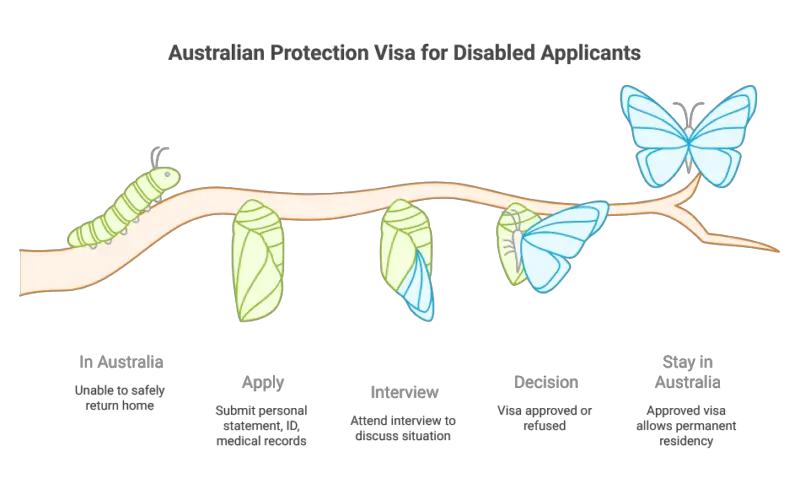
Step-by-step: how the application process works
1. Submit your application
You complete an online form and upload your documents. Accuracy matters — errors can delay the process significantly.
2. Provide supporting documents
This includes identity documents and evidence supporting your claim. Strong documentation can make a real difference to how your case is understood.
3. Attend an interview
You may be asked to attend an interview with a case officer. This is your chance to explain your situation in more detail.
Research published in BMC Psychiatry found that mental health deteriorates significantly for many applicants during the long period of uncertainty before and during this process. Anxiety and cognitive stress at interview stage are common — and are not signs of dishonesty. (PMC, 2023)
If you need adjustments — extra time, a support person, written rather than verbal responses — request them in advance, in writing.
4. Wait for a decision
Processing times vary. Some applications take months, depending on complexity and current demand. You may be asked for further information during this time. Responding promptly helps keep things moving.
Lived experience: when disability becomes the deciding factor
Kayban’s case, reported by the BBC, illustrates how disability can override other circumstances entirely in an immigration outcome. Kayban, a family member seeking to remain in Australia, was initially refused a temporary visa on the grounds that his disability represented too great a burden on the healthcare system — despite the family holding private health insurance and not relying on state support.
After a lengthy appeal process, he was allowed to stay. His mother’s response, as reported by BBC News (July 2024), cuts to the core of what many disabled applicants experience:
“Disability is the only thing that stops you from migrating. There is nothing else.”
— Kayban’s mother, as reported by BBC News, July 2024
This case shows why building thorough, specific evidence matters — including financial independence, private insurance, and the detail of what support actually exists. Decision-makers can and do weigh these factors when they are presented clearly.
What happens while your application is being processed?
While waiting for a decision, some applicants may be able to access:
- Basic healthcare services
- Limited financial support
- Community or legal support services
The Refugee Council of Australia, in its submission to the Royal Commission into Violence, Abuse, Neglect and Exploitation of People with Disability, noted that “the experiences of people with disability in immigration detention have not been adequately explored” and called for urgent review of conditions and support for disabled people during this period. (Refugee Council of Australia, 2022)
Keep your contact details updated throughout and respond promptly to any requests from the immigration department.
What happens after a decision?
If your visa is approved
You can stay in Australia and may be able to apply for permanent residency. In some cases, family members can also be included in the application.
If your visa is refused
You may have the right to request a review or lodge an appeal. Deadlines are strict — getting advice quickly after a refusal is important.
Where to get support
You do not have to manage this process alone. The following organisations can help:
- Asylum Seeker Resource Centre (ASRC) — practical support, advocacy, and legal help for asylum seekers in Australia
- National Ethnic Disability Alliance (NEDA) — specifically supports people with disability from CALD backgrounds navigating migration
- Legal aid organisations — often provide free or low-cost immigration advice
- Refugee support charities — can assist with applications, evidence gathering, and interview preparation
- Disability organisations — may offer guidance on access adjustments during the process
Support can make a practical difference, especially around gathering evidence, managing costs, and preparing for interviews.
Why accessibility matters in asylum processes
Disabled people often face greater risks when seeking safety — and greater barriers when trying to prove those risks. A process that relies heavily on paperwork, strict timelines, and formal verbal interviews creates structural disadvantage for people who need different forms of access.
NEDA’s research is direct on this point: “Australian migration policy fails migrants and refugees with disability. The laws are discriminatory; they do not provide fair opportunity to people with disability.” (NEDA, No Right to Discriminate)
Making these processes accessible is not an extra feature. It is part of ensuring equal access to protection. This work connects directly to what the disability community has long argued: that inclusion is not a favour extended to disabled people, but a requirement of fair systems. It is the same principle behind disability-led innovation and independence tools — the idea that when systems are built around disabled people’s actual needs, they work better for everyone.
Sources: Jan Gothard / BBC News (July 2024); NEDA No Right to Discriminate and CALD Experiences Report (2023); Australian Parliament House Migration Committee submission; BMC Psychiatry via PMC (2023); Refugee Council of Australia Royal Commission submission (2022). The Kayban case and associated quote are attributed to BBC News (July 2024) as the original reporting source.
Frequently asked questions about the Australian Protection Visa
Can disabled people apply for an Australian Protection Visa?
Yes. Disabled people can apply if they meet the same eligibility criteria, including being in Australia and facing a real risk of harm if they return to their home country.
What evidence is needed for a Protection Visa?
Evidence can include personal statements, identity documents, medical records, police reports, and letters from community members. Consistency across all evidence is important.
Can I request adjustments during the visa process?
Yes. Applicants can request adjustments such as interpreters, accessible formats, extra time, or support during interviews to ensure fair access.
How long does a Protection Visa decision take?
Processing times vary. Some applications take several months depending on complexity and case volume.
What happens if my application is refused?
You may be able to request a review or appeal. Deadlines are strict, so it is important to seek advice quickly.
