How Social Media Affects Disabled People’s Mental Health and How to Protect Your Wellbeing

Social media can be a source of connection, advice and community for disabled people. It can also expose people to ableist comments, benefit debates and stressful news. Here is how online spaces can affect mental health, and practical ways to make social media feel safer and more supportive.
Key Takeaways About Social Media and Disabled People’s Mental Health
| Key point | What it means |
|---|---|
| Social media can support disabled people | Online spaces can reduce isolation, help people find peer advice and connect disabled people with shared experiences. |
| Online hostility can affect mental health | Ableist comments, benefit debates and misinformation can create anxiety, stress and self-doubt. |
| The quality of online use matters | Research suggests social media can be more positive when disabled people find it useful, supportive and relevant. |
| Personal boundaries can help | Muting, blocking, filtering keywords and limiting difficult content can reduce emotional strain. |
| Platforms still have responsibility | Disabled people should not have to manage online abuse and inaccessible systems alone. |
Why Social Media Can Affect Disabled People’s Mental Health
For many disabled people, social media is part of everyday life. It is where friendships grow, practical advice is shared and people find others who understand what it is like to deal with inaccessible systems, public judgement or poor support.
At the same time, the same platforms can expose disabled people to a steady stream of hostile comments, stressful news and public debates about benefits, care, work, accessibility and who is seen as “disabled enough”.
The Social Model of Disability helps explain why this matters. Disability is shaped by barriers in society, including inaccessible environments, poor systems and negative attitudes. Online spaces can create those barriers too, especially when platform design rewards outrage and conflict.
Researchers have found that social media can create mixed experiences for disabled people. One study on disabled people and political social media found that online platforms helped some people access information, but also increased stress, anxiety and isolation when discussions became hostile or overwhelming.
That is why this issue is not simply about spending less time online. It is about what disabled people are exposed to, whether they feel safe taking part, and whether online spaces support or drain them. Many people describe this as doomscrolling — the habit of continuing to scroll upsetting or distressing content even when it stops feeling useful.
How Online Disability Debates Create Ambient Stress
Some psychologists describe this as “ambient stress” — the background strain that builds when you’re repeatedly exposed to negative messages, even if they’re not directed at you.
For example, a disabled person might open a social media app during lunch and see several posts about benefit fraud, disabled parking abuse or people “faking” conditions. None of the posts mention them. Even so, the tone can leave them feeling watched, judged or worried about future assessments.
Real experiences: when social media brings both support and pressure
This tension between support and stress comes through clearly in disabled creators’ own stories.
In our interview with Tracy Kiss, she explains that social media helped her recognise symptoms of hEDS after years of pain and medical dismissal. She says online communities gave her language, understanding and comfort — but her story also shows the pressure many people with invisible disabilities feel when they do not “look disabled” to others.
Similarly, our interview with Tom Davies, known online as DovelyTom, explores what it is like to share disability publicly while managing energy, privacy and people’s assumptions. For disabled creators, posting online can build community, but it can also invite intrusive questions, criticism or pressure to explain personal health details.
These stories show why social media is rarely simply good or bad for disabled people. It can help people find answers, feel less alone and challenge stereotypes. It can also become another place where disabled people feel watched, judged or expected to prove themselves.
This can be especially difficult for people with invisible or fluctuating conditions. A photo from a good day, a short trip out, or a post about work or parenting can sometimes be misread by others as “proof” that someone does not need support.
Over time, this background pressure can affect confidence, mood and energy. It can make social media feel less like a place for connection and more like another space where disabled people have to defend themselves.
Why Social Media Still Matters for Disabled Communities
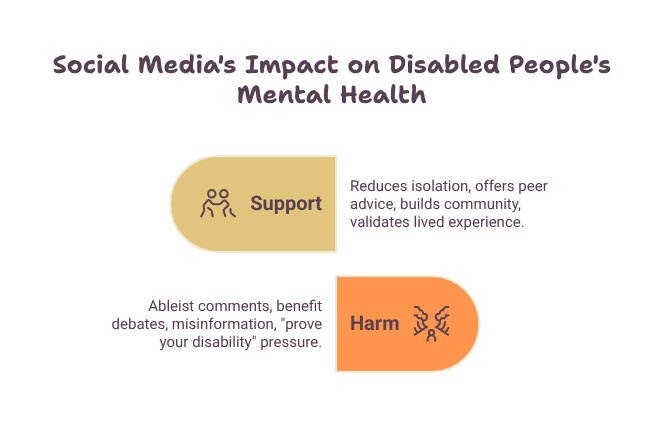
Social media is not only harmful. For many disabled people, it is a lifeline.
It can help people find advice about benefits, accessible travel, mobility aids, education, work, care, parenting and daily life. It can also help people find disabled-led spaces where lived experience is valued rather than questioned.
Research on adults with disabilities has found that when social media feels useful, it can be linked with lower depression and higher self-esteem. Another study on people with physical disabilities found that social media use can support wellbeing when it helps people build meaningful social support.
That matches what many disabled people say in everyday life. The problem is rarely social media itself. The problem is being pushed towards hostile content, inaccessible design and public conversations that treat disabled people as a topic to argue about rather than people with full lives.
Disability Horizons has long centred disabled voices and lived experience, because peer knowledge is often one of the most useful forms of support.
Signs Social Media Is Affecting Your Mental Wellbeing
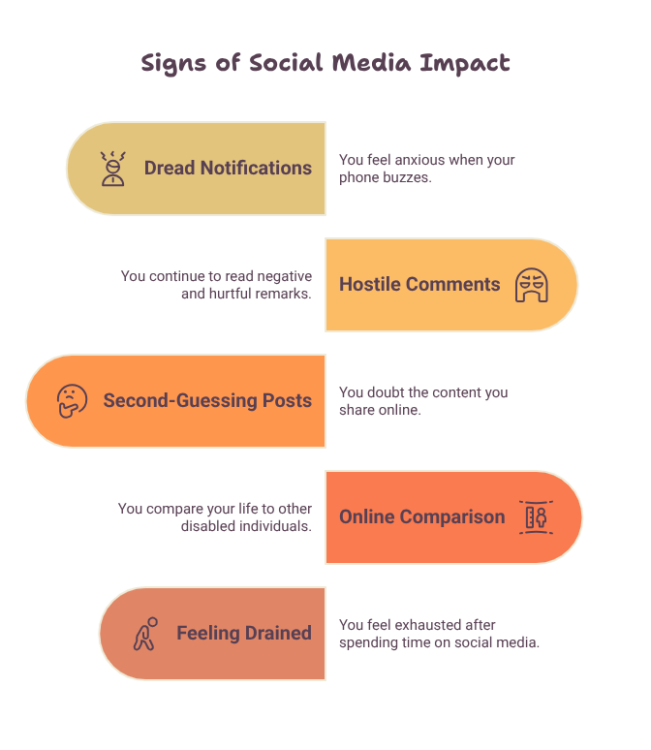
The signs are often practical rather than dramatic. You might notice that your mood changes before you even open an app, or that you keep reading comments long after they have stopped being useful.
| Sign | What it may suggest |
|---|---|
| You dread notifications | You may be expecting conflict, judgement or upsetting replies. |
| You keep reading hostile comment sections | You may be finding it hard to step away from stressful content. |
| You second-guess your own posts | You may feel pressure to prove or justify your disability. |
| You compare yourself with other disabled people online | You may be judging your own needs against someone else’s life. |
| You feel drained after scrolling | Your emotional or cognitive energy may be used up by online content. |
If this happens often, it does not mean you are too sensitive. It may mean your online environment is asking too much of you.
Practical Ways Disabled People Can Protect Their Wellbeing Online
Choose who and what appears in your feed
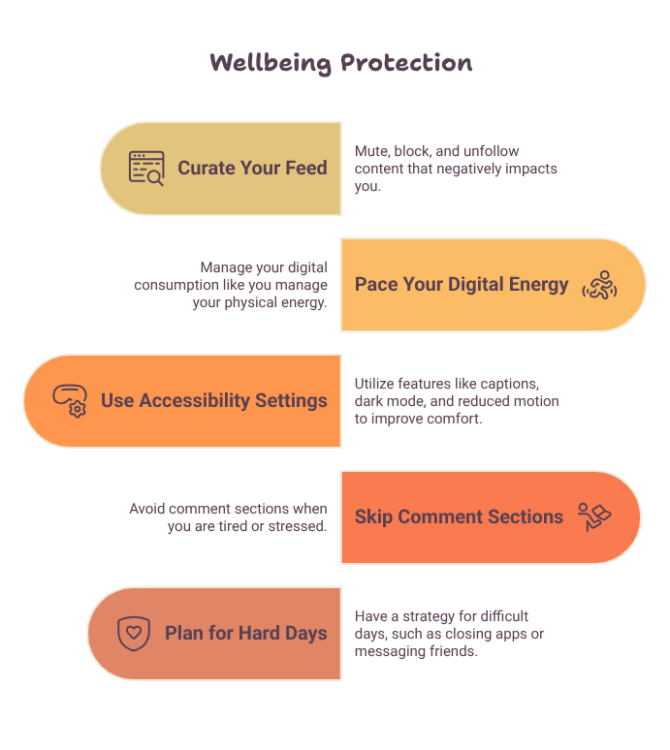
Your feed has a direct effect on how social media feels. Follow people and organisations that share useful, thoughtful or supportive content. Mute or unfollow accounts that regularly leave you tense, angry or exhausted.
Blocking abusive users is not rude. Filtering keywords is not avoidance. These are reasonable ways to protect your time and energy.
Use digital pacing
Many disabled people pace physical, mental or sensory energy. The same idea can help with social media.
Reading news, replying to comments, watching videos and processing arguments all take effort. If you are already dealing with fatigue, pain, brain fog or sensory overload, online activity can use more energy than expected.
Many disabled people already think carefully about how they use limited energy during the day, whether that means pacing tasks, rest or social contact. Social media deserves the same consideration. Spending twenty minutes arguing with strangers may leave you with less energy for work, hobbies, family or simply resting.
Shorter planned sessions may feel better than checking apps all day. You might also choose not to read comment sections when you are tired, unwell or already stressed.
Make accessibility settings work for you
Accessibility settings can reduce strain. These may include captions, larger text, screen reader support, reduced motion, dark mode and notification controls.
Scope’s accessible social media guide is useful for organisations, creators and anyone who wants to make online content easier for disabled people to use.
Remember that you do not have to correct everything
It can be tempting to respond to every ableist comment or misleading post. Sometimes speaking up matters. Other times, stepping away is the healthier choice.
You are not responsible for fixing every misconception about disability. You are allowed to save your energy for the people, causes and conversations that matter most to you.
Have a simple plan for difficult days
Some days will be harder than others. A simple plan can help you step away before stress builds.
- Close the app as soon as you notice your mood changing.
- Message someone you trust.
- Switch to a calming activity that does not involve scrolling.
- Save a useful post for later instead of reading everything at once.
- Return only when you feel ready.
This does not need to be a strict routine, it is a safety net for healthier social media use.
How to Find Healthier Online Disability Communities
Not all online spaces feel the same. Some are thoughtful, practical and well moderated. Others are dominated by arguments, judgement or constant crisis.
Look for communities with disabled-led moderation, clear rules against abuse, practical advice and respect for different disability experiences.
Smaller groups can sometimes feel safer than large public pages. Condition-specific communities may also be helpful, especially when members understand the everyday details that wider audiences often miss.
A good online community should leave you feeling more informed, less alone or better supported. It should not regularly leave you feeling as if you have to defend your existence.
Why Safer Social Media Should Not Be Disabled People’s Responsibility Alone
Personal boundaries can help, but they do not solve the wider problem.
Social media platforms, policymakers, regulators and organisations all have a role in making online spaces safer and more accessible. That includes stronger action on disability hate, clearer reporting tools, better moderation and platform design that does not push users towards harmful content.
Disabled people should not have to carry the full burden of protecting themselves from inaccessible systems and hostile attitudes online.
Further Support and Useful Resources
If social media is affecting how you feel, these UK sources may be useful:
- NHS Every Mind Matters offers simple tools to manage stress, anxiety, low mood and sleep.
- NHS self-help mental health guidance shares tips, tools and activities to support mental health.
- Mental Health Foundation provides research-informed mental health advice and resources.
- Mental Health UK offers information and downloadable resources for people looking for support.
If you feel unable to cope or keep yourself safe, seek urgent help through NHS 111, your GP, local crisis support, or emergency services.
Social Media and Disabled People’s Mental Health: Final Thoughts
Social media should help disabled people feel more connected, informed and included — not leave them questioning their worth or legitimacy. Until online spaces become safer and more accessible, protecting your wellbeing is important. But creating better digital environments is a responsibility we all share.
FAQ: Social Media and Disabled People’s Mental Health
Can social media be good for disabled people’s mental health?
Yes, it can be. Social media can help disabled people find peer support, practical advice and community. It is most helpful when online spaces feel useful, respectful and relevant.
Why can social media feel stressful for disabled people?
Social media can feel stressful when disabled people are repeatedly exposed to ableist comments, benefit debates, misinformation or pressure to prove their disability.
What is doomscrolling?
Doomscrolling is the habit of continuing to consume upsetting or negative online content even after it stops being helpful. It can leave people feeling anxious, exhausted or emotionally overwhelmed.
How can disabled people make social media safer?
Disabled people can make social media safer by muting harmful keywords, blocking abusive accounts, following supportive creators, using accessibility settings and taking breaks when scrolling becomes draining.
Should disabled people avoid social media completely?
Not necessarily. For many disabled people, social media is an important source of connection. The aim is to build healthier boundaries rather than lose useful support.
Who is responsible for making social media safer for disabled people?
Platforms, policymakers, regulators and organisations all have responsibility. Disabled people can use personal boundaries, but they should not be left to manage online abuse or inaccessible systems alone.
