Can’t Fix Your Sleeping Pattern? Poor Temperature Regulation Could Be the Reason
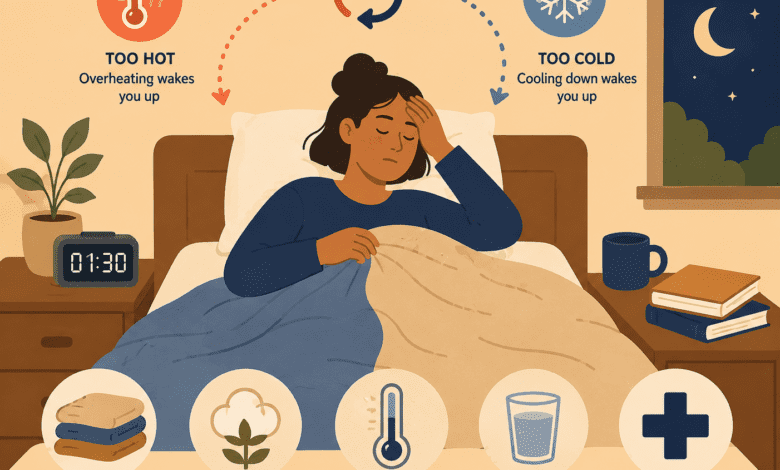
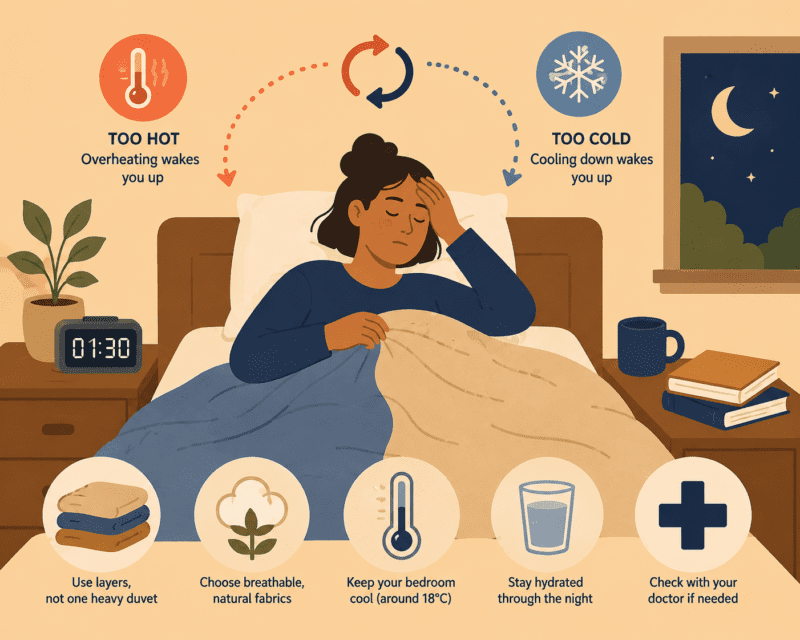
There is a particular kind of broken sleep that has nothing to do with stress, screens, or a racing mind. A person falls asleep without trouble, then wakes an hour or two later feeling uncomfortably hot. The duvet is kicked off, the bedroom suddenly feels stifling, and sleep becomes impossible. Twenty minutes later, the chill arrives, the covers go back on, and the cycle repeats.
By morning, enough hours may have passed to count as sleep, but very little of it feels restorative.
Key Takeaways: How Poor Temperature Regulation Affects Sleep
| Key Point | What It Means |
|---|---|
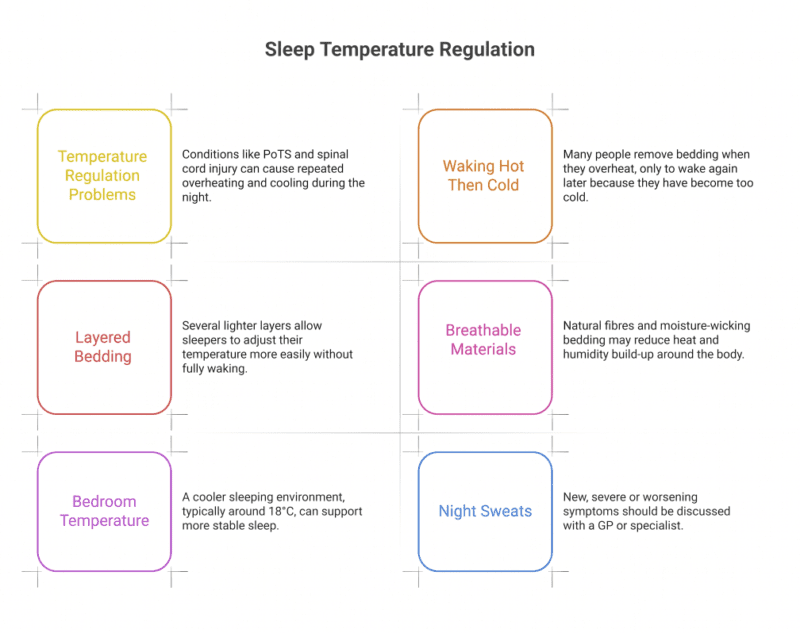
| Temperature regulation problems can disrupt sleep | Conditions such as PoTS, spinal cord injury, autonomic dysfunction, chronic illness and hormonal changes can cause repeated overheating and cooling during the night. |
| Waking hot then cold is a common pattern | Many people remove bedding when they overheat, only to wake again later because they have become too cold. |
| Layered bedding often works better than a heavy duvet | Several lighter layers allow sleepers to adjust their temperature more easily without fully waking. |
| Breathable materials can help | Natural fibres and moisture-wicking bedding may reduce heat and humidity build-up around the body. |
| Bedroom temperature matters | A cooler sleeping environment, typically around 18°C, can support more stable sleep for people who struggle with temperature regulation. |
| Night sweats should not always be ignored | New, severe or worsening symptoms should be discussed with a GP or specialist, particularly if they are affecting sleep quality. |
When your body struggles to regulate temperature at night
For some people, these disrupted nights are linked to conditions that affect the body’s ability to control temperature. Neurological conditions such as multiple sclerosis, spinal cord injuries, autonomic dysfunction, postural orthostatic tachycardia syndrome (PoTS), and some chronic illnesses can make it harder to maintain a comfortable temperature. Certain medications can have a similar effect.
Hormonal changes can also play a role. Some women notice more night-time overheating around menstruation, during pregnancy, or through perimenopause and menopause. Whatever the cause, the result is often the same: body temperature rises, sleep is interrupted, and the cycle repeats several times during the night.
Many people who experience poor temperature regulation describe feeling trapped between two extremes. They overheat under the covers, remove them to cool down, then wake again because they have become too cold.
Lived experience – Clare’s story
Clare, my wife and co-founder of Trabasack, has a spinal cord injury and limited movement, so staying at a comfortable temperature overnight is a constant balancing act. For years we relied on hot water bottles, including one she used under her head, until one finally burst (mercifully when she wasn’t in bed), which made us rethink the safety of anything that can overheat next to skin you cannot easily move away.
We now use an over-blanket electric blanket that sits on top of her, never underneath, so the wiring isn’t trapped against her body and we can avoid the higher burn risk that comes with not being able to reposition in the night. It is on a timer and we do not use the hottest setting, but Clare’s body still tends to overshoot – she can swing to too hot before she registers it, then crash to too cold, which means I am often woken to adjust the covers for her.
Because extra weight makes her uncomfortable, we do not use a heavy duvet. Instead we have a cotton sheet, the electric blanket, and a thin quilted bedspread with a patterned side and a plain side – our “summer” and “winter” sides. That way we can tweak warmth without piling on layers she can’t move or kick off herself. Our bedroom is one of the cooler rooms in the bungalow, which helps in summer, but in winter I pre-warm both the room and the bed with the wall heater and the blanket for about an hour before we get in. Once Clare is in bed, I switch off the central heating; from that point on, it is the micro-climate around her body that matters more than the thermostat on the wall.
People with autonomic conditions such as PoTS often describe this as a tug-of-war their body can’t win: they go to bed freezing, then wake drenched in sweat an hour later. PoTS UK notes that many people with PoTS have problems with temperature regulation at night and suggests using multiple thin layers of bedding rather than a single heavy duvet, alongside cooling aids such as cooling pillows or mats.
In online PoTS communities, people frequently talk about building a “layered toolkit” around their body at night – for example, natural-fibre sheets, a very light duvet or blanket, and extra throws just for cold legs, plus a fan on a timer or smart plug so they can change airflow without fully waking. One person described going to bed in light pyjamas, with a fan running and several thin blankets instead of one thick one, so they can throw off or pull on layers as their temperature swings during the night.
Why throwing off the duvet often makes things worse
The instinctive response is to strip the bed back to the bare minimum. Unfortunately, that can create a different problem.
Sleep tends to be most stable when body temperature remains within a relatively narrow range. Without enough insulation, the body can cool too quickly once an overheating episode passes. Instead of waking because they are too hot, the sleeper wakes because they are now too cold.
The goal is not to stay cool at all costs. It is to avoid large swings in temperature that repeatedly pull the brain out of sleep.
The duvet does more than people think
This is where bedding can make a surprising difference.
Many synthetic duvets trap heat and moisture around the body. When someone overheats, sweat builds up within the bedding and against the skin. As that moisture cools, it can leave the sleeper feeling damp and chilled, creating another reason to wake up.
Breathable, moisture-wicking materials behave differently. Rather than trapping heat and humidity, they allow excess warmth to escape more easily and help moisture move away from the body. That can reduce the intensity of temperature spikes and help someone stay asleep when their body begins to warm up.
For people with temperature regulation difficulties, the right duvet or combination of bedding layers is often less about comfort and more about creating a more stable sleeping environment. Some bedding brands’ customer reviews for wool or cooling duvets, for example, often mention staying warm enough on cooler nights but not overheating when a hot flush or night sweat hits – reflecting the same principles of breathability and humidity control described here.
Choosing a duvet that helps regulate body temperature is a practical step rather than a luxury for anyone whose nights run hot.
Small changes that can help
Several practical adjustments can work alongside suitable bedding.
Natural-fibre nightwear, such as cotton or merino, usually allows better airflow than polyester. Keeping the bedroom relatively cool, around 18°C, can also help reduce overnight overheating – this is in line with guidance for people with PoTS and other conditions that affect temperature regulation.
A glass of water within reach (or a night bottle in the bed, like a Hydrant) can make brief awakenings less disruptive, while bedding that can be adjusted in layers gives more control than a single heavy duvet. A lighter duvet combined with a thin blanket often works better than one thick cover because layers can be removed or added without fully waking.
In practice, many people with PoTS or hyperhidrosis use several thin layers of bedding and natural-fibre sheets so they can adjust quickly when they wake feeling too hot or too cold, sometimes alongside a fan, cooling pillow or cooling mat. Community posts from people with PoTS often mention limiting clothing at bedtime, using breathable sheets and keeping a fan or open window on their side of the bed, so they can stick out an arm or leg to cool down without stripping the bed completely.
For couples with different temperature needs, separate duvets or separate layers on each side of the bed can sometimes be the simplest solution. Each person can adjust their own bedding without affecting the other.
Looking beyond the bedding
Bedding can improve comfort, but it cannot address every cause of night-time overheating.
People who suddenly develop night sweats, experience severe temperature regulation problems, or notice symptoms worsening should speak to their GP or specialist. In some cases, disrupted temperature control may be linked to an underlying condition, medication side effect, hormonal change, or another health issue that deserves medical attention. The NHS notes that heavy night sweats can be a symptom of different medical conditions or medicines, and that persistent or severe symptoms should be checked.
Organisations supporting people with temperature regulation problems give similar advice on managing symptoms at home: PoTS UK suggests keeping the room cool and using layers of blankets instead of one duvet for night sweats and temperature swings, while the International Hyperhidrosis Society highlights the value of moisture-wicking sleepwear, quick-drying bedding and adjustable layers for people who experience heavy sweating at night.
One of the few factors you can control
Conditions that affect temperature regulation are not something a person can simply switch off. Neither are hormonal fluctuations, warm weather, or a partner who naturally sleeps hot.
The bed itself is one of the few parts of the equation that can be changed. Choosing bedding that supports a more consistent temperature throughout the night can reduce the number of interruptions and help create the conditions for deeper, more settled sleep.
For many people whose bodies struggle to stay within a comfortable temperature range, that small adjustment can make a noticeable difference to how rested they feel in the morning.
Useful resources
- NHS – Night sweats
- NHS – Postural tachycardia syndrome (PoTS)
- PoTS UK – Sleep and PoTS
- r/POTS – Tips to regulate body temperature overnight
- International Hyperhidrosis Society – Night sweats and bedding
FAQ about poor night temperature regulation
Why do I wake up too hot and then too cold at night?
Some health conditions affect the body’s ability to regulate temperature. This can cause sudden overheating followed by rapid cooling, leading to repeated sleep interruptions.
Can PoTS affect sleep temperature?
Yes. Many people with PoTS report problems regulating body temperature overnight. Some experience night sweats, overheating, cold extremities, or rapid changes between feeling too hot and too cold.
Can spinal cord injuries affect temperature regulation?
Yes. A spinal cord injury can affect the nervous system’s ability to regulate body temperature, making it harder to stay comfortable during hot weather, cold weather, or while sleeping.
What bedding is best for people who overheat at night?
Breathable bedding made from natural or moisture-wicking materials is often preferred. Many people find that using several light layers gives more flexibility than a single heavy duvet.
When should night sweats be checked by a doctor?
Anyone experiencing new, severe, persistent, or worsening night sweats should speak to a GP or specialist, particularly if symptoms are affecting sleep or daily life.

