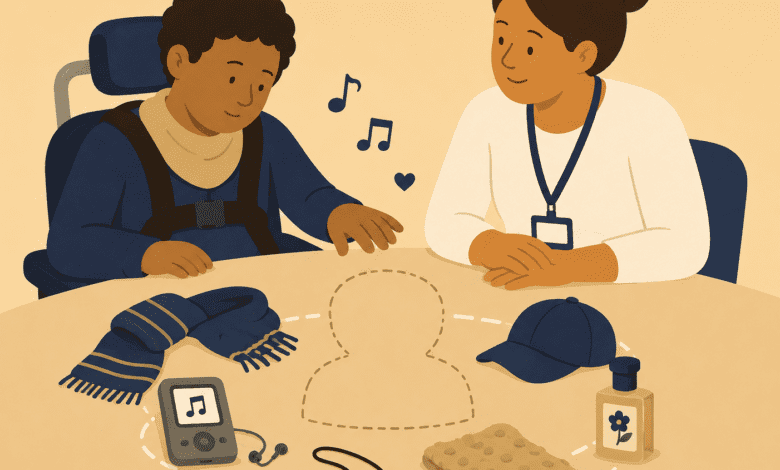
Supporting people with profound and multiple learning disabilities with bereavement

Earlier this year, sensory engagement specialist Joanna Grace shared the deeply personal story When Dalila Died, reflecting on the loss of a young girl she knew and the questions that followed about grief, connection and understanding.
That article explored an issue that is rarely discussed: how people with profound and multiple learning disabilities (PMLD) experience bereavement. While society often assumes that grief depends on understanding death as an abstract concept, Joanna challenged that idea, arguing that loss can be felt even when it cannot be described in words.
In this follow-up article, she moves from reflection to practical guidance. Drawing on her experience in sensory engagement and profound disabilities, Joanna explores how families, support workers, teachers and carers can support someone with profound intellectual disabilities through grief. She shares ideas around sensory stories, memory-making and creating space for people to experience loss in ways that make sense within their own sensory world.
Bereavement affects everyone differently. For people with profound and multiple learning disabilities, recognising grief may require us to look beyond traditional ideas of communication and understanding. Joanna’s article offers thoughtful, practical ways to support people through loss while recognising their full humanity and emotional lives.
How do you support someone with profound intellectual disabilities through grief?
Who are we thinking about?
People with profound and multiple learning disabilities have multiple sensory and physical impairments, they often have significant co-occurring health issues, epilepsy and lead foreshortened lives. Most significantly for our conversation they have a profound intellectual impairment.
The level of cognitive impairment experienced by people with profound and multiple learning disabilities means they face significant barriers to communicating and understanding, they can have trouble laying down memories, lack the ability to anticipate the future, and be unable to shape their experiences into any form of symbolic communication in order to be able to express them.
How does someone with a profound intellectual disability understand death?
What is death to someone who lives their life in the moment? If you cannot remember a past, cannot conceptualise an abstract concept, cannot imagine a future, your experience of life is the sensory experiences you are having now.
But there is no level of disability that protects a person from experiencing bereavement.
More experiences of bereavement than most
People with profound and multiple learning disabilities are likely to experience more bereavements in a lifetime than someone living a life with less challenges. Not just because they are more likely to encounter the death of peers in special school settings but because without the capacity to understand that a person can have moved away, moved class, started a new job, the absence of someone who has previously been a regular part of life can be felt as a bereavement.
I remember a young man I used to teach arriving in my class in September super subdued. He usually had such a sunny personality but over the summer he seemed to have faded. In the class before mine he had been best friends with a little girl, always together, but she was a year younger than him and wouldn’t arrive in my class until the following year. It was a chance encounter between them in a corridor that made us realise what had happened. When he saw her walking towards him he looked so shocked. The teaching assistant supporting him remarked “It was like he had seen a ghost!”
In a way he had – she had always been with him, and then she was gone, he had not understood she was just down the hall in his old classroom, so when he saw her it was as if to him she had risen from the dead.
What is more human than feeling?
At times people with profound and multiple learning disabilities have been viewed as less than human, old research used to refer to people with learning disabilities as sub human, and people with profound and multiple learning disabilities as severely subhuman! Philosopher John Vorhaus argued against this, saying rather than being in some way a lesser human, people with profound and multiple learning disabilities are the epitome of what it means to be human, striped of all the complications complex thought patterns allow their experience is the core experience of being human: that of feeling. For them life is feeling and presence, and death is the absence of these things. For all of us, the loss of a loved one is the loss of their presence in our life, the loss of how they were able to influence our feelings.
How can we support people with profound disabilities to grieve?
To support people with profound and multiple learning disabilities as they grieve we have to bring our support to the space they occupy. This is not done by providing theoretical bridges from that space to the intellectual sphere, we are not trying to teach them to point to a picture of feeling sad so that they can express their grief.
We are not trying to explain what death means to them (they do not need that explanation they can already feel what it means).
Instead our challenge is to lay aside all the intellectual equipment we use to protect ourselves – our words, our stories, our ideas, our rationale, and explore being with them in the experience they are having.
The first step to support
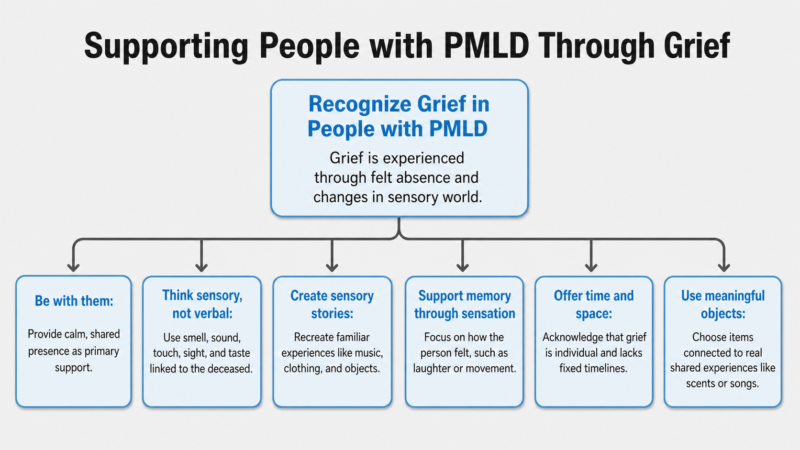
The first and most important step to supporting a person with profound and multiple learning disabilities with their grief is to be with them.
Approaches such as Intensive Interaction (Hewett and Nind 1994, 2001) or Being With (Grace 2025) (derived from Intensive Interaction), can deepen your understanding and capacity to be with people.
But it is natural for those of us used to keeping busy to want to ‘do’ something as well as ‘be’ with people. If you are looking for an activity to support someone with profound and multiple learning disabilities in experiencing and processing the death of a loved one you need to look to the sensory world as they apprehend it.
You can try:
- Sensory Stories to understand the absence
- Sensory stories to remember
- Sensory conversations to share
Sensory stories to experience absence
Sensory stories typically combine concise text with rich and relevant sensory stimulation (Grace 2022). To create a sensory story to explore absence think of the sensations the person you will be sharing the story with would have shared with the person who has gone. What did it sound like to be around that person? What actions happened? I remember Julia Barnes writing in PMLD link about Remembering Larry, she wrote of how his empty standing frame stood in the circle for the register each day so that his peers could experience his absence in a tangible way.
Top tip – think through the famous five senses:
Think through the famous five senses identifying experiences for each that relate to the person who has gone.
- Smell – what perfume did they wear, what soap did they use?
- Sight – did they wear bright clothes, sparkly jewellery, were they always in a hat?
- Sound – did they sing a song, greet you in a particular way, have you a recording of their voice?
- Touch – was there something about them that had a memoriable tactile property, or what did you touch when you were with them?
- Taste – what was their favourite food? What drink did you share with them?
My sensory story “When You Were Gone” (available at www.TheSensoryProjects.co.uk/sensory-stories) was designed to be used with a person with profound and multiple learning disabilities when a member of a group they belonged to died. It leads people through a sequence of experiences of the absence of that person. In each the experience of the absence is felt, rather than symbolically represented. We listen to the music they used to listen to, feel their clothes, play with their toys. All of these experiences are sensations that would previously have been had in the presence of that person, but within this story are had in the absence of that person.
Sensory stories to remember
More than once I have had people comment to me that they learned a lot about someone from their funeral and from the stories told at the wake. As we grieve we love to share our memories of the person we have lost. Creating sensory narratives about a person can be a great way to support someone with profound and multiple learning disabilities, when you think about these narratives try to position yourself alongside the person with profound and multiple learning disabilities and consider their experience of that person.
They are unlikely to remember the punchline of the hilarious joke the person used to tell, but they would respond to the sound of laughter, they might not follow the timeline of someone growing up in one area, travelling, and settling down in another area, but might respond to the scent of the sunscreen they always wore on their travels.
There is free guidance on how to share sensory stories available at www.TheSensoryProjects.co.uk/sensory-stories.
Top tip – focus on the quality of the experience:
When creating sensory memory stories focus on the quality of the sensory experience, rather than representational items, for example if the person loved to drive fast cars a toy car is not going to be a good sensory experience in relation to this as whilst it might be an exact replica of that person’s car this is only appreciated by a mind that can understand representation, instead what about a seatbelt tight across the body to mimic the feel of their braking after high speeds?
Think – what would the person with profound and multiple learning disabilities experience of them have been?
Opening sensory conversations
Grief is experienced by all people in different ways and to different time frames, people with profound and multiple learning disabilities are no exception to this. The very significant differences in their cognition, apprehension and processing that they live through are likely to mean the time scale of their experience is different from what we might expect from a peer without profound and multiple learning disabilities.
Offer space and time
People with profound disabilities are a great reminder to us that grief is personal, and we all need our own time and space to process the big feelings life brings our way. Just as you would do with anyone you will want to offer the bereaved person the time and the space to talk about the person they have lost and the grief that they feel. For people with profound and multiple learning disabilities you want to do the same, the first step of being with them is enough, is everything, but if you want to open the topic of the absence of that person then doing so in a sensory way is a sensitive way to approach this.
Remember to think sensory rather than representational
Often people’s first thought when seeking a sensory representation of a person is to show a photograph, this works well for people whose eyesight is great and who understand visual representations. Whilst some people with profound and multiple learning disabilities maybe able to access a photo for many it is not going to be a relevant introduction to the subject matter at hand.
Think in a sensory way, find an object that has sensory properties the person you are supporting can access, and sensory properties that relate specifically to the person they have lost.
I remember supporting a man who was struggling visiting his elderly mother, she was living through the final stages of dementia, like a person with profound intellectual disabilities she had no access to standardised forms of communication, no understanding of her past or future, and she often did not recognise her son. We worked together to find out from her friends how she had cared for him when he was a baby. We sourced the baby lotion she had used on him, and on his next visit he gave her a hand massage using that lotion. She stilled. Sensing a connection between them.
Top tip – ask those who loved the same person:
The best people to ask what this object might be are the other people grieving the same person, they will be able to hold up a shirt and tell you it smells of them, or to play you a song and tell you they used to listen to it all the time.
Top tip – think about the direction of perception:
Think about the direction of the experience of the person with profound and multiple learning disabilities, if they are a wheelchair user their viewpoint is different – a bold belt buckle that the person used to wear or the bright pendant that used to dangle in their view when they leant to greet them.
Once you have your sensory conversation opener, you can offer it to them, and offer them time and space with you as they feel its meaning. Ultimately the best thing you can do is the first step I suggested here: be with them. Give them time and space, allow them to process things in their own way at their own speed. Recognise them as people experiencing grief equal in their humanity to everyone else.
Barnes, Julia (2013) Remembering Larry. PMLD Link issue 76
Grace, J. (2025). Recognising the belonging of people with profound intellectual and multiple disabilities in research through a collaborative exploration of identity [Https://eprints.soton.ac.uk/497372/]. University of Southampton.
Frequently asked questions and PMLD and Bereavement
Can people with profound and multiple learning disabilities experience grief?
Yes. There is no level of disability that prevents someone from feeling bereavement. Grief may be shown through changes in mood, behaviour, attention, sleep, appetite or responses to familiar sensory experiences.
How might a person with profound intellectual disabilities understand death?
They may not understand death as an abstract idea. Instead, they may experience it through the absence of a familiar person, routine, voice, smell, touch or shared activity.
What is the first step in supporting someone through grief?
The first step is to be with them. Calm presence, patience and shared time can matter more than explanations, especially when words and symbolic communication are not accessible.
How can sensory stories help with grief?
Sensory stories can help someone experience absence and memory through sounds, smells, textures, objects, music or routines linked to the person who has died.
Should supporters use photographs?
Photographs may help some people, but not everyone can access visual representation. A scent, song, item of clothing or familiar tactile object may be more meaningful.
How long does grief last for someone with profound disabilities?
There is no fixed time. People with profound and multiple learning disabilities may process loss in ways and timescales that differ from non-disabled people. Support should remain patient and responsive.
