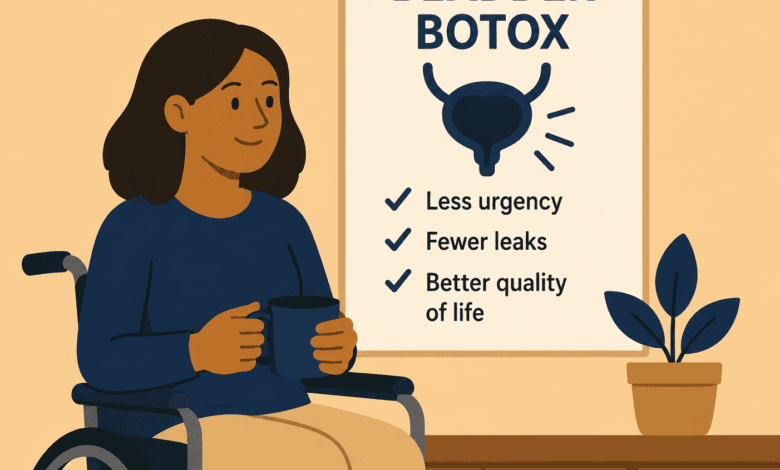
Bladder Botox: How It Changed Our Lives After Spinal Cord Injury (Complete UK & USA Guide)

About the author
I’m Duncan Edwards, Editor of Disability Horizons and an award-winning entrepreneur. My wife has lived with a spinal cord injury for many years, and bladder Botox has genuinely transformed our day-to-day life. Before treatment, bladder accidents meant lengthy hoist transfers, complete clothing and bedding changes, and hours lost to daily routines. Today, those interruptions are far less common, giving us the freedom to travel, work, and enjoy everyday life.
When we first heard about the treatment, we realised very few people outside specialist clinics knew it existed. That’s why I wanted to create this guide. It combines our personal experience with current clinical guidance from trusted UK and US sources, helping disabled people, family members, and carers understand what to expect.
Every person’s experience is different, and bladder Botox isn’t right for everyone. My aim is simply to make this option better known. It took many years for it to be recommended to us, but anyone living with bladder problems deserves to know there may be another path to discuss with their healthcare team.
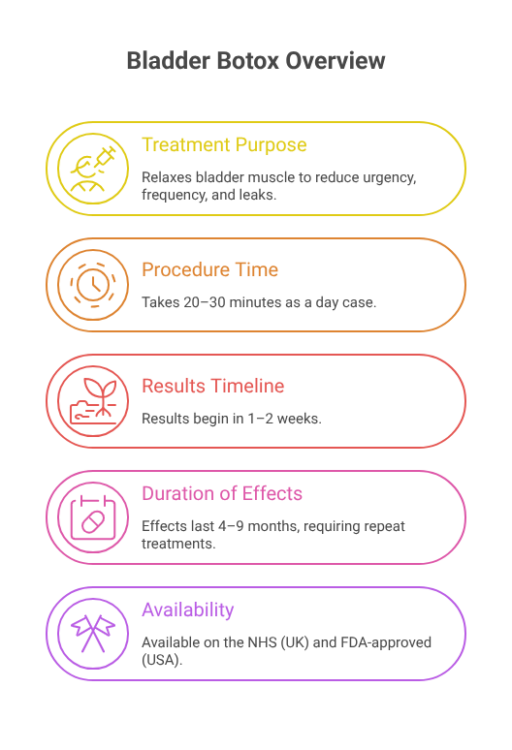
Fast Facts: Bladder Botox at a Glance
- Procedure time: 20–30 minutes
- Setting: Day case — most people go home the same day
- Results start: 1–2 weeks after treatment
- Effects last: 4–9 months before repeat treatment is usually needed
- Availability: Available on the NHS (UK) and FDA-approved (USA)
Key Takeaways
| Question | Answer |
|---|---|
| What is bladder Botox? | A treatment that relaxes an overactive bladder muscle to reduce urgency, frequency and urinary leakage. |
| Who can benefit? | People with overactive bladder or neurogenic bladder, including many people with spinal cord injuries, MS and other neurological conditions. |
| How long does it last? | Most people experience benefits for around 4–9 months before repeat treatment is needed. |
| Is it available on the NHS? | Yes, for suitable patients under specialist urology and neuro-urology teams. |
| Is it available in the USA? | Yes. Botox is FDA-approved for overactive bladder and neurogenic detrusor overactivity. |
Living with bladder problems affects much more than your bladder
For many people, bladder problems are one of the least talked about parts of living with a neurological condition or spinal cord injury.
People often become experts at planning every journey around accessible toilets. Nights are interrupted several times by the need to empty the bladder. Social invitations become stressful because of concerns about accidents, while holidays require military-style planning.
Many people describe bladder problems as one of the biggest barriers to feeling spontaneous.
Although urinary incontinence can affect anyone, it is especially common among people living with:
- spinal cord injury
- multiple sclerosis (MS)
- Parkinson’s disease
- spina bifida
- stroke
- other neurological conditions affecting bladder function
If you’re looking for wider support with bladder management after a spinal cord injury, the Spinal Injuries Association’s guidance on bladder management is a helpful starting point.
The good news is that treatment options continue to improve. One of the most effective for many people is bladder Botox.
Despite the name, this treatment has little to do with cosmetic procedures. It has been used in urology for many years and is now routinely offered in specialist services across both the UK and the United States for suitable patients.
What is Bladder Botox and How Does It Work?
Botox is the brand name for botulinum toxin type A.
When injected into the bladder wall, it reduces the unwanted nerve signals that cause the bladder muscle to squeeze too often or too strongly.
Instead of constantly signalling that it needs emptying, the bladder can hold urine for longer before you feel the urge to go.
For many people this means:
- fewer accidents
- less urgency
- fewer daytime toilet visits
- better sleep
- greater confidence leaving home
Why bladder Botox can make such a difference
Looking back, the number of toilet visits wasn’t what mattered most. It was the hours spent dealing with accidents, changing clothes and bedding, and rearranging plans. Bladder Botox has cut much of that out of our routine.
In our own experience, the difference has been far greater than simply reducing bladder leaks. Before treatment, bladder accidents often meant using a hoist to transfer from a wheelchair to bed for a full change of clothes, bedding and continence products. That could easily take an hour or more and sometimes happened several times a day. Less leakage has meant fewer interruptions, less laundry, less skin soreness and much less planning around everyday life.
People who respond well often describe being able to:
- travel without worrying about every toilet stop
- attend family events
- sleep through most nights
- return to work with greater confidence
- spend less time thinking about their bladder every day
Travel has become much less stressful. Before bladder Botox, flights and holidays often involved worrying about leaks, odours and whether there would be somewhere suitable to change if an accident happened. Social events could bring similar anxiety. Having more reliable bladder control has made it much easier to enjoy days out and travel with greater confidence. It’s been genuinely life changing.
Everyone’s experience is different, but this illustrates why many patients see Botox as much more than another medical procedure.
Who is bladder Botox suitable for?
Doctors usually recommend Botox after simpler treatments have not provided enough relief.
These may include:
- bladder training
- pelvic floor exercises
- dietary changes
- medications for overactive bladder
Bladder Botox may be appropriate if you have:
- overactive bladder
- neurogenic bladder
- neurogenic detrusor overactivity
- persistent urgency incontinence despite medication
Many people receiving treatment have spinal cord injuries or multiple sclerosis, although it is also used for other neurological conditions.
Why more people are hearing about bladder Botox
Bladder Botox is not a new treatment.
It has been used successfully for many years.
In the UK, NHS specialist urology, neuro-urology and spinal injury services have long offered it for appropriate patients, and awareness has grown as more people share their experiences and clinicians discuss it earlier in the treatment pathway.
In the United States, Botox has FDA approval for treating both overactive bladder and neurogenic detrusor overactivity.
As evidence has grown, more patients are being referred before bladder symptoms begin to dominate everyday life.
Our experience at Sheffield Spinal Injuries Centre
My wife was referred for bladder Botox by the specialist team at the Princess Royal Spinal Injuries Centre in Sheffield after years of managing bladder problems following her spinal cord injury.
We now attend our local hospital roughly every six months, although we usually notice the effects beginning to wear off after around four months. Once that happens, booking the next treatment is straightforward. We simply complete the online follow-up process and the hospital sends an appointment.
The treatment itself has become part of our routine. We arrive at the hospital, have the procedure as a day patient and are normally back home later the same afternoon. Although everyone’s experience will be different, we’ve found the whole process far simpler than we expected before the first appointment. We are normally in and out within 2 hours.
What to Expect During the Bladder Botox Procedure
If you’ve never had a bladder Botox treatment before, it’s natural to feel nervous. Many people imagine it will involve a major operation, but the procedure is usually much simpler than they expect.
In both the UK and the USA, bladder Botox is normally carried out as a day procedure, meaning you can usually go home the same day.
Before treatment, your specialist will review your symptoms, medical history and any previous bladder treatments you’ve tried. You’ll usually be asked to provide a urine sample to make sure you don’t have a urinary tract infection (UTI), as treatment is normally postponed until any infection has cleared.
The procedure itself takes around 20 to 30 minutes, although you’ll usually be at the hospital or clinic for longer because of preparation and recovery.
A local anaesthetic gel is often placed into the bladder through a small catheter to numb the area. Some hospitals and specialist centres may offer sedation or a general anaesthetic, particularly if you have complex medical needs or are having other procedures at the same time.
Your doctor then passes a thin camera, called a cystoscope, through the urethra into the bladder. Using this camera for guidance, they inject small amounts of Botox into several areas of the bladder wall.
Although this sounds uncomfortable, many patients describe it as more of an odd sensation than a painful one. If you’re worried about discomfort, talk to your healthcare team beforehand so they can explain the options available.
After the injections are complete, you’ll usually stay for a short period so staff can make sure you’re comfortable and able to pass urine before going home.
For wheelchair users or people with spinal cord injuries, hospitals will usually discuss any individual positioning or accessibility requirements before the procedure to help make the experience as straightforward as possible.
For a detailed walkthrough of what happens during treatment, UCLH’s patient information on botulinum toxin injections for the bladder covers the procedure step by step.
Worth knowing: Botox doses and totals
All botulinum toxin treatments add up in your body over time.
This includes bladder Botox, injections for spasticity or migraine, and cosmetic facial Botox.
During one of our appointments, the team explained that all botulinum toxin treatments count towards the amount your body receives over time. If you’re having cosmetic Botox as well as bladder Botox, make sure your specialist knows before treatment so they can take this into account.
Most adults are kept below about 400 units in any 3‑month period, across all treatments.
Typical doses are 100 units for overactive bladder and 200 units for neurogenic bladder such as spinal cord injury, with smaller amounts for cosmetic use.
Other Botox treatments, such as migraine injections, muscle spasticity injections, eye‑muscle treatments and cosmetic facial Botox, also count towards your total dose over time and should be included when your specialist calculates how much you receive. If you have other Botox treatments as well as bladder Botox, update each specialist about the other doses.
This helps them add the doses together and keep you safely within recommended limits while still aiming for good symptom control.
What recovery is really like
Recovery is often quicker than many people expect.
Most people go home the same day and return to their usual routine within 24 to 48 hours, although your healthcare team may advise avoiding strenuous activity for a short time.
For the first day or two, it’s common to notice:
- mild discomfort when passing urine
- needing to urinate slightly more often
- small amounts of blood in the urine
- mild bladder irritation
These symptoms usually settle within a few days.
The Botox doesn’t start working immediately. Most people begin noticing improvements after around one to two weeks, although it can sometimes take a little longer before the full benefit is felt.
Your healthcare team may arrange a follow-up appointment to check how well your bladder is emptying and whether the treatment is working as expected.
For some people, particularly those with neurogenic bladder caused by spinal cord injury or multiple sclerosis, the bladder may become so relaxed that it doesn’t empty completely. If this happens, you may need to use clean intermittent self-catheterisation (CISC) for a period of time. While this possibility understandably worries some people, your specialist will discuss the risk before treatment and provide training and support if catheterisation becomes necessary.
Many patients feel that this short adjustment period is outweighed by the longer-term improvement in bladder control, although everyone’s experience is different.
What results can you realistically expect?
Bladder Botox isn’t a cure, and it won’t work the same way for everyone. The goal is to reduce symptoms enough to improve your daily life.
For many people, that means fewer urgent trips to the toilet, fewer accidents and more confidence in situations that previously felt stressful.
You may notice improvements such as:
- fewer episodes of urinary leakage
- less urgency and frequency
- sleeping for longer without waking to use the toilet
- greater confidence travelling or spending time away from home
- less reliance on continence pads or other continence products
- feeling more in control of daily routines
Clinical studies have shown that many people experience a significant reduction in urinary incontinence episodes after bladder Botox treatment. For people with neurogenic bladder, research has also found improvements in bladder pressure, bladder capacity and overall quality of life.
The effects are temporary because the nerve endings gradually recover. Most people need repeat injections every four to nine months, although this varies from person to person.
Bladder Botox Side Effects and Risks
Like any medical treatment, bladder Botox carries some risks. Most side effects are temporary and manageable, but it’s important to understand them before deciding whether treatment is right for you.
The most common side effects include:
- burning or discomfort when passing urine for a few days
- small amounts of blood in the urine immediately after treatment
- urinary tract infections (UTIs)
- temporary difficulty emptying the bladder completely
The possibility of urinary retention is one of the main issues your specialist will discuss before treatment. Because Botox relaxes the bladder muscle, some people find they cannot empty their bladder properly for a period after the injections.
If this happens, you may need to use intermittent self-catheterisation until normal bladder function returns. This is more likely in some people with neurological conditions, which is why many hospitals discuss catheterisation before offering treatment.
Serious side effects are uncommon. In rare cases, people may experience more widespread muscle weakness or an allergic reaction. Your healthcare team will explain what symptoms to look out for and when to seek medical advice.
It’s also worth remembering that every treatment involves balancing potential risks against the impact your current bladder symptoms have on your daily life. For many people living with severe urgency or frequent accidents, the possibility of better bladder control outweighs the temporary risks, but that’s a personal decision that should always be made with your specialist.
The most helpful conversations with your healthcare team are often the most honest ones. If you’re worried about catheterisation, infection or whether the treatment will work for you, raising those concerns before the procedure can help you make an informed decision that fits your own priorities and lifestyle.
Can you still need to catheterise afterwards?
One of the biggest questions people ask before bladder Botox is whether they’ll still need to use a catheter afterwards.
The honest answer is possibly.
Botox works by relaxing the bladder muscle. While this helps reduce the urgent contractions that cause leakage and frequent trips to the toilet, it can also make the bladder less effective at emptying completely.
For some people, particularly those with spinal cord injuries, multiple sclerosis or other neurological conditions, this means intermittent self-catheterisation (ISC or CISC) may be needed after treatment.
If you already use intermittent catheters, your routine may stay much the same, although many people find they catheterise less often because their bladder stores urine more effectively.
If you don’t currently catheterise, your specialist will explain the possibility before treatment. Some hospitals teach patients how to use intermittent catheters in advance, so they’re prepared if they need them.
While the thought of catheterisation can feel daunting, many people find it easier to manage than they expected. For those who experience significant improvements in urgency and incontinence, using a catheter occasionally or regularly may be a worthwhile trade-off for better bladder control and greater confidence.
Not everyone will need to catheterise, and if urinary retention does occur, it is often temporary. Your healthcare team will monitor how well your bladder is emptying after treatment and advise you if any additional support is needed.
The key is to have an open conversation before your procedure so you understand both the potential benefits and the possible adjustments afterwards.
Accessing Bladder Botox: UK vs USA at a Glance
| Feature | United Kingdom (UK) | United States (USA) |
|---|---|---|
| Primary Pathway | NHS Specialist Urology / Neuro-Urology | Private Urologists or Urogynecologists |
| Referral Needed? | Yes, via GP or existing Consultant | Depends on insurance plan; often requires prior authorisation |
| Coverage | Fully covered by the NHS for eligible patients | Covered by Medicare and private plans if clinical criteria are met |
| Treatment Schedule | Usually repeated when symptoms return | Varies by insurance approval and clinical need |
Accessing bladder Botox treatment through the NHS
In the UK, bladder Botox is available on the NHS for suitable patients, although it is usually offered after other treatments have not provided enough relief.
You will normally be referred to a consultant urologist, uro-gynaecologist or neuro-urologist by your GP, spinal injuries consultant or another specialist involved in your care.
Before recommending Botox, your healthcare team may carry out assessments such as:
- bladder diaries
- urine tests
- ultrasound scans
- urodynamic testing to understand how your bladder stores and empties urine
- a review of medications and previous treatments
These assessments follow the NICE guidance on urinary incontinence in neurological disease, which sets out how bladder problems linked to neurological conditions should be assessed and managed.
If Botox is considered appropriate, the procedure is usually carried out as a day case in a hospital or specialist clinic.
Most NHS patients receive repeat injections when symptoms return, rather than on a fixed schedule. For many people, this is every six to nine months, although some find the benefits last longer.
Access can vary depending on where you live and the specialist services available in your area. If you think bladder Botox could help but it has not been discussed, ask your consultant or continence specialist whether a referral to a neuro-urology or specialist urology service would be appropriate.
Accessing bladder Botox treatment in the USA
In the United States, bladder Botox is widely available through urologists and urogynecologists and is approved by the U.S. Food and Drug Administration (FDA) for treating overactive bladder and neurogenic detrusor overactivity in eligible patients — see the FDA prescribing information for Botox for full clinical details.
Many private insurance plans and Medicare cover the treatment when medical criteria are met, although prior authorisation is often required. Your healthcare provider’s office can usually help with the approval process and explain any out-of-pocket costs before treatment. Clinics need a reliable supply of licensed botulinum toxin products, companies like Ogomed sell Botox vials online.
Most specialists recommend trying medication before moving on to bladder Botox. That was our experience too. My wife was prescribed anti-spasmodic tablets, but the side effects made them difficult to tolerate, so she often chose not to take them. We never really explained that to the clinic, and in hindsight that may have delayed the conversation about bladder Botox.
Your specialist will assess whether Botox is suitable based on factors including:
- your symptoms
- previous treatments
- bladder function
- any neurological conditions
- your ability to manage catheterisation if it becomes necessary
These decisions are informed by the AUA/SUFU guideline on overactive bladder, which many US urologists follow when weighing Botox against other treatment options.
If you have concerns about insurance coverage or treatment costs, ask your healthcare provider or insurer for a written explanation of what is included. Understanding this before your appointment can help avoid unexpected expenses.
Questions to ask your specialist
Choosing bladder Botox is a personal decision, and there is no such thing as a silly question. The more you understand before treatment, the more confident you’ll feel about whether it’s the right option for you.
Consider asking:
- Is bladder Botox suitable for my specific condition?
- What benefits can I realistically expect?
- How likely is it that I’ll need intermittent self-catheterisation afterwards?
- How long do the effects usually last in patients like me?
- What happens if Botox doesn’t work for me?
- How many bladder Botox procedures do you perform each year?
- What side effects should I watch for once I’m home?
- How soon can I return to work, driving or my usual activities?
- If the treatment helps, how often can it be repeated?
- Are there any alternative treatments I should consider first?
Don’t feel pressured to make a decision during your appointment. If you’re unsure, ask for written information to take home, discuss it with family or carers if appropriate, and arrange another appointment if you have further questions.
Is bladder Botox right for you?
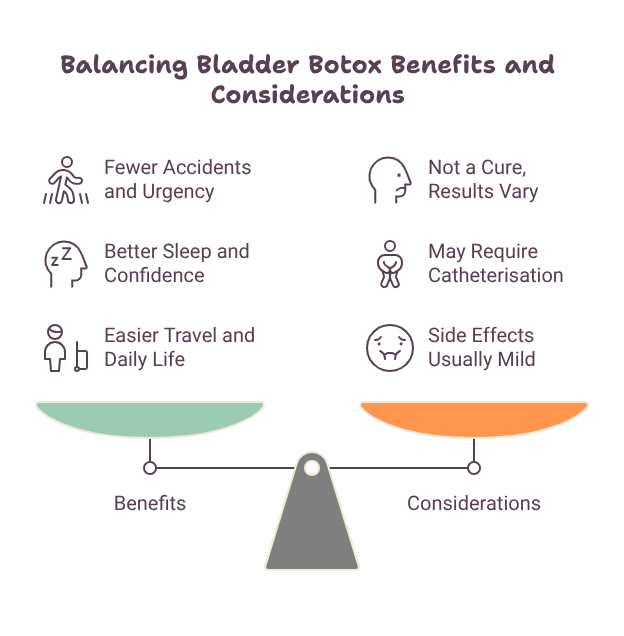
Bladder Botox can be a very helpful treatment, but it is not the right choice for everyone. The decision depends on your symptoms, medical history, bladder function, access to follow-up care and how you feel about the possibility of catheterisation.
It may be worth asking about bladder Botox if urgency, leakage or frequent urination is affecting your sleep, work, travel, relationships or independence, and other treatments have not helped enough.
For some people, the biggest benefit is practical. They can leave home with less planning, sleep for longer, or spend less time worrying about accidents. For others, the possible need for intermittent catheterisation may feel like too much of a trade-off.
There is no single right answer. A good specialist should help you weigh up the likely benefits and risks in relation to your own life, not just your test results.
Bladder Botox and quality of life
The value of bladder Botox is often measured in clinical terms: fewer leaks, fewer toilet visits and improved bladder capacity. Those things matter, but they do not tell the whole story.
One of the biggest changes has been reducing the amount of time bladder care takes each day. For wheelchair users who need a hoist for transfers, every clothing change can involve a lengthy routine. Fewer accidents don’t simply save a trip to the toilet—they can mean fewer transfers, less washing, fewer bedding changes and more time spent actually living life.
For many patients, bladder symptoms affect everyday choices. Someone may stop travelling because accessible toilets are unreliable. A person with a spinal cord injury may avoid social plans because continence routines take too much energy. Someone with MS may lose sleep night after night because bladder urgency keeps waking them.
When treatment works well, the difference can be deeply practical. It may mean getting through a work meeting, visiting family, taking a longer journey or sleeping without repeated disruption.
That does not mean bladder Botox removes every barrier. People still need accessible toilets, reliable healthcare, continence support and respectful conversations with professionals. But for suitable patients, it can be one part of a wider plan that makes daily life more manageable.
Bladder Botox FAQs for UK and USA patients
Is bladder Botox the same as cosmetic Botox?
The medicine is related, but the treatment is different. Bladder Botox is injected into the bladder wall by a trained urology specialist to reduce bladder overactivity. It is a medical treatment used for urinary incontinence, overactive bladder and some neurological bladder conditions.
Does bladder Botox hurt?
Many people describe the procedure as uncomfortable rather than very painful. Local anaesthetic, sedation or general anaesthetic may be used depending on the hospital, clinic and your individual needs.
How long does bladder Botox take to work?
Many people notice changes within one to two weeks. For some, it may take a little longer before the full effect is clear.
How long does bladder Botox last?
The effect is temporary. Many people need repeat treatment after around four to nine months, although this varies from person to person.
Can bladder Botox stop incontinence completely?
Some people have a major reduction in leakage, while others have partial improvement. It is best to think of Botox as a treatment that may reduce symptoms rather than a guaranteed cure.
Can I get bladder Botox on the NHS?
Yes, bladder Botox is available through NHS specialist services for suitable patients. It is usually offered after other treatments, such as bladder training or medication, have not worked well enough.
Is bladder Botox available in the USA?
Yes. In the USA, bladder Botox is available through urologists and urogynecologists. Insurance cover depends on your diagnosis, treatment history and policy requirements.
Will I need to use catheters after bladder Botox?
Some people do. Botox can make the bladder less able to empty fully, so intermittent self-catheterisation may be needed. Your specialist should explain this risk before treatment.
Can people with spinal cord injury have bladder Botox?
Yes, many people with spinal cord injury are considered for bladder Botox, especially when they have neurogenic bladder or detrusor overactivity. Suitability depends on individual assessment by a specialist.
Can people with MS have bladder Botox?
Yes, bladder Botox can be used for some people with MS who have bladder overactivity or urgency incontinence. A specialist will assess bladder function, symptoms and the risk of urinary retention.
Final thoughts on bladder Botox
Bladder problems can affect far more than toilet routines. They can shape sleep, confidence, relationships, travel, work and independence. For people with spinal cord injury, MS, overactive bladder or other neurological conditions, those effects can be constant and exhausting.
Bladder Botox is not suitable for everyone, and it does carry risks, including urinary retention and urinary tract infections. But for many patients, it offers meaningful relief when other treatments have not helped enough.
The most important step is a proper conversation with a specialist who understands both the medical side and the daily reality of living with bladder problems. Good treatment should not only focus on bladder function. It should support the person’s life, choices and independence.
