Workplace Disability Discrimination: UK vs USA Rights, Barriers, Mental Health and Compensation Compared

Workplace disability discrimination can affect someone’s income, career, health and sense of security at work. Legal protections exist in both the UK and USA, but the rules, claims process and compensation differ. This guide compares disability discrimination law in the UK and USA, including how emotional distress and injury to feelings may be addressed.
Workplace Disability Discrimination: UK vs USA Key Takeaways
| Key issue | What readers should know |
|---|---|
| UK protection | The Equality Act 2010 protects disabled workers from several forms of workplace discrimination in Great Britain. Northern Ireland has separate legislation. |
| US protection | Federal protection comes from the Americans with Disabilities Act (ADA), while state laws can give workers further rights. |
| Workplace changes | UK law uses the term “reasonable adjustments”. US federal law refers to “reasonable accommodation”. |
| Mental health | Mental health conditions can fall within disability protections in both countries, although the legal definitions and circumstances differ. |
| Workplace barriers | Legal protection does not automatically remove inaccessible systems, discriminatory attitudes or concerns about disclosing a disability. |
| Emotional impact | UK discrimination awards can include compensation for injury to feelings. US federal law can allow compensatory damages for emotional harm in qualifying cases. |
| California | California’s Fair Employment and Housing Act (FEHA) provides state-level protections and remedies that can differ from federal law. |
What Counts as Disability Discrimination at Work in the UK?
In Great Britain, disability is one of the protected characteristics covered by the Equality Act 2010. The law can apply to recruitment, working conditions, training, promotion, pay, dismissal and other employment decisions.
Disability discrimination can take several forms. These include direct and indirect discrimination, discrimination arising from disability, harassment, victimisation and failing to make reasonable adjustments.
The practical circumstances matter as much as the terminology. A disabled employee may be perfectly capable of doing their job but encounter barriers because working hours are unnecessarily rigid, software is inaccessible or important information is provided in a format they cannot use.
Someone could also be disadvantaged by assumptions about disability. A manager deciding that a disabled employee would find a promotion “too stressful”, for example, is making a decision about that person’s abilities without allowing them to make that judgement themselves.
What Are Reasonable Adjustments at Work?
Employers have a duty to make reasonable adjustments in certain circumstances where a disabled worker would otherwise be put at a substantial disadvantage.
An adjustment might involve changing working hours, providing accessible equipment, altering a physical workspace or changing the way information is communicated. It can also mean changing a workplace practice that creates an unnecessary barrier.
There is no standard list that works for every disabled person. Two employees with the same impairment may need completely different adjustments because their jobs, working environments and individual circumstances differ.
What Counts as Disability Discrimination at Work in the USA?
The Americans with Disabilities Act (ADA) provides important federal workplace protections for disabled people in the USA. Title I covers areas including recruitment, hiring, advancement, pay, training and dismissal for employers covered by the legislation.
The US term “reasonable accommodation” has similarities to reasonable adjustments in Britain. An accommodation might involve changes to how or where someone works, accessible equipment or changes that allow a disabled employee to perform their job.
There are important differences between the two legal systems, so the terms should not be treated as interchangeable.
There are also restrictions on when US employers can ask disability-related questions. Before a conditional job offer, the ADA restricts disability-related questions and medical examinations. Different rules apply after an offer has been made and during employment.
Federal law is only part of the picture. Individual states can have their own employment discrimination laws, which may give workers protections or remedies beyond those available under the ADA. California is one example, which we look at later in this guide.
Do Employees Have to Disclose a Mental Health Condition at Work?
Deciding whether to tell an employer about a mental health condition can be complicated. Some people want colleagues and managers to understand what is happening. Others worry that disclosure could change how they are treated or how their abilities are perceived.
There is not a general requirement for every employee in either Britain or the USA to proactively tell their employer about a mental health condition. There are circumstances where particular jobs, safety requirements or employment processes can make the position more complicated.
Disclosure can also become relevant when someone needs changes at work.
Why Can Disclosure Be Important for Workplace Adjustments?
In Britain, an employer’s duty to make reasonable adjustments generally depends on the employer knowing, or being reasonably expected to know, that someone is disabled and is likely to be placed at a substantial disadvantage.
In the USA, an employee who needs an accommodation will normally need to make the employer aware that a change is required because of a health condition. This can begin an interactive process between employer and employee to identify an appropriate accommodation.
That does not necessarily mean telling every colleague about a diagnosis or sharing every detail of someone’s health.
For some people, it can be more useful to explain the practical barrier. Someone might explain that a particular working pattern is worsening symptoms and ask whether their hours can be changed, for example. What information is required will depend on the circumstances and applicable law.
Why Do Some Disabled Employees Choose Not to Disclose?
Having rights on paper does not remove the social consequences people may fear when deciding whether to disclose a disability or mental health condition.
Someone may worry about being overlooked for promotion, being regarded as less capable or having ordinary mistakes attributed to their condition. Previous experiences of discrimination can also affect whether someone feels safe discussing disability with a new employer.
This creates a difficult situation. Accessing adjustments can require an employer to understand that a disability-related barrier exists, yet fear of how that information will be received can make disclosure difficult.
A good workplace should make that decision easier by having confidential, straightforward adjustment procedures and by responding to disabled employees without making assumptions about their abilities.
What Workplace Barriers Do Disabled Employees Still Face?
Discrimination is not limited to an employer openly refusing to employ someone because they are disabled. Workplace systems themselves can exclude people.
An online recruitment system may not work properly with assistive technology. An employer might insist that every employee works identical hours despite there being no practical need. Meetings may routinely be held without captions or accessible documents. An office might be technically “accessible” but still have desks, kitchens or meeting rooms that some employees cannot use.
Attitudes create barriers too. Disabled employees can encounter low expectations, intrusive questions, bullying or assumptions that adjustments give them an unfair advantage.
Mental health conditions and non-visible disabilities can create another layer of difficulty because colleagues may not recognise the barriers someone encounters. An employee should not have to repeatedly prove that their needs are legitimate simply because other people cannot see their impairment.
These problems occur on both sides of the Atlantic. The legal routes for responding to them differ, but legislation alone cannot create an inclusive workplace. Employers also need accessible systems, knowledgeable managers and a culture in which disabled employees are listened to.
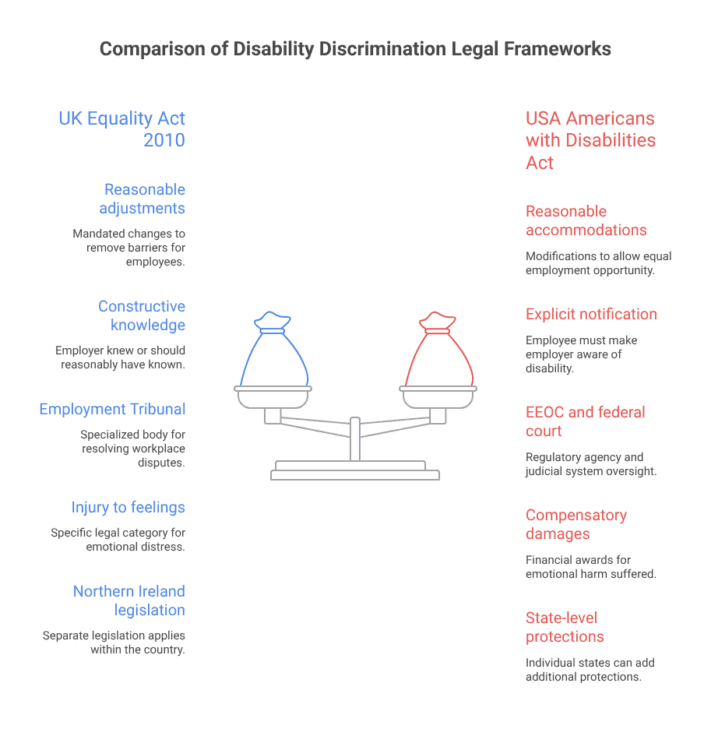
UK vs USA Disability Discrimination Laws: What Are the Main Differences?
| Issue | UK | USA |
|---|---|---|
| Main legislation | Equality Act 2010 in Great Britain | Americans with Disabilities Act at federal level |
| Workplace changes | Reasonable adjustments | Reasonable accommodations |
| Employer knowledge | What the employer knew, or could reasonably have been expected to know, can be important | Employees seeking an accommodation generally need to make the employer aware that a disability-related workplace change is needed |
| Enforcement | Employment Tribunal | EEOC and, in some cases, federal court |
| Emotional impact | Compensation can include injury to feelings | Compensatory damages can include emotional harm in qualifying cases |
| Regional differences | Northern Ireland has separate discrimination legislation and procedures | Individual states can provide additional protections and remedies |
The similarities can make the two systems appear closer than they really are. “Reasonable adjustments” and “reasonable accommodations”, for example, address comparable workplace problems but sit within different legislation and legal tests.
The same caution applies when discussing compensation. Injury to feelings in a British discrimination claim should not simply be described as another name for emotional distress damages in the USA.
That distinction becomes particularly important when discrimination has caused serious distress.
Can You Claim for Emotional Distress After Workplace Discrimination?
Workplace discrimination can have consequences well beyond lost wages. Being repeatedly excluded, harassed, denied adjustments or treated differently because of disability can affect someone’s confidence, mental health and sense of security at work.
Both UK and US law can recognise this emotional impact when compensation is considered, but they do so in different ways.
UK Compensation for Injury to Feelings
In Britain, an Employment Tribunal can award compensation for “injury to feelings” following unlawful discrimination. This is intended to recognise the upset and distress caused by discriminatory treatment.
Tribunals generally calibrate these awards using the “Vento bands,” updated annually by the Presidents of the Employment Tribunals. For claims presented on or after 6 April 2026, the bands are a lower range of £1,300 to £12,600 for less serious cases, a middle range of £12,600 to £37,700, and an upper range of £37,700 to £62,900 for the most serious cases, with exceptional cases capable of exceeding £62,900.
This is separate from financial losses. Someone who loses earnings because of discrimination, for example, may be able to claim for those losses as well as injury to feelings.
Where discrimination has caused an illness or injury, other compensation may sometimes be relevant. The circumstances and supporting evidence become important, particularly where a connection needs to be established between the discriminatory treatment and its effect on someone’s health.
A published Employment Tribunal remedies judgment illustrates how this works in practice: in Mr Y Mahmood v Rotherham Metropolitan Borough Council, the Tribunal awarded £4,881.11 for injury to feelings, including harassment linked to his son’s disability, with statutory interest calculated on top of the award.
Injury to feelings should not be confused with US emotional distress damages. Although both recognise that discrimination can have emotional consequences, they belong to different legal systems with different rules.
USA Compensation for Emotional Harm
Under US federal employment discrimination law, compensatory damages can be available for emotional harm in qualifying cases involving intentional discrimination.
This can include consequences such as emotional pain, mental anguish, inconvenience and loss of enjoyment of life.
Federal law places limits on combined compensatory and punitive damages. The cap depends on the size of the employer, ranging from $50,000 for employers with 15 to 100 employees to $300,000 for employers with more than 500 employees.
Those federal limits do not necessarily tell someone everything they need to know. State discrimination laws can be different, and California provides a particularly useful example.
How Does California Workplace Discrimination Law Differ?
The Americans with Disabilities Act provides federal protection, but individual states can give disabled workers additional rights. California has its own employment discrimination protections under the Fair Employment and Housing Act (FEHA).
One important difference concerns damages. California does not apply the same statutory caps on compensatory and punitive damages that apply to claims under federal discrimination law. This can make the potential remedies considerably different depending on which law applies to a case.
Workers in the state looking at possible compensation may also want to understand how emotional harm is treated under California law. This guide considers Can you sue for emotional distress in a workplace discrimination case and explains how emotional distress damages may form part of a discrimination claim.
California is a useful example of why “US employment law” should not be treated as a single set of rules. Where someone works, the size of their employer and the law under which a claim is brought can all affect their rights and possible remedies.
What Evidence Can Help With a Workplace Discrimination Claim?
If something is going wrong at work, keeping a clear record can help someone explain what happened later. This can be useful whether they raise the problem with a manager, use a formal grievance process or eventually seek outside advice.
Useful records might include:
- emails and workplace messages;
- requests for reasonable adjustments or accommodations;
- the employer’s responses to those requests;
- relevant workplace policies;
- dates and descriptions of incidents;
- records of grievances or complaints;
- pay or employment records where there has been a financial impact; and
- the names of people who witnessed relevant events.
It can be particularly useful to keep copies of written adjustment requests and responses. They can provide a clearer record than trying to remember the details of conversations months later.
Health or medical evidence may also be relevant in some circumstances, particularly where a claim concerns the effect discrimination has had on someone’s health. Whether this is necessary depends on the type of claim and the law that applies.
How Do You Report Disability Discrimination at Work?
Many people initially raise a problem within their workplace. That might mean speaking to a manager, HR department or trade union representative, or using the employer’s grievance procedure.
Internal processes do not necessarily stop legal deadlines from running, however. This is particularly important if someone is considering taking the matter further.
Reporting Workplace Discrimination in the UK
In Great Britain, someone considering an Employment Tribunal claim will usually need to notify Acas and go through Early Conciliation before making a claim.
Employment Tribunal deadlines are short. At the time of writing, discrimination claims will commonly need action within three months minus one day of the act being complained about, although the way time limits apply can depend on the circumstances.
Employment law is changing, including planned changes to tribunal time limits. Anyone considering a claim should check the current Acas and GOV.UK guidance rather than calculating a deadline from an older article.
Reporting Workplace Discrimination in the USA
In the USA, a worker may use their employer’s internal procedures, but federal discrimination complaints can also involve filing a charge with the Equal Employment Opportunity Commission (EEOC).
Deadlines vary. An EEOC charge will generally need to be filed within 180 calendar days of the alleged discrimination, although this can extend to 300 days where a state or local agency enforces a law prohibiting the same type of discrimination.
State processes can add another layer. A worker in California, for example, may also need to consider the state’s Civil Rights Department and the rules that apply to FEHA claims.
Because both deadlines and procedures depend on where someone works and what happened, anyone who thinks they may have experienced unlawful discrimination should check current official guidance as early as possible.
According to Fort Lauderdale discrimination lawyer Michelle Cohen Levy, the enforcement of a worker’s rights should be aggressively pursued when employers fail to comply with the law.
How Can Employers Reduce Disability Discrimination?
Legal claims deal with problems after something has gone wrong. A better workplace removes as many barriers as possible before an employee has to complain about them.
Accessible recruitment is one place to start. Application forms and recruitment websites should work with assistive technology, interview adjustments should be straightforward to request, and hiring managers should avoid making assumptions about what a disabled applicant can do.
The same principle applies once someone is employed. Adjustment and accommodation procedures should be clear, confidential and easy to use. Accessible technology, flexible working practices and accessible physical spaces should be part of ordinary workplace planning rather than treated as unusual exceptions.
Managers also need to listen. A disabled employee generally understands the barriers affecting their own work better than someone making assumptions on their behalf.
That matters for mental health and non-visible disabilities too. Employees should not have to repeatedly justify a legitimate need because colleagues cannot see the impairment involved.
Workplaces designed with different access requirements in mind reduce the amount of individual negotiation disabled people have to undertake simply to do their jobs. The responsibility for accessibility should not sit entirely with the person encountering the barrier.
UK vs USA Workplace Disability Rights: What Should Employees Remember?
Disabled workers have legal protections against workplace discrimination in both the UK and USA, but the systems are not interchangeable.
In Great Britain, the Equality Act 2010 includes the duty to make reasonable adjustments and allows compensation for injury to feelings in discrimination cases. In the USA, the ADA provides federal protection and uses the concept of reasonable accommodation. Federal compensatory damages can include emotional harm in qualifying cases, while state laws such as California’s FEHA can provide different protections and remedies.
The law is only part of the picture. Accessible recruitment, flexible working practices, inclusive technology and employers who take disabled employees seriously can prevent many workplace barriers from developing into disputes in the first place.
If discrimination does occur, keeping records and checking the relevant deadlines early can be important. Rights and procedures vary according to jurisdiction and individual circumstances.
This article provides general information rather than legal advice. Employment discrimination law, compensation rules and filing deadlines can change, so readers considering action should check current official guidance or seek appropriate professional advice.
Workplace Disability Discrimination FAQ
What counts as disability discrimination at work in the UK?
In Great Britain, disability discrimination can include direct and indirect discrimination, discrimination arising from disability, harassment, victimisation and a failure to make reasonable adjustments. The Equality Act 2010 can apply to recruitment, pay, promotion, training, working conditions and dismissal.
What counts as disability discrimination at work in the USA?
The Americans with Disabilities Act (ADA) protects disabled people from employment discrimination at federal level where the legislation applies. Protection covers areas such as recruitment, hiring, advancement, pay, training and dismissal. State laws may provide further rights.
What is the difference between reasonable adjustments and reasonable accommodations?
Reasonable adjustments is the term used under British equality law, while reasonable accommodation is used under US federal disability law. Both can address barriers affecting disabled employees, but they operate under different legislation and legal tests.
Do employees have to disclose a mental health condition at work?
There is no general requirement for every employee in Britain or the USA to proactively disclose a mental health condition. Disclosure may become relevant when an employee needs a workplace adjustment or accommodation, although the information required depends on the circumstances and applicable law.
Can you claim compensation for emotional distress after workplace discrimination?
Both UK and US law can recognise the emotional effects of unlawful workplace discrimination, but the legal approaches differ. British discrimination claims can include compensation for injury to feelings. Under US federal law, compensatory damages can include emotional harm in qualifying cases involving intentional discrimination.
How much compensation can you receive for injury to feelings in the UK?
For claims presented on or after 6 April 2026, the Vento bands range from £1,300 to £12,600 for less serious cases, £12,600 to £37,700 for the middle band and £37,700 to £62,900 for the most serious cases. Exceptional cases can exceed the upper figure. The amount awarded depends on the circumstances of the discrimination.
Does California have different disability discrimination laws?
Yes. California has employment discrimination protections under the Fair Employment and Housing Act (FEHA). Its protections and possible remedies can differ from those available under federal law, including the rules affecting compensatory and punitive damages.
What evidence can help with a workplace disability discrimination claim?
Useful records can include emails, workplace messages, adjustment or accommodation requests, employer responses, relevant policies, incident dates, grievance records, pay records and details of witnesses. Health evidence may also be relevant where a claim concerns the effect discrimination has had on someone’s health.
