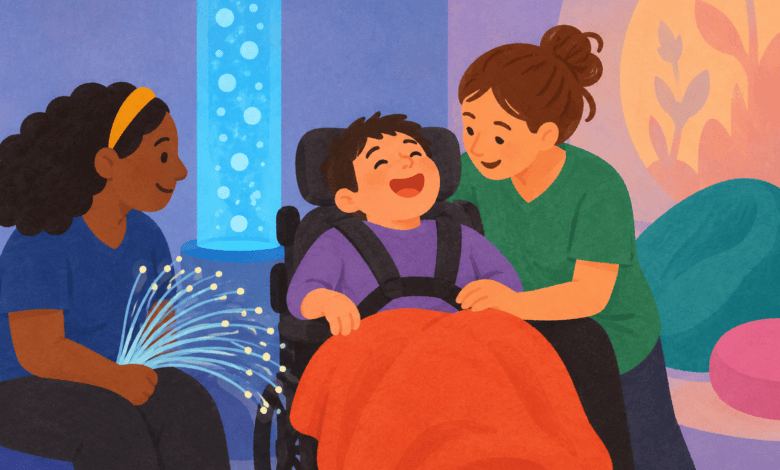
The Privilege of Caring: Why Good Support for People With Profound and Multiple Learning Disabilities Needs Supported Staff

The Privilege of Caring
Good support for people with profound and multiple learning disabilities requires time, attention and respect for each person’s communication, choices and preferences. Joanna Grace reflects on what happens when that support falls short and asks a harder question: what conditions help support workers provide good care consistently? Looking at training, staffing, workplace culture, supervision and personal privilege, she considers how better-supported staff and clear accountability can help protect disabled people’s autonomy and dignity.
Key Takeaways About Support for People With Profound and Multiple Learning Disabilities
| Key point | Why it matters |
|---|---|
| Disabled people have a right to respectful support | Support should recognise a person’s communication, preferences, choices and autonomy. |
| Good support requires attentiveness | People with profound and multiple learning disabilities may communicate choices and interests in many different ways, which can require time and close attention. |
| Support workers do not work in isolation | Training, staffing levels, supervision, pay and workplace culture can affect the conditions in which support is provided. |
| Understanding poor support does not excuse it | Difficult working conditions may help explain what has happened, but they do not remove a disabled person’s right to dignity, choice and respectful support. |
| Better systems can support better care | Consistent staffing, time to build relationships, reflective supervision, training and accountability can create better conditions for attentive support. |
Why Respectful Support Matters for People With Profound and Multiple Learning Disabilities
I remember the story of the special school who were making a cascading poppy display ahead of Remembrance day. Every child in the school was to paint a paper plate red; a black circle was then stuck to the middle and all the plates would be stapled to the display board. The problem was one teaching assistant tasked with loading the plates onto the drying rack took it upon themselves to ‘finish’ every plate, filling in any white parts with red and thus annihilating any expression of individuality within the student’s artwork.
We all rolled our eyes – how could they!
There’s another story; this one is about the member of the care team who was supposed to support people to access the multisensory room who, instead of switching on the item of equipment that person so loved, parked them in the corner facing the bubble tube whilst they sat on the waterbed scrolling on their phone.
We all tutted – what an awful human!
And then there is the one about the creative practitioner running an expressive dance session for people with learning disabilities. Their practice involves holding the space, responding to the movements of those around. The person they were to be dancing with was more interested in looking out the window. The support worker who had accompanied them to the dance scolded them and tried to draw the curtains.
We sighed – sometimes other people just get in the way!
I have oodles of these stories from my own experiences and from the experiences of others. I am sure you have your own. The frustration of why can’t that other person see this disabled person the way I do, why don’t they respect their autonomy, why don’t they pay attention to their preferences, why don’t they allow them time to express themselves, and so on and on and on.
How Support Workers Affect Choice, Communication and Autonomy
Lately at The Sensory Projects I have had the privilege of working as a consultant on other people’s Sensory Projects. It is so SO much fun to get to talk about all the exciting ideas without any of the responsibility of actioning them. I get to watch projects unfold, providing advice and insight but without having to lift a finger. Every single project, whether it has been mentoring an artist, providing support to a gallery, advising a CIC, or tutoring new teachers, every single project has had a moment in it where the person I am advising has brought a story like those above to me. They are creating this wonderful, thoughtful, carefully considered, respectful offer for people described as having profound and multiple learning disabilities, and someone else has come along and, in one careless or thoughtless act, destroyed the magic they sought to create.
Disabled people have a right to attentive, respectful support. Understanding the pressures and histories that may shape someone’s practice is not the same as excusing support that ignores a person’s communication, choices or dignity. The eye rolling, tutting and sighing described above is people signalling they know that the practice they’ve witnessed are not good enough. Thinking about what contributes to that lack of care is useful if we want to consider what we can work to change in order to create set ups where care thrives.
I have noticed something about those stories. There are three people in them: The disabled person receiving support; The person leading a project; The support worker.
Of those three people one has the most power. One likely earns the most money. One has the most freedom, the most autonomy.
Most likely one also has had the most access to training, has the highest academic qualifications, has had the most time to consider the project.
Often, people in that position have benefited from other forms of support too:
A stable childhood
People who cared about them as a person as they grew up (not just about what they could do or not do)
People who supported them in their education.
People who encouraged their creative practice.
They may have people to fall back on now, a partner who supports them in the enterprise they run, family who would pitch in if times got rough, parents who could help them out financially.
We know everyone deserves these things but not everyone gets them. These advantages have not been distributed equally.
We are privileged to care. Everyone has the capacity to care. But not everyone is given the time, security, knowledge and support needed to show that care consistently in their work.
I come from a happy loving home. My parents were not rich but worked to support me finically, emotionally and academically through my childhood and early adulthood (and I have no doubt would try to support me now were I to need it).
As someone used to being loved and who witnessed what a respectful loving relationship looks like all through my growing up it has been easy for me to choose partners who love me (people who do not use or abuse me). Consequently I have, through life, had the love and support of some thoroughly decent and gorgeous human beings. People who have paid the bills to afford me the time to set up as an independent, people who have worked fulltime so I could work part time and peruse a dream, people who have gone parttime to care for children so I could keep on at work. I have and have always had incredible back up.
The education and adventures I have had have afforded me a group of kind and fascinating friends, many of whom have talents I can call upon if I need, or can advise me on things I do not understand. I am an enormously privileged person. I have had many of the advantages that make caring easy.
Think of those three people again: There is the disabled person receiving support. The person leading a project. And the support worker.
We know people with profound and multiple learning disabilities to be an exceptionally diverse group of people. People who communicate preferences, interests and choices in many different ways. People who engage with the world and express themselves within it in multiple ways. Recognising those communications requires time, knowledge and attentiveness from the people supporting them.
Why Working Conditions Can Affect the Quality of Disability Support
What of the support worker, who are they? We rarely know what someone brings with them into a shift. Have they had good training? Do they feel supported at work? Do staffing levels give them time to provide thoughtful support? Does anyone listen when they raise concerns?
What about in their workplace? Are they treated as an individual, are their likes and dislikes respected, are their preferences understood, do they feel heard, are their ideas responded to?
None of this excuses ignoring a disabled person’s choices or preferences. But if we want better support, we need to understand what helps staff provide it consistently. Condemning them for not providing it, tutting, eye rolling, instructing…these things do little to tackle the root cause of the problem.
How Better Staff Support Can Improve Disability Support
Most importantly, poor pay, inadequate training, exhaustion or difficult working conditions can help explain poor support, but disabled people still have a right to autonomy, attention and respectful support.
How do we give people the care they need to be able to be caring?
How do we change the way we work so that everyone feels understood, heard and valued?
What Helps Support Workers Provide Attentive and Respectful Care?
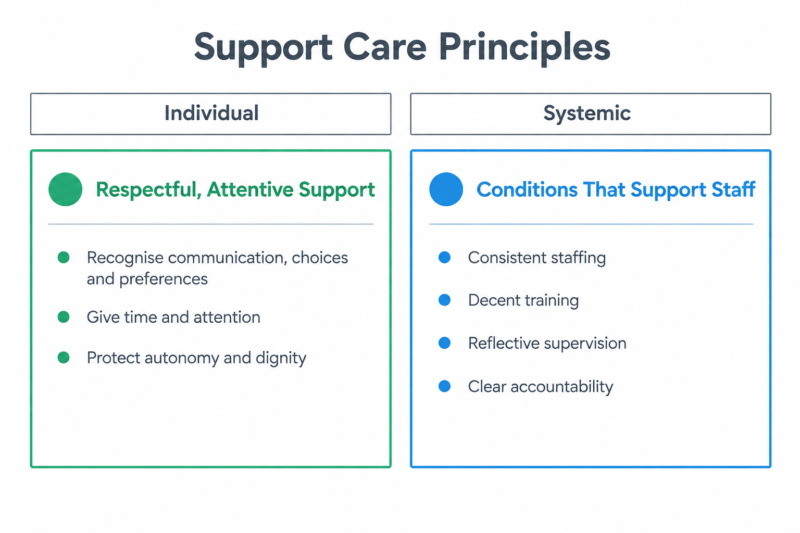
Perhaps part of the answer is consistent staffing, enough time to build relationships, reflective supervision, decent training in communication and sensory preferences, and clear accountability when support falls below the standard people deserve.
The question is not how do we tell them to change, it is how do we share our privilege?
