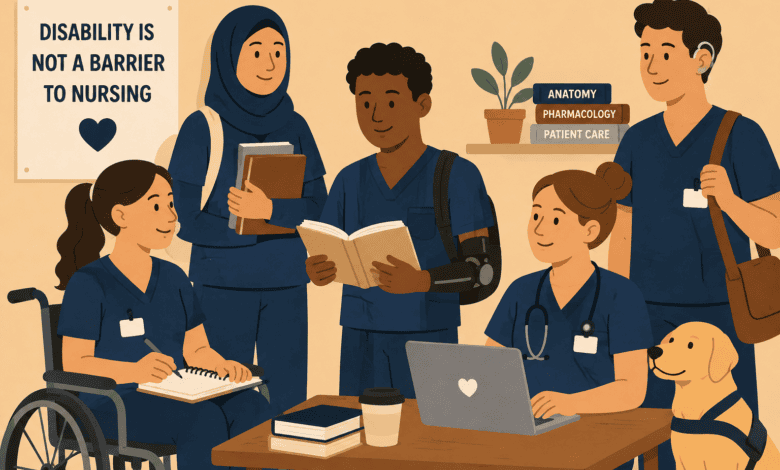
This article is for readers in USA. According to the U.S. Bureau of Labor Statistics, more than three million registered nurses work across the United States, and many of them practice successfully while living with a disability or long-term health condition. Their careers show that disability does not automatically prevent someone from becoming a skilled and compassionate nurse.
If you use a wheelchair, live with chronic pain, manage a mental health condition, or have any other disability, you may have wondered whether nursing school will even let you through the door. It is a legitimate concern and one that rarely receives a direct answer in general career resources.
However, the legal protections, the real adjustments available, and the stories of nurses who have already done this give a clear answer that disability does not close the door to nursing. In this guide, you will learn how you can pursue a nursing career as a disabled student, what challenges you might face along the way, and what support is available.
Key Point:
Disability does not prevent someone from becoming a nurse. Many disabled students successfully complete nursing school by using reasonable accommodations, managing challenges proactively, and meeting essential program requirements. With legal protections, accessible learning environments, and appropriate support, nursing remains an achievable and rewarding career path for disabled students.
Why Disabled Students Can Become Nurses
Nursing has always demanded skill, judgment, and stamina, but none of those things require a body or mind that matches one narrow template. The barriers disabled students run into usually come from outdated assumptions and inflexible systems, not from any real inability to do the job.
Disability is not a social or legal barrier to nursing for several important reasons.
How the Social Model of Disability Applies to Nursing
Medical institutions traditionally viewed disability as a personal deficit that needed fixing or masking. The social model of disability shifts that blame away from your body and places it squarely onto inflexible environments. It explains that people become disabled when environments, systems, or attitudes create barriers.
For example, a nursing student who cannot stand for a twelve-hour shift is not “failing” at nursing. Instead, a placement that only schedules twelve-hour shifts with no rotation option is the thing that needs to change. Once you apply that lens to nursing education, most of the so-called barriers turn out to be design choices.
Legal Rights and Reasonable Adjustments for Disabled Nursing Students
In the United States, the Americans with Disabilities Act (ADA) and Section 504 of the Rehabilitation Act require nursing schools that receive federal funding, which is nearly all of them, to provide reasonable adjustments to qualified disabled students.
The ADA National Network offers free, region-based guidance on exactly what those rights look like in an education setting. Schools cannot simply reject an applicant because of a disability. They have to look at whether the person can meet the program’s core requirements, with reasonable adjustments in place, before making any decision.
“You can definitely be a nurse with a disability, but you will probably have to fight for your rights. Accommodations can be made for you.”
Source:
r/nursing – “Nurses with disabilities”
Types of Disabilities Among Nursing Students
Disabled people pursue nursing with a wide range of conditions and experiences. Every disability affects daily life differently, and support needs vary from one student to another. The following are some of the disabilities nursing students may have.
Nursing School with a Visible Disability
Visible disabilities are conditions that other people can easily recognize. For example, it can be any of the following:
- Wheelchair use
- Limb differences
- Cerebral palsy
- Muscular dystrophy
- Certain mobility impairments
Students with visible disabilities may need additional support to pursue their nursing career. These may include accessible laboratories, adjustable examination tables, and accessible transportation to clinical placement. Many universities are now working with healthcare organizations to identify placements that can safely accommodate individual access requirements.
Nursing School with an Invisible Disability
Many nursing students live with disabilities that are not immediately obvious. These conditions usually create different challenges compared to visible ones. This is because classmates or instructors may not immediately identify them, which may make them take time to accommodate accordingly. Common disabilities that cannot be seen physically include:
- Crohn’s disease
- Diabetes
- Epilepsy
- Fibromyalgia
- ADHD
- Anxiety disorders
- Depression
Many students with invisible disabilities describe spending almost as much energy deciding whether to disclose their condition as they do managing it. Some prefer to request adjustments before placements begin, while others wait until they know what support they will need.
Mental health conditions can also affect nursing students in different ways. Placement anxiety, changing symptoms, or periods of poor mental health may require temporary adjustments such as additional breaks, modified schedules, or access to counselling services. Since many of these conditions fluctuate, reviewing accommodations throughout the program can be just as important as requesting them at the beginning.
Common Challenges Disabled Nursing Students Face
Being honest about the real challenges is part of preparing for them. That’s why it is important to be familiar with all the potential hurdles you may have to face during your nursing education.
These are the challenges that come up most often:
Managing the Physical Demands of Nursing
Long shifts, patient transfers, and hours on your feet are a real part of many nursing roles. That said, plenty of specialties and adjustments exist precisely because not every nurse works the same way. Telehealth nursing, case management, informatics, and school nursing all carry lighter physical demands while still using a full nursing license.
Accessibility Barriers in Nursing Education
Some clinical sites still have narrow corridors, inaccessible bathrooms, or equipment set at a fixed height that was never designed with a wheelchair user in mind.
These barriers are frustrating, and they are also solvable through advance planning with placement coordinators who know the sites well.
Challenging Misconceptions About Disabled Nurses
You will likely encounter outdated assumptions from educators or clinical staff who assume disabled students cannot handle high-stress emergency environments.
Challenging these biases requires immense emotional labor. You prove your capability through calm decision-making and sharp clinical competence during patient encounters.
Managing Fatigue, Pain and Flare-Ups During Nursing School
Chronic conditions do not follow a class schedule. A flare-up during exam week or a bad pain day before a clinical shift is a real logistical problem, and it is one that disability services offices deal with regularly through flexible deadlines and modified attendance policies.
So, when planning to go for accelerated nursing programs, you may face sudden symptoms, which requires you to be ready for unpredictable conditions all the time.
Many disabled nursing students plan their week around both clinical responsibilities and their health. They often build in extra time for rest after placement days, schedule medical appointments well in advance, and communicate early if their condition changes unexpectedly.
Balancing Nursing Placements and Coursework with a Disability
Nursing programs stack heavy coursework on top of unpaid clinical hours, and disabled students often carry the added weight of managing appointments and medication schedules.
To deal with the extra burden, you should have robust time management habits to avoid burnout. At the same time, make sure you take care of your rest time, even during exams.
Reasonable Adjustments for Disabled Nursing Students
Reasonable adjustments are changes to how a program is delivered or assessed that remove a disability-related barrier without lowering the academic or clinical standard a student has to meet.
Here are some common adjustments nursing schools and placement providers usually offer to support disabled students:
Classroom Accommodations for Disabled Nursing Students
Extended time on exams, note-taking support, accessible course materials, and captioned lectures are among the most common classroom adjustments. Most nursing schools already have a process for requesting them through a disability services office.
Clinical Placement Adjustments for Disabled Students
Placement adjustments might include a modified shift pattern, an accessible clinical site, additional breaks, or a support person for specific physical tasks. The Job Accommodation Network publishes detailed, condition-specific guidance on what has worked for nursing students and nurses in similar situations.
“One of the significant challenges I faced was having battled cancer two years ago, which has left me dealing with excessive sweating even now. Fortunately, my school allowed me to wear an Under Armour shirt instead of the light-colored scrub top that would get soaked in just five minutes. However, there was no official policy addressing my situation, so I had to advocate for myself to make it happen.”
Source:
r/StudentNurse – “Nursing students with disabilities, and how have your clinical placements gone?”
Assistive Technology for Nursing Students with Disabilities
Technology has expanded opportunities for many disabled nursing students. There are many helpful tools that enable disabled students to successfully gain nursing education and practice the learned lessons in real life.
These assistive devices can be different depending on the type of disability of a learner. However, the most common ones include:
- Speech-to-text software
- Screen readers
- Electronic magnifiers
- Digital note-taking applications
- Smart pens
- Amplified stethoscopes
Exam Accommodations for Disabled Nursing Students
Standardized nursing exams often cause severe anxiety, especially for students with processing differences or chronic pain. You can secure extended testing time, a distraction-reduced environment, or alternative formats for practical check-offs. These measures ensure your grade reflects your actual understanding rather than your speed under pressure.
The National Council of State Boards of Nursing also provides accommodation options for the NCLEX-RN licensing exam itself, so support does not stop once classroom exams are over.
“I would highly recommend making an appointment with the disability services department at your school ASAP; they can offer free accommodations based on your disability… Many times, you are given distraction-free testing environments, time and a half on exams, and other media support with notes, etc. You just have to ask what accommodations are available!”
Source: allnurses.com – “Any nursing students out there with ADD/ADHD?”
How to Choose an Accessible Nursing Program
Picking the right program shapes almost everything that follows, so it is worth spending real time on this decision rather than rushing into the first acceptance letter that arrives.
Traditional BSN vs. Accelerated Nursing Programs (ABSN)
A traditional BSN typically runs four years and gives students more room to space out coursework and manage energy or health needs over time. Accelerated nursing programs compress that same content into twelve to eighteen months, which suits students who already hold a degree and want to enter the workforce faster.
Some students choose accelerated nursing programs because they already hold a previous degree, but the faster pace may not suit everyone. If you manage fatigue, chronic pain, or fluctuating health, it is worth discussing whether the timetable and placement structure can accommodate your access requirements before applying.
How to Choose an Accessible Nursing School
You should pass the glossy brochure and check for a dedicated disability services office or clinical placement partners with a track record of accommodating students. Also, look for current students or alumni who are willing to talk honestly about their experience.
Hearing directly from disabled students who have completed the program often provides practical insights that brochures cannot. Their experiences can help you understand how accommodations work during both classroom learning and clinical placements.
Questions to Ask Before Applying to Nursing School
Many students hesitate to ask about accommodations before applying. In reality, these conversations help you make an informed decision.
- What assistive technology is available on campus?
- How long does the accommodation approval process usually take?
- Can placements be selected with accessibility needs in mind?
- What happens if my medical condition changes during the semester?
- Who should I contact if accommodations are not implemented?
- How does the nursing program coordinate accommodations during clinical placements?
Practical Tips for Succeeding in Nursing School with a Disability
None of these strategies remove the challenges entirely, but they consistently make the path more manageable for students who use them.
- Plan ahead by requesting adjustments before the semester starts rather than after a problem shows up.
- Communicate support needs clearly and in writing to instructors and clinical supervisors.
- Use disability services fully, since most students only tap a fraction of what is actually available to them.
- Build a support network of peers, mentors, and disabled nurses who understand the specific demands of the field.
- Protect physical and mental well-being as seriously as any clinical skill, because burnout undoes progress fast.
Key Takeaway: Planning ahead, communicating your needs early, and making full use of available accommodations can make nursing school significantly more manageable without lowering academic expectations.
Meet a Nurse Who Built a Successful Career From a Wheelchair
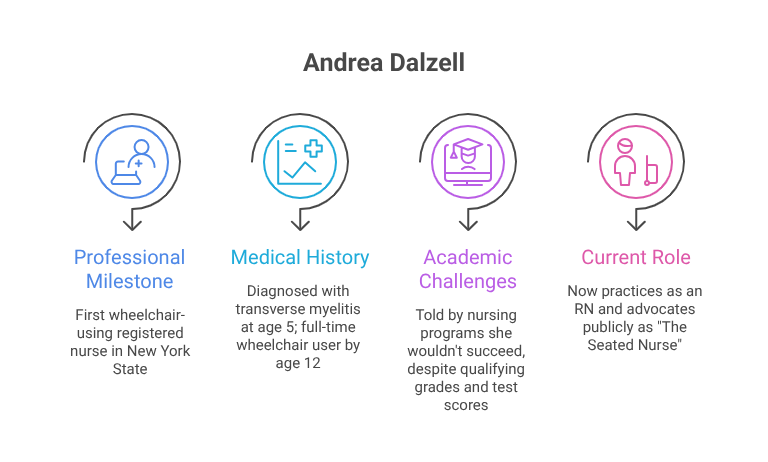
Andrea Dalzell became the first wheelchair-using registered nurse in New York State, and her path there was not smooth. Diagnosed with transverse myelitis at age five, she started using a wheelchair full time by age twelve.
When she applied to nursing programs, she described being warned outright that she would not succeed, despite having the grades and passing entrance exams to prove otherwise. She pushed through that resistance, earned her nursing license, and now works as a registered nurse while publicly advocating for other disabled healthcare workers under the name The Seated Nurse.
Helpful Organizations and Resources for Disabled Nursing Students
A number of established organizations exist specifically to support disabled nursing students and nurses. Knowing about them early can prevent a considerable amount of trial and error later. So, let’s learn about some of the most relevant resources and see what support they provide.
| Organization | What They Offer |
| National Organization of Nurses With Disabilities (NOND) | Advocacy, mentorship, and resources built specifically for nursing students and nurses with disabilities |
| American Association of Colleges of Nursing (AACN) | Standards and guidance for nursing education, including accessibility in curriculum design |
| National Council of State Boards of Nursing (NCSBN) | NCLEX accommodation requests and licensing guidance |
| American Nurses Association (ANA) | Professional standards and advocacy across the nursing profession |
| ADA National Network | Free regional guidance on disability rights in education and employment |
| Job Accommodation Network (JAN) | Practical, condition-specific accommodation advice for students and employees |
| Association on Higher Education and Disability (AHEAD) | Best practice guidance for college disability services offices |
Nursing was never intended to be a profession that demands one acceptable body type or one acceptable way of thinking. The legal protections exist, the practical adjustments exist, and nurses like Andrea Dalzell demonstrate daily that disabled students can complete rigorous programs and build lasting careers in patient care.
So, if you dream of becoming a nurse, do not let your disability stand in the way. With the right support, determination, and reasonable adjustments, you can build a rewarding career in nursing.
FAQs for disabled Nursing Courses
Can you become a nurse if you have a disability?
Yes. Many disabled people successfully become nurses by meeting essential programme requirements with reasonable accommodations and accessible learning environments.
What accommodations are available in nursing school?
Common accommodations include extended exam time, accessible teaching materials, modified clinical placements, assistive technology, additional breaks, and accessible learning spaces.
Does the ADA protect disabled nursing students?
Yes. The Americans with Disabilities Act and Section 504 require most nursing schools to provide reasonable accommodations for qualified disabled students.
Can wheelchair users become nurses?
Yes. Wheelchair users work successfully in many nursing specialties. Accessible placements and reasonable adjustments can remove many physical barriers.
What is the best nursing specialty for someone with limited mobility?
It depends on the individual, but telehealth, informatics, case management, education, and school nursing often involve fewer physical demands than acute hospital wards.
Do NCLEX exams offer disability accommodations?
Yes. The National Council of State Boards of Nursing provides accommodations for eligible candidates during the NCLEX licensing examination.

