Could a Stairlift Help You Stay at Home? Questions to Ask Before Choosing a Home Adaptation

A stairlift can make it easier for some disabled and older people to use their whole home, but stairs may be only one of several barriers. Before choosing a home adaptation, look at everyday routines, transfers, bathroom access, the property layout, changing needs, available support and possible funding.
Stairlifts and Home Adaptations: Key Points
| What to consider | Why it matters |
|---|---|
| Start with the barrier | Work out which parts of daily life have become difficult before deciding which equipment might help. |
| Look beyond the stairs | A stairlift can improve access between floors but will not make an inaccessible bathroom, entrance or bedroom usable. |
| Check transfers and space | You need enough room to get on and off safely. Stairlift dimensions vary considerably, so a home survey is more useful than relying on a standard minimum width. |
| Think about changing needs | An adaptation that works now may not suit you if your mobility, equipment or support needs change. |
| Ask for an assessment | A local-authority or occupational therapy assessment can look at your daily life and the home as a whole. |
| Check funding before buying | A Disabled Facilities Grant may help with eligible adaptation costs. Starting work before approval can affect whether you receive funding. |
| Compare suppliers carefully | Ask about fitting, batteries, servicing, warranties, breakdown support, removal and what happens if your needs change. |
Many people would prefer to remain in a familiar home if their mobility or support needs change.
A OnePoll survey of 2,000 UK adults, commissioned by Halton Stairlifts in September 2026, found that 44.9% would prefer to adapt their current home if they or a family member needed help with mobility.
Another 42.2% said their decision would depend on the circumstances.
 Source: OnePoll survey commissioned by Halton Stairlifts, September 2026. See the survey methodology and results at the end of this article.
That second figure matters. There is no single home adaptation, piece of equipment or housing choice that suits everyone.
That is something we have experienced in our own family. When we needed to make a multi-storey home accessible for a powerchair user, a conventional stairlift would not have met our needs. Later in this guide, we explain why we chose a through-floor lift instead and what we learned from living with a major home adaptation for three years.
For one person, stairs might be the main barrier between them and their bedroom or bathroom. Someone else may have difficulties with transfers, washing, narrow doorways or getting through the front entrance. Another person might have changing support needs that require several parts of the home to be reconsidered.
A useful starting question is: “What is getting in the way of everyday life, and what changes could reduce those barriers?”
What Problems Should a Home Adaptation Solve?
When stairs become difficult, it is understandable to start looking at stairlifts straight away. But choosing equipment before looking at the whole situation can mean missing another barrier that matters just as much.
Image credit: Disability Horizons
Think through an ordinary day at home.
Can you get out of bed and reach the bathroom when you need it? Can you prepare food and drinks? Can you move between floors without excessive pain or fatigue? Can you leave the house and get back inside? Are you depending on somebody to physically support you on the stairs?
The answers may show that the staircase is the main issue. They may also reveal problems elsewhere.
You might be avoiding upstairs rooms because climbing the stairs takes too much energy. Perhaps you have started sleeping downstairs because using the stairs at night feels unsafe. A family member may be taking some of your weight as you climb, putting both of you in an awkward position.
Getting upstairs will not solve the problem if the bathroom is unusable once you arrive.
Questions worth considering include:
- Are the stairs painful, tiring, difficult or unsafe to use?
- Have you fallen or nearly fallen?
- Do fatigue, dizziness or breathlessness change what you can do?
- Are there rooms you have stopped using?
- Are some days much harder than others?
- Can you use the toilet and bathroom when you need them?
- Are transfers from your bed, chair, toilet or mobility aid difficult?
- Is somebody physically helping you on the stairs?
- Can you enter and leave the property safely?
- Is there enough room for your usual mobility equipment?
This wider view reflects the Social Model of Disability. Stairs, narrow doorways, inaccessible bathrooms and poorly designed entrances can create barriers for disabled people. Many homes were designed without considering different bodies, mobility needs and ways of moving.
Can a Stairlift Help You Stay at Home Safely and Independently?
A stairlift is a powered seat that travels along a rail fitted to a staircase. It can help somebody move between floors without climbing the stairs, provided they can get on and off safely and use the controls.
When the staircase is the main barrier, that can make a noticeable difference to everyday life.
You may be able to return to using your preferred bedroom, reach the only bathroom in the property or move between floors without waiting for another person to assist you.
A stairlift still addresses one particular problem: access between different levels of the home.
It will not make an inaccessible bathroom usable. It cannot provide personal assistance or overnight support. It does not remove steps outside the property or make narrow corridors wider.
The NHS lists stairlifts as one of many possible home adaptations, alongside changes such as ramps, widened doorways, bathroom adaptations and handrails.
A stairlift may remove one barrier in a home, but it cannot by itself determine whether staying at home is safe, practical or the person’s preferred option.
Disability Horizons Shop also has a separate guide to choosing the right stairlift for people who have already identified a stairlift as a possible option.
Which Type of Stairlift Would Suit Your Home?
There are several types of stairlift, and the shape of the staircase is only one part of deciding which might be suitable.
Straight Stairlifts
Straight stairlifts are designed for a staircase that runs in a straight line without turns or intermediate landings. Their rails can often be produced in standard lengths rather than made specifically around bends.
Curved Stairlifts
A curved stairlift follows bends, corners or intermediate landings. The rail has to follow the shape of the particular staircase, so the survey and fitting process differs from a straightforward installation.
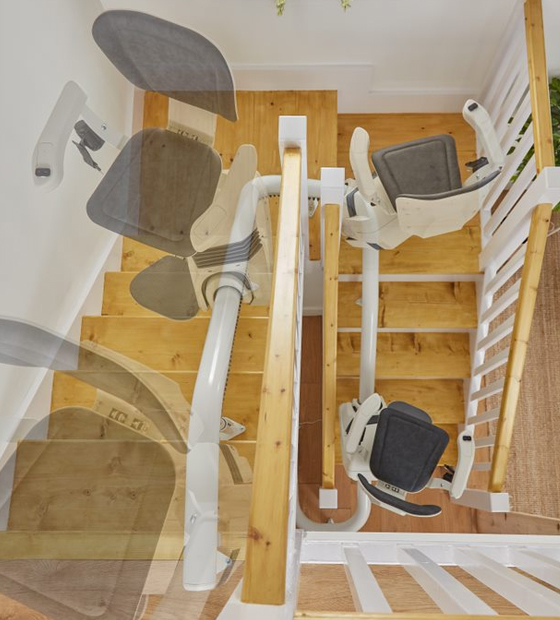
Image credit: Halton Stairlifts
Perch and Upright Stairlift Options
Some stairlift designs support the user in a more upright position rather than requiring the same seated position as a conventional chair.
These may be considered where bending the knees or hips is difficult, or where a particular staircase has limited space. They will not be suitable for everybody, so the person’s balance, posture, transfers and other needs have to be considered.
How Much Space Does a Stairlift Need?
No single width or weight figure applies to every stairlift.
Current manufacturer specifications show substantial differences between models. The amount of room required also depends on the user’s body position, transfer method, staircase shape, footrest and seat design, and what happens at the top and bottom of the stairs.
This is why a figure found online should not be used to decide that a staircase definitely can or cannot take a stairlift.
A supplier survey should measure the property and consider how the individual person would use the proposed lift.
Will a Stairlift Work During a Power Cut?
Many current stairlifts use rechargeable batteries, with the batteries charging from the household electricity supply. This can allow some models to make journeys during a power cut.
The number of journeys available and how the system works depend on the model and the condition of its batteries, so ask the supplier to explain the arrangement for the particular stairlift being proposed.
Is a Stairlift Right for You? Questions to Ask Before Choosing One
Whether a stairlift can physically be fitted is only one part of the decision. How you will use it during everyday life matters just as much.
Can You Transfer Safely?
Think about what happens immediately before and after travelling on the stairlift.
Can you approach the seat using your usual mobility aid? Can you sit down and stand again? Can you turn safely? Is there somewhere practical for your walking frame, stick or other equipment?
If you are a wheelchair user, consider both ends of the journey. A conventional seated stairlift transports you between floors, not your wheelchair.
That can create another access problem when you arrive. Some people may be able to keep a second wheelchair upstairs, but that will not suit everyone. A different chair may not provide the same independence, positioning or support as the wheelchair you usually use.
If you cannot transfer independently, think about what assistance or equipment would be required every time you get on and off the stairlift. Someone who needs a hoist for transfers, for example, may find that a conventional seated stairlift does not work well for the way they move around their home.
These questions may point towards alternatives such as a through-floor lift or wheelchair platform lift. Your ability to transfer and move around your home should help guide the choice.
If somebody assists with transfers, there also needs to be enough space for them to help without awkward lifting, twisting or reaching.
Is There Enough Safe Space at Both Ends of the Stairs?
There is no universal minimum staircase width that tells you whether a stairlift will work.
Different models require different amounts of space. The person’s height, seated position and transfer requirements matter too.
Look at the landing as well as the staircase. Doors, radiators, cupboards, furniture and low ceilings can affect whether getting on and off will work safely.
Some stairlifts can use hinged or retracting rail sections where the lower end would otherwise obstruct a doorway or passage. If this is proposed, ask how it operates and whether it suits everyone who uses that area of the home.
Can You Use the Controls and Safety Features?
Controls need to work for the person who will use them.
Consider reach, hand movement, vision, hearing, tremor, sensation, pain and fatigue. Cognitive changes can also affect somebody’s ability to remember the steps required to use equipment safely.
Think about difficult days rather than assessing yourself only when you feel at your best. Something manageable when you are rested may be much harder when you are tired, in pain or unwell.
Does the Rest of the Home Work for You?
Ask what happens after you reach the other floor.
Can you enter the bedroom? Can you use the toilet? Can you wash in the way you prefer? Can your mobility aid pass through the corridor and doorways?
Look outside the property too. Travelling upstairs independently may not make much difference if steps at the entrance still prevent you from leaving the house.
Will the Stairlift Suit You if Your Needs Change?
Some people’s mobility stays fairly consistent for years. Other disabled people have fluctuating or progressive conditions, or change the mobility equipment and support they use.
Consider what would happen if transfers became more difficult, you started using a wheelchair more often or another person needed space to assist you.
Thinking about how your mobility and support needs might change can help you avoid buying equipment that becomes unsuitable later.
What Are the Alternatives to a Stairlift?
If the stairs are only one part of the problem, a stairlift may still be useful. Other adaptations, equipment or support may be needed alongside it.
| Barrier or situation | Why a stairlift alone may not solve it | Other areas to discuss |
|---|---|---|
| Inaccessible bathroom | You may reach the bathroom but still be unable to use the toilet, bath or shower. | Level-access shower, toilet adaptations, grab rails, shower seating or space for assistance. |
| Difficult transfers | A seated stairlift requires you to get on and off at each end. | Transfer assessment, seating changes, transfer equipment or another type of lift. |
| Transferring from a wheelchair is not practical | A conventional seated stairlift may not support the way you move between floors. | Through-floor lifts, wheelchair platform lifts or changes to where essential rooms are located. |
| No suitable bedroom | Reaching another floor does not automatically provide a usable sleeping space. | Ground-floor sleeping arrangements, property changes or a different housing option. |
| Inaccessible entrance | Improving the indoor staircase does not remove barriers outside. | Ramps, rails, threshold changes, step lifts or entrance alterations. |
| Changing mobility | A seated stairlift that suits you now may become harder to transfer onto later. | Forward planning and a wider home adaptation assessment. |
| Personal support needs | Equipment cannot provide personal care, medication assistance or supervision. | Care-needs assessment, carer’s assessment and support planning. |
Why We Chose a Through-Floor Lift Instead of a Stairlift
We faced this decision in our own family. My wife is a powerchair user and can’t transfer without a hoist, so a conventional seated stairlift would have created several problems.
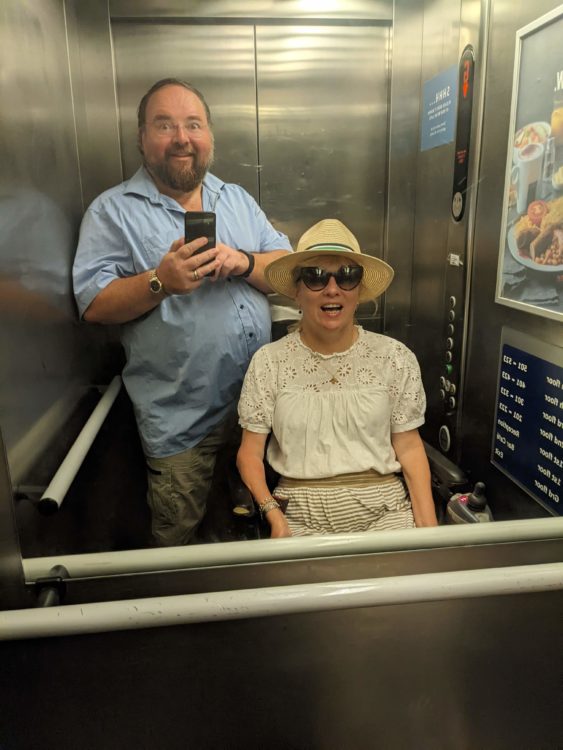
Even if we had found a practical way to transfer her onto the stairlift, her powerchair would still have been on the other floor. We could have bought a second powerchair or had her use a manual wheelchair upstairs, but either option would have reduced the independence she had using her own chair.
We had a large house and could potentially have converted a room downstairs. However, Clare wanted to continue using the upstairs rooms and enjoying the space throughout our home.
Our master bedroom and ensuite were on the second floor, and it was important to my wife that she could continue using them. She also wanted access to the rest of her home, including the upstairs space and views, and to be involved in maintaining and cleaning those areas with help where she needed it.
We wanted Clare to be able to use as much of our home as possible, including her upstairs bedroom, ensuite and other rooms.
We chose a through-floor lift instead. It meant she could stay in her powerchair, enter and leave the lift independently and operate it using a control positioned at an appropriate height. The lift also had an automatic door.
We had it for around three years and would probably have kept it much longer. We moved because my wife became pregnant and we wanted to live closer to her mother for family support.
There were things about living with a major adaptation that we hadn’t anticipated.
Although the lift itself was fairly compact, it required more usable space than we expected. It travelled between part of our utility room and a small bedroom, and the areas needed for the lift to move had to remain clear. Ours had a carpeted floor section on top, so when the lift was on the other level you could walk across that part of the room.
We didn’t have problems with breakdowns, but we had the lift serviced regularly and found servicing quite expensive. It would also sometimes make noises as it settled or levelled itself, even when nobody was using it.
Another surprise came when we sold the house.
Before installation, we hadn’t been warned about the possible cost of removing the lift and making good the rooms afterwards. We had been told that it could enhance the property’s selling features.
When we came to sell, estate agents raised concerns about the space occupied by the lift. They explained that many buyers looking for a large family home would be concerned about the cost and disruption of removing it.
We eventually had it removed. We received nothing for the lift itself and it was scrapped. There was then the work involved in making good the areas where it had been installed.
Properties, buyers and adaptations differ, so other families may have a different experience. We learned to consider the whole life of an adaptation, including servicing, space, removal and what happens when you eventually move.
Most importantly, the lift did what we needed it to do. For the years we had it, my wife could remain in her powerchair and independently reach the bedroom, ensuite and other parts of our home that mattered to her.
Our experience showed how important it is to start with the activities you want to do around your home. These should guide your choice of equipment and adaptations.
How Can an Occupational Therapist Help With Home Adaptations?
A stairlift company can survey your staircase and explain which of its products could be fitted. An independent home assessment takes a wider view of your daily activities, mobility, transfers and support needs.
An occupational therapist or trained assessor can look at everyday activities, mobility, transfers, equipment, the property and any assistance provided by other people.
An adaptation might fit perfectly into a property yet still prove awkward or impractical for the person using it.
The NHS says local councils provide home assessments that can recommend equipment and home adaptations. Its guidance says an occupational therapist can visit, discuss the activities you find difficult and work with you to identify what may help.
GOV.UK also says a council may send an occupational therapist or trained assessor as part of a Disabled Facilities Grant application.
How to Prepare for a Home Adaptation Assessment
A short record of what is happening at home can make the conversation more useful.
- Write down tasks that have become difficult or require help.
- Record falls and near-falls.
- Include problems that happen overnight.
- Explain how things change on difficult days.
- List mobility aids and other equipment you already use.
- Describe any changes you expect in your mobility or support needs.
- Explain what you want to be able to do independently.
You can ask a friend, relative, carer or advocate to take part if that would make it easier to explain what happens during everyday life.
Can You Get a Grant for a Stairlift or Home Adaptation?
Check possible funding before paying for major adaptation work yourself.
A Disabled Facilities Grant can help with eligible changes needed to make a home more accessible for a disabled person.
Examples on GOV.UK include widening doors, installing ramps, improving access to rooms and facilities, and providing adaptations that make essential parts of the home easier to use.
How Much Is a Disabled Facilities Grant?
Current GOV.UK guidance gives the maximum for a single application as £30,000 in England, £36,000 in Wales and £25,000 in Northern Ireland. Councils may provide more under their own policies. Scotland has a different system for help with equipment and home adaptations.
For many adult applicants, the amount received depends on household income and household savings over £6,000. Disabled children under 18 can receive a grant without their parents’ income being included in the calculation.
These figures and rules can change, so check the current Disabled Facilities Grant guidance and speak to the relevant council before making financial decisions.
How Long Can a Disabled Facilities Grant Decision Take?
GOV.UK says a council must give you a decision within six months of your application.
The six-month deadline applies to the council’s decision. Assessment, design, permissions, quotations and installation can all affect the overall timescale.
If you need an urgent solution, such as following a hospital stay, ask the health or social-care professionals involved what temporary arrangements and equipment may be appropriate rather than assuming a privately purchased stairlift is the only answer.
Should You Buy a Stairlift Before Applying for a Grant?
Speak to the council first if you hope to use Disabled Facilities Grant funding.
GOV.UK warns that you might not receive a grant if you start work before the council approves your application.
This is one of the strongest reasons to check possible funding before signing an installation contract.
What Questions Should You Ask a Stairlift Supplier?
Once you know that a stairlift is a suitable option to consider, ask the supplier to explain the proposed installation in writing.
- What type of stairlift are you recommending, and why?
- How have you checked that the staircase and landings provide enough room?
- How will I get on and off at each end?
- Will the rail affect a doorway, corridor or route through the house?
- Will other household members still be able to use the stairs?
- Would a hinged or retracting rail be needed?
- What is the maximum user weight for this exact model?
- What happens during a power cut?
- How are the batteries charged and maintained?
- What is included in the quoted price?
- Is electrical, building or decorating work excluded?
- What servicing is recommended?
- What are the expected servicing costs?
- What does the warranty cover?
- What happens if the stairlift breaks down?
- What are the repair and call-out arrangements?
- What are typical call-out and repair charges once the warranty ends?
- Are rental or reconditioned options available?
- What happens if my mobility or transfer needs change?
- If I move home or no longer need the stairlift, can it be removed and reused or sold?
- Does the supplier offer a removal or buy-back service?
- What does removal usually cost?
- What work might be needed to make good the stairs, walls or decoration after removal?
- Is any making-good work included in the removal price?
- Can I have the quotation and terms in writing before deciding?
Published manufacturer specifications show why asking about the exact model matters. Current models from major UK suppliers have different staircase dimensions and maximum user weights. A number quoted for one stairlift cannot safely be treated as a rule for every product.
It is also worth asking about costs at the end of the product’s useful life. Removal, resale and making good the area afterwards can be easy to overlook when the immediate priority is improving access.
How Do Home Adaptation Costs Compare With Care Costs?
Cost is understandably part of planning for changing mobility and support needs, but broad averages do not tell you what your own circumstances will cost.
The OnePoll survey commissioned by Halton Stairlifts found that 41.5% of respondents said they felt confident that they understood what a care home costs.
Among respondents who supplied an estimate, the average estimate of annual care-home costs was £51,508.
This was a respondent estimate, not an independently verified national average of care-home fees.
Among respondents who gave a figure for money set aside specifically for future care, the average was £14,122. That figure does not show respondents’ total savings, pensions, income, property, family resources or possible eligibility for public support.
The survey findings are useful for showing how people think about future care costs. They should not be used as a direct financial comparison between buying a stairlift and moving into residential care.
The two provide very different things.
A stairlift addresses access between floors. Social care can include personal assistance, support with daily activities and, in residential settings, accommodation. Costs and funding depend on the person’s needs and financial circumstances.
If care support is becoming necessary, ask the local authority about a care-needs assessment and financial assessment at the same time as checking possible help with home adaptations.
What Should You Check Before Ordering a Stairlift?
Identify the Barriers Around Your Home
List the activities that have become difficult, tiring, unsafe or dependent on somebody else’s assistance. Include the whole property rather than focusing only on the staircase.
Address Immediate Safety Concerns
If you have fallen, cannot transfer safely or cannot reach essential facilities such as the toilet, food or medication, seek appropriate health or social-care advice rather than waiting for a future adaptation.
Look at the Whole Property
Consider your bedroom, bathroom, toilet, doorways, entrance, outside routes and the space needed for mobility aids or assistance.
Ask for an Independent Assessment
Contact your local council about a home adaptations, occupational therapy or adult social-care assessment before committing to major work.
Think About Possible Changes
Consider how the proposed adaptation would work if your mobility, transfers, equipment or support requirements changed.
Check Funding Before Work Starts
Ask about Disabled Facilities Grant funding and any other local schemes before entering into an installation agreement.
Compare Written Proposals
Compare what each supplier proposes, what is included in the price and what happens after installation. Pay particular attention to transfers, landing space, servicing, repair arrangements, removal and any work that may be needed afterwards.
Base the Decision on Everyday Life
A good home adaptation should make everyday life easier. It should support the routines, relationships, privacy and activities that matter to the person using it.
Making the Right Home Adaptation Decision
The Halton Stairlifts survey found considerable interest in adapting an existing home, but almost as many respondents said their choice would depend on the circumstances.
That reflects the reality of accessible housing.
Homes are different. Disabled people are different. Mobility, finances, families, support networks and plans for the future vary too.
A stairlift can be a useful adaptation when stairs are a major barrier and the person can use the equipment safely. For somebody else, bathroom changes, entrance adaptations, a through-floor lift, ground-floor living, personal assistance or a more accessible home may make more sense.
Our own experience showed how important it is to consider the whole home. Clare wanted to continue using her upstairs bedroom, ensuite and other rooms, and be able to enjoy the light and space of the upper floor. She is an artist and enjoyed the views! A through-floor lift allowed her to do this independently in her powerchair.
Start by looking at your everyday routines and the barriers around your home. Consider what you want to do, what changes could help and how your needs might develop over time.
An independent assessment, accurate funding information and a detailed supplier survey can then help identify which options make practical sense.
About Halton Stairlifts

Halton Stairlifts supported this Advertisement Feature. If an assessment suggests that a stairlift could suit your needs, you can find information about the company’s products and request a quotation on the Halton Stairlifts website. Compare the proposed model, total price, servicing, warranty, breakdown support and removal arrangements with other suitable options before deciding.
Advertisement Feature: This article was produced in partnership with Halton Stairlifts.
Frequently Asked Questions About Stairlifts and Home Adaptations
Can you get a grant to pay for a stairlift?
Yes. A Disabled Facilities Grant may help pay for a stairlift or other eligible home adaptations. Funding depends on your circumstances, assessment and local rules. Contact your council before starting work.
Can wheelchair users use a stairlift?
Some wheelchair users can transfer onto a seated stairlift. However, their wheelchair remains on the other floor. A through-floor lift or wheelchair platform lift may be more suitable for people who cannot transfer independently.
Will a stairlift work during a power cut?
Many modern stairlifts use rechargeable batteries and can make some journeys during a power cut. The number of journeys depends on the model and battery condition. Ask the supplier about its specific arrangements.
What happens to a stairlift when you move house?
A stairlift may be removed, sold, reused or disposed of, depending on its design and condition. Removal and repairs to the property may involve additional costs. Ask about these before installation.
Should you get an occupational therapy assessment before buying a stairlift?
An occupational therapy assessment can identify barriers throughout your home. It can also consider transfers, mobility equipment, safety and other adaptations. This helps you decide whether a stairlift is suitable.
Survey Methodology and Results
The survey figures in this article come from research conducted by OnePoll on behalf of Quirky Digital and Halton Stairlifts.
OnePoll surveyed 2,000 UK adults between 8 and 10 September 2026. The sample was nationally representative by age, gender and region, with weighting applied.
Participants answered questions about home adaptations, care-home costs and financial planning for future care.
What did the survey ask?
When asked what they would prefer if they or a family member needed help with mobility at home:
- 44.9% preferred adapting their current home.
- 42.2% said their decision would depend on the circumstances.
- 7.1% preferred moving into a care home.
- 5.8% were unsure.
The survey also asked participants to estimate annual care-home costs.
The reported average of £51,508 was calculated by OnePoll from banded estimates provided by 1,498 respondents. It represents respondents’ perceptions of care-home costs, rather than independently verified fees.
A separate question about money set aside specifically for future care produced a reported average of £14,122, based on 737 respondents who provided a numeric estimate. This figure does not represent total household savings or assets.
Source: OnePoll research commissioned by Quirky Digital / Halton Stairlifts, September 2026. Survey methodology and results supplied directly to Disability Horizons. The full research has not been published online.
