London as a Wheelchair User: Accessible Travel, West End Tips + a Wicked Review

“Independence doesn’t always mean doing everything by yourself. Life becomes a lot more fun when you can ask for help to make room to enjoy yourself.”
— Liesl Hammer
Following her debut piece for Disability Horizons on travelling the world as a wheelchair user, Liesl Hammer is back with her second article – this time turning her attention closer to home. Having grown up just two hours from London by train, Liesl has visited the capital more times than she can count. On this trip, she tried the Underground after years of avoiding it, stayed in a West End hotel with an accessible room that worked well for her, and finally ticked off a long-awaited trip to see Wicked live on stage. As ever, Liesl doesn’t shy away from the messier, more honest side of travel – the anxiety, the misread theatre address and the moments when she needed help – while making the case that none of that makes a weekend any less independent.
Visiting London as a Wheelchair User
London still captivates me and is one of my favourite cities. Of course, sometimes the crowds can be overwhelming, but I always love its vibrancy and energy. You can be anyone, dress any way you want and no one bats an eyelid.
Living just two hours away by train my whole life, I have been lucky enough to go to London a lot and experience it in its many different forms. Sometimes I’m there to visit friends, see a show or go to a work conference.
Being able to see the centuries-old churches alongside new flats and billboards in Piccadilly Circus never gets old. The possibility, however improbable, of seeing a celebrity always forces me to live in the moment, experiencing everything just a moment longer.
Over time, I’ve realised that planning is key to enjoying London as a wheelchair user. It doesn’t have to be a lot of work; just knowing where to go, how to get there and what the accessibility is like is often enough.
I’m not quite an ambulatory wheelchair user, but I can get out of my chair and walk on the arm of someone if I have to. I find this very useful when I come across unforeseen steps leading to a park, for example. But as a wheelchair user, planning is essential for a fun, stress-free experience.
Train Travel to London as a Wheelchair User
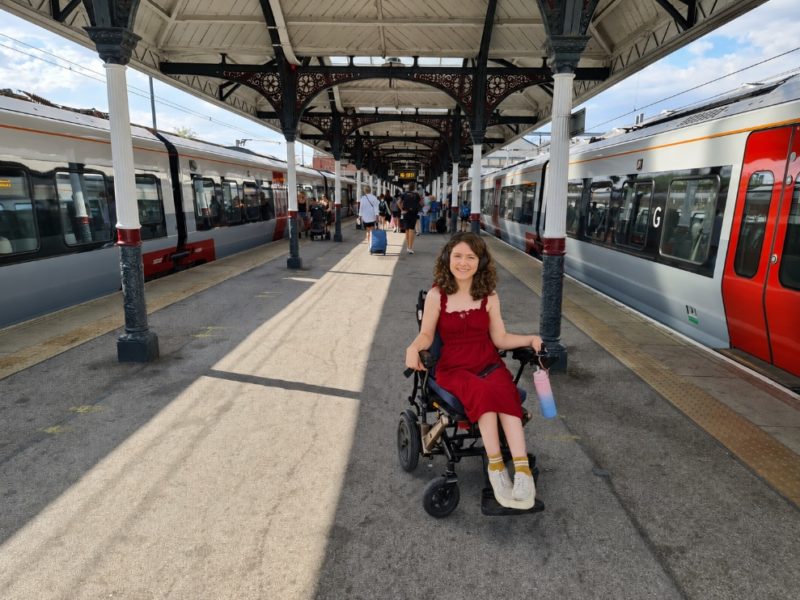
On Friday 7th August 2026, I packed a small bag with a few dresses, shorts, toiletries and makeup and made my way to the train station. My mind likes to anticipate everything that could go wrong, so I ended up arriving an hour early.
I don’t think anyone needs to be quite that early, but it is nice to relax. I got some lunch and went to the assistance desk where, thanks to the Passenger Assist app, they were already expecting me.
The app is easy to use. Just find your train, tell them what kind of assistance you require and get a confirmation email in under 24 hours.
On modern trains, like the Norwich to London route, there is often step-free access, but I like to book it just in case. In recent years, I have taken the train so many times to places like Cambridge and Edinburgh that the staff know me by name. They are always so helpful, offering to carry my luggage, and are happy to be led by me.
If I’m travelling on my own, I stay seated in my wheelchair as this allows me to use the toilet by myself. However, if I’m with friends, I love sitting at a table seat as it allows me to work on my computer.
Using the London Underground as a Wheelchair User
Throughout my life, I have used many modes of transport to get around London. I usually find buses the easiest option, as London buses have wheelchair spaces and are substantially cheaper than taxis.
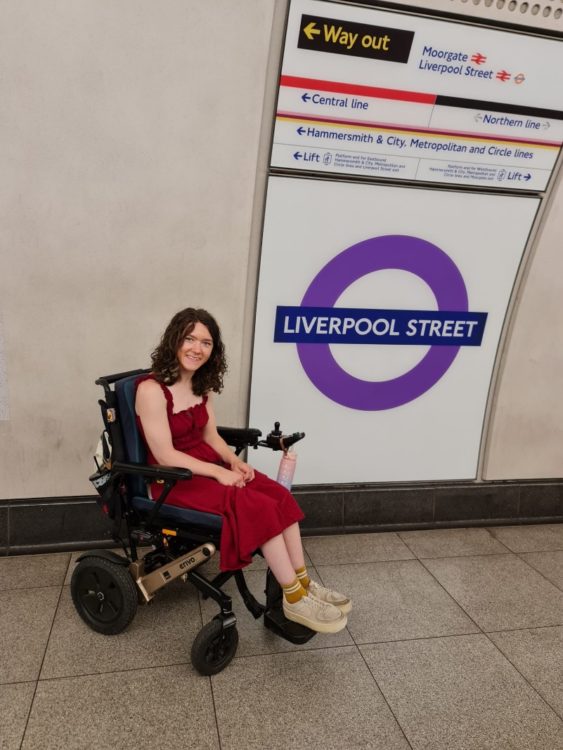
The Underground is fast, but it was never an option until recently. The Elizabeth and Jubilee lines have made travelling around London much easier, with step-free access at many stations.
Still, for many years, I didn’t try it. I had heard horror stories of disabled people getting stuck on platforms because the lift had stopped working. Now, I can’t believe how long I waited.
I still get nervous, but it’s so easy, quick and cheap.
At first, I didn’t understand how people were getting around the Underground so seamlessly, but all it took was someone describing it to me as we went, and suddenly it felt much less intimidating.
Now, I feel giddy and accomplished every time I complete another successful Tube journey.
Accessible Hotels in London for Wheelchair Users
Accessible hotels make all the difference. As a wheelchair user, finding an accessible hotel anywhere can be hard work. ‘Accessible’ tends to have different meanings depending on who you ask. Accessible infrastructure is often designed without enough input from the disabled people who will actually use it, which I have always taken issue with. That’s how handrails end up on walls where they aren’t needed, or you get a lower sink where the mirror is still at a normal height. Beds are often too high, and there isn’t enough space to manoeuvre.
Editor’s note: Need a hoist? It’s worth reading our recent piece on Royal Lancaster London’s bookable mobile hoist, one of the first mainstream UK hotels to offer this as standard.
Ham Yard Hotel, however, was amazing. Located in the heart of the West End and next to Piccadilly Circus, it provides the perfect base for a weekend in London.
I’ve now stayed there twice, and both times I have loved the very cool, slightly quirky atmosphere. What makes me want to return, though, is the combination of the atmosphere and how friendly the staff were.
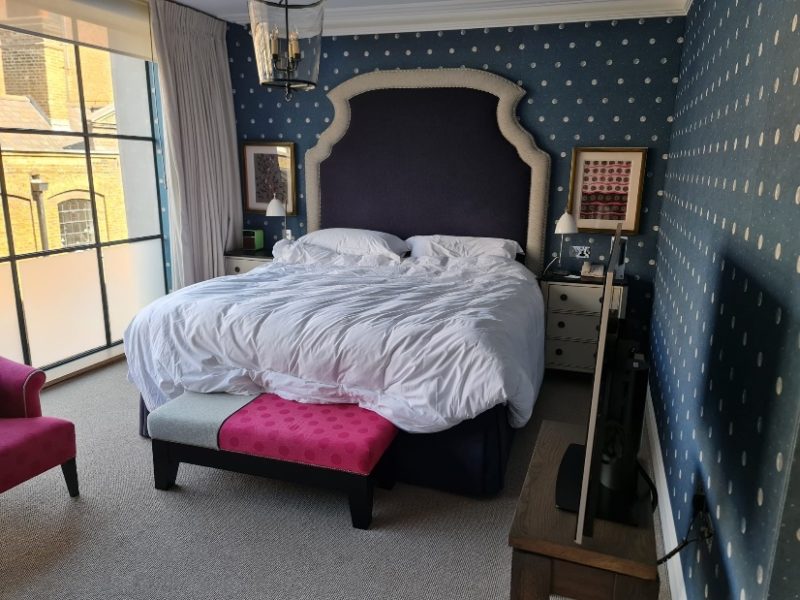
The accessible room was spacious enough for me to manoeuvre my electric wheelchair without constantly having to think about whether I was going to knock into something.
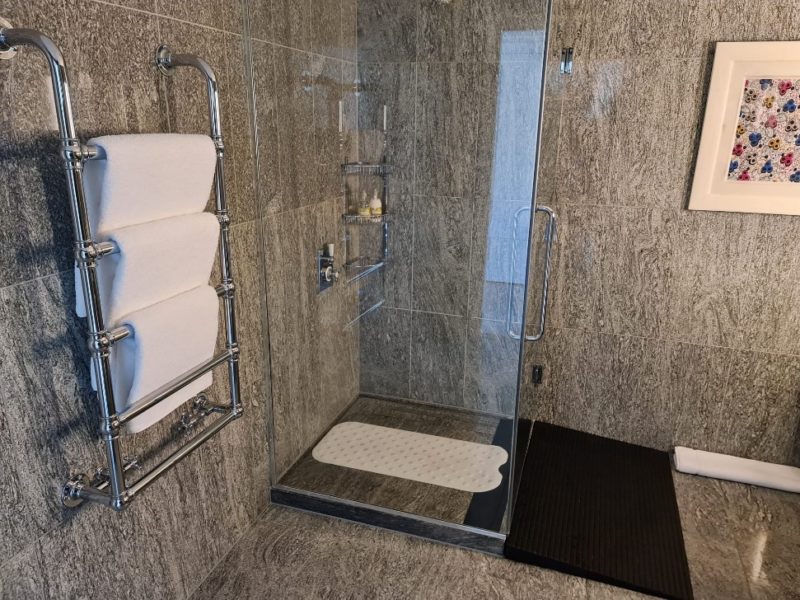
The bathroom was equally well thought out. There were grab rails either side of the toilet, and the sink was low enough for me to use from my wheelchair. The shower had a small ramp leading into it, and there was enough space to use a shower chair. I, however, opted to sit on a non-slip mat on the floor instead, and the shower controls were low enough for me to reach from there.
But what I appreciated most wasn’t actually the room.
Throughout my stay, every member of staff spoke directly to me rather than automatically addressing my father, who I was with. This might sound obvious, but it isn’t always the case. I’ve lost count of the number of times someone has spoken to a friend or family member about me while I’m sitting right there.
For me, that’s what good accessibility looks like. Of course, ramps, grab rails and accessible bathrooms matter. They are essential. But so is the attitude of the people providing them.
There is also one thing I think wheelchair users should be aware of when booking hotels. Because accessible rooms tend to be larger, they can sometimes be placed in a higher room category and therefore cost more. But I don’t want a bigger room because I’m looking for luxury; I need the space to manoeuvre.
If you find that the accessible room you need costs more than an equivalent standard room, ask the hotel why and whether they can offer it at the same rate. You shouldn’t have to pay a premium simply to get the accessibility features you need.
Accessible Transport in London: Tube, Buses and Taxis
How many Different Modes of Transport can I Tackle in One Weekend?
Throughout the two days I was in London, I took the Tube, walked/wheeled and used taxis to get around.
If the route is accessible, I would always opt for the Tube. It’s just the fastest and cheapest route. However, this is often not an option.
I love wheeling around a city because it feels the most immersive. I get to experience the city in all its glory: seeing everyone walk past and wondering what kind of lives they lead, dancing to street musicians or stumbling across a hidden café.
There seem to be dropped kerbs everywhere, and people are mostly attentive in the typical British way – getting out of the way and apologising profusely.
London black cabs are also accessible for me, which is a welcome change after being in Norwich and not even being able to book an accessible taxi.
On my way back to the hotel on the Saturday, another taxi honked at us because I was taking too long to get out, as I had to wait for the ramp to be put out. Two complete strangers yelled at him, which made me giggle with a sense of pride and gratitude for living in a country where a good proportion of people understand my desire to not be treated like a burden.
Wicked West End Accessibility at the Apollo Victoria Theatre
My Wicked West End Adventure
One of my biggest causes of stress is not being completely independent, something I’m working on. Unfortunately, the world wasn’t made for wheelchair users.
But I love live musical theatre, so I have to be okay sitting in a crowd, away from my chair, for three hours.
The anticipation is the worst. Hours beforehand, there was a pit in my stomach. What if something happens and I need to get out? What if I need the toilet?
Unfortunately for me and my emetophobia (fear of vomiting!), my anxiety manifests itself as feeling nauseous. It becomes a vicious cycle, which resulted in me being really quiet and not being able to eat much the morning of Wicked.
Though I was really excited.
I walked round the park on the warm summer’s morning and started feeling much better.
And then disaster struck, which turned out to be a blessing in disguise.
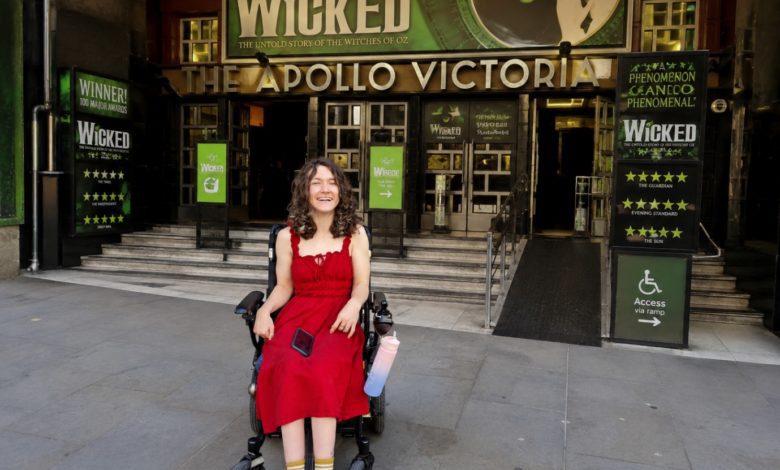
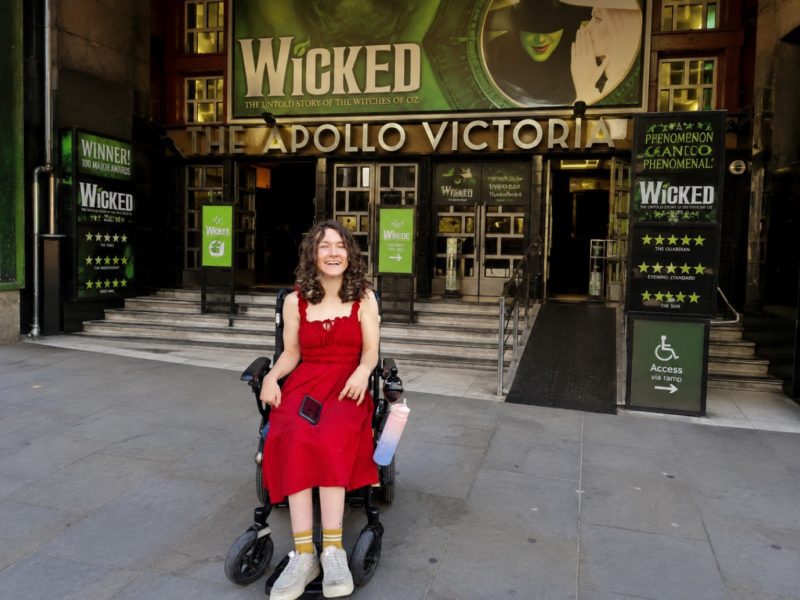
I misread the theatre. Instead of it being the Apollo Theatre in Soho, which would have been right around the corner from the hotel, it was the Apollo Victoria Theatre in Victoria.
Fifteen minutes away in a taxi.
Luckily, I had the nicest taxi driver who reassured me and drove as fast as he could without breaking any laws, and we were in our seats with thirty seconds to spare.
The accessible entrance was located at the back of the theatre, with the ramp already prepared. I left my wheelchair in the foyer, where the staff stored it in a safe location while another person guided me to my seat in the second row. I was so focused on the moment, my mind forgot to wander into the future, and my anxiety subsided.
One thing that has made theatre more affordable for me as a disabled musical theatre fan is this magical card called an Access Card. It is available for a range of disabilities and can help make sure I’m not paying extra when I need someone to accompany me.
For this booking as someone who needs assistance walking, I was able to get an Essential Companion ticket as well as a discounted ticket for myself.
Sometimes I really love being disabled.
It took me years of procrastination to get one, when my application only took about ten minutes. If you think you might be eligible for one, my biggest piece of advice would be: do it now!
Wicked West End Review: Seeing the Musical Live
Seeing Wicked Live for the First Time
The actual show was amazing.
Before the first film came out at the end of 2024, I knew Idina Menzel and Kristin Chenoweth were the original Elphaba and Glinda and I knew the iconic song Defying Gravity, but that was about it.
Then Part One came out in cinemas and I was obsessed.
I related to Elphaba’s struggle to fit in, and I loved that there was a main character in a wheelchair. I knew I had to see it live.
My favourite part was witnessing my favourite song, The Wizard and I, performed by the incredibly powerful voice of Emma Kingston. The costume and set design were so good I had to remind myself multiple times that I was watching it in person and not just the film.
Everyone told me, ‘Don’t expect Cynthia Erivo and Ariana Grande,’ but seeing it live is a different experience altogether.
Not only was it beautiful, powerful and devastating, but I have so much respect for theatre actors. They never break character, and they somehow have enough voice for eight shows a week. And then having to dance on top of that.
I am forever in awe.
Wicked and Disability: Nessarose’s Portrayal in the Musical
The Debate Around Wicked and its Portrayal of Disability
The only part of the show that I struggled with was the portrayal of disability through Nessarose.
In the film, she is played by disabled actress Marissa Bode, who had conversations with the director about Nessarose’s disability, which subsequently led to some adjustments being made. I didn’t know the extent of the changes before seeing the musical, so I wasn’t prepared for how uncomfortable I would feel watching a disabled character become so desperate to walk that it played a big part in her becoming a villain.
It left me wondering: when will we get to see a disabled character who is simply happy being disabled?
Of course, I have bad days too. There are moments when I think life would be easier if I were not disabled. But those moments are few and far between.
My disability isn’t something I spend my life wishing away, so seeing disability portrayed almost entirely as something that needs to be fixed was not something I enjoyed.
As a disabled dancer myself, I did like seeing Nessarose dance and, ultimately, I had an incredible time seeing Wicked in the West End. I’m sure it won’t be long until I’m back.
Wheelchair Travel in London and What Independence Means to Me
What London Taught Me About Independence
Like many weekends I have spent in London, this one was full of joy and independence. But none of this would have been possible if I wasn’t already familiar with London’s accessibility and planned what I wanted to do.
That doesn’t mean everything went perfectly. I got anxious. I misread the theatre. I needed help from my father, taxi drivers and hotel staff.
But none of that made the weekend any less independent.
Independence doesn’t always mean doing everything by yourself. Life becomes a lot more fun when you can ask for help to make room to enjoy yourself.
London Travel Tips for Wheelchair Users
- Get familiar with your route. If you know where you’re going, you can plan which mode of transport will be easiest. There are lots of options.
- Ensure you are not being penalised for being disabled when booking an accessible room. If an accessible room costs more than an equivalent standard room, ask the hotel why and whether it can offer the same rate.
- Get an Access Card if you’re visiting the West End. It can help you access discounts, companion tickets and other adjustments. My application only took about ten minutes.
- Make sure your hotel is right for you. Hotels, especially in London, are expensive, but knowing that you can go back to an accessible room at the end of the day makes all the difference. I’ve had good experiences at Premier Inn and The Radisson Hotels and, because they are chain hotels, all locations seem to have the same style of room. Always make sure the room meets your needs. You could ask for photos.
- Use the Passenger Assist app for train travel. Even if you don’t think you need assistance, I find it reassuring to know someone is expecting me at the station.
- Check your Tube journey in advance. Check which stations are step-free and make sure you have a backup route in case a lift isn’t working.
Editor’s note: Accessibility is personal, and what works well for one person may not work for another. A low bed might make independent transfers easier for one person, for example, while a higher bed may provide a better working height for someone who receives assistance from a PA or carer. The same applies to bathrooms, transport, wheelchair spaces and other access features. Liesl’s experiences are a useful starting point, but if you can, check directly with hotels, venues and transport providers before travelling to make sure their facilities meet your particular access needs.
